Is AI-Generated Music Shaping the Future?

On 25 April, TIPi Group’s Shaping the Future event will delve into the subject of AI-generated content, exploring how digital marketing can utilise AI with an in-depth review of ChatGPT, Bard, and other AI tools.

Ahead of this, there are many nuanced areas that can be explored in relation to AI-generated content in which questions, including, ‘Is there a place for humans?’ and ‘How do we harness these tools to our advantage?’ can be applied. One such area is the subject of music and art.Google Research has introduced MusicLM: Generating Music from Text, an AI model that can generate high-fidelity music from text. Whilst the concept of AI-generated music is not completely unheard-of, AI music technology is progressing so rapidly that MusicLM might be called groundbreaking.

Whilst the technology has not been released yet due to copyright issues, Google Research have released MusicCaps, providing 5.5k music-text examples to demonstrate the capabilities of the technology and to support further research. MusicLM is trained on datasets of 280,000 hours of music and the AI is prompted to generate music with a plethora of instruments, including vocals, melodies, genres, and moods, turning any form of text into music.

For instance, text prompts can be descriptive:

‘A fusion of reggaeton and electronic dance music, with a spacey, otherworldly sound. Induces the experience of being lost in space, and the music would be designed to evoke a sense of wonder and awe, while being danceable’

Text descriptions can be a period of time. One example set of prompts given by MusicCaps:

Club music in the 50s, 60s, 70s, and 80s’.

This being said, MusicLM is not limited to just text prompts, the platform also has the ability to generate music based upon pictures and captions. You can listen to what AI-generated music is created when provided with Salvador Dalí’s The Persistence of Memory.

Listen to the AI-generated music here. You can find the details on GitHub.

Is AI-generated content a cause for concern?

As ambiguous territory, the phenomenon of AI-generated content instigates a variety of questions and debates, that extend beyond just musical content, but creativity in general.

Creators are faced with the fear of losing their jobs and the need to create. After all, the progression of technology prompts the question: what is the point of humans learning to play instruments, to compose, and learning how to create, when technology can do all of these things instead?

Secondly, this leads to an even murkier question, what we can truly claim is ours? When content is created through artificial means, it provokes issues in terms of ownership and copyright. Copyright law dictates that you can only copyright something that has been created from human output. Legal clarification and effective policies are warranted here.

In terms of the actual content, AI-generated music, art, and so on, there is no originality because the AI platforms are fed pre-existing information, they do not generate anything new.

The wider impact of ingesting all musical knowledge into AI extends past authorship and the need to create, essentially removing the need for human learning, to the responsibility we have over creativity and the creation of content. How we navigate these issues will set a precedent for future generations.

Whilst there are concerns here, the progression of technology is unavoidable, and instead of focusing on its grey areas, it should be harnessed.AI Image 1.jpg
Why should it be looked at positively?

AI-generated music is an efficient tool.

There are some drawbacks to the technology, for one, Music LM is not currently released. Plausibly, like with ChatGPT, the content created by AI is not truly original because it is based on pre-existing content, therefore there is no stance, no original thought, and cannot be claimed as truly innovative. In that sense, this technology relies on human input to prevent a cyclical effect in which no new music is created, where only reworked snippets are repeated. Similarly, there will always be a lag, as the software ingests training data, there will be a delay in it learning the newest trends in music, for example.

Like with ChatGPT, the AI platforms which generate music are excellent tools, but because of these drawbacks, it must be taken with a pinch of salt.

With evolving technology, it is human nature to be tentative in accepting it, but we must adapt, and use it to our advantage. As an agency, we are forward-thinking, adaptable, and restless-minded.

After all, one analogy that can be brought in here is the very similar conversation that occurred with the invention of the camera in 1816. Artists, outraged, questioned ‘How can I create a piece of art that imitates life, and more importantly, what is the point, when there are other means, a piece of technology, that can do it more accurately, quicker, and cheaper?’. But over time, photography became another art form, its use adding to, not taking away from, the creation of art. In the same way, we will grow to accept and benefit from AI-generated musical content as the technology continues to progress.

In essence, AI will only add to the creation of art, not remove the need for humans, but will become a creative tool that shapes the future of music.

Examples of how we can use AI-generated music

  • To create background music for social/organic ads where budgets don’t extend to custom music creation/buying rights for ads.
  • Creating sound effects/background music for conversational experiences, for example, Alexa Skills and background music for call centres.
  • Innovative music for USG content campaigns. For instance, Spotify Wrapped could create a custom track based on a users entire playing history.

Evidently, Google is being more cautious with MusicLM than some of its competitors may be with comparable technology, admitting “We have no plans to disclose models at this point”. But it is worth keeping in mind that while there are some limitations with AI-generated music, including copyright issues, MusicLM is not the first AI that can turn text to music, OpenAI who have developed ChatGPT, are also the creators of text-to-music AI called Riffusion. That is to say, we are not far off and soon AI-generated music will become a concept more widely utilised.

Evidently, the future will come hand in hand with artificial intelligence. As a society, we do have a responsibility here to set the rules and ethical considerations for future generations and the world we want to create. But as an industry, we have a responsibility to harness this AI and use it to our best advantage.

With this in mind, following the introduction of MusicLM, as an agency, we warmly welcome AI-generated content, identify its value as a tool, and are excited as it paves the way to shape the future.
If you’re interested in learning more about AI-generated content, our Shaping the Future event will take place on 25 April which you can sign up to here. You can also sign up for our newsletter here and follow us on LinkedIn and Twitter

Chat GPT and PPC: A tool for the future, not quite for the now

On 25 April, TIPi Group’s Shaping the Future event will delve into the subject of AI-generated content, exploring how digital marketing can utilise AI with an in-depth review of Chat GPT, Bard, and other AI tools. As part of this, Patrick Kearney, on behalf of ROAST’s Paid Media team, will provide a taster with some initial thoughts on the practical uses of Chat GPT.Over the last four months the topic of Artificial Intelligence (AI), specifically ChatGPT, has been a very audible hum around workspaces. Colleagues have been discussing its capabilities, how it can be leveraged to support our roles, what type of content you can get it to produce, and on a slightly bleaker note – will AI make us redundant?

Nipping the last question in the bud, I do not foresee, at least in its current format, ChatGPT being anything other than a moderately helpful tool. When it comes to the knowledge of a client, creating strategy, and the in-depth Expertise of paid media, the AI cannot compete.

As the majority of users currently do not have access to version 4 of the tool just yet, I will approach this subject largely focusing on the current widely available version 3.5 (V3.5). Those who have paid for a premium account are able to access both version 4 (although this is restricted to several questions an hour) and older versions of ChatGPT. The update is unquestionably more sophisticated than previous models, and I will cover where and how it can be used effectively and not so effectively.

But first, some initial thoughts.

When I first started playing around with the tool, one immediate realisation was how important it was to know the correct prompts. Whilst the AI is undoubtedly intuitive, to achieve the exact desired outcome, I found there was often a degree of trial and error. This would then result in not an unsubstantial amount of time spent amending prompts to eventually achieve the desired outcome.

To an extent, there is a kind of prompt language that must be adopted to use ChatGPT in the most efficient way, though even then, its use can still prove to be frustrating when the AI did not immediately produce exactly what I was looking for.As one could imagine, there is an abundance of topics which could be covered regarding ChatGPT in the Paid Media space, so, I am going to focus on some of its more obvious capabilities:

  • Ad Copy creation
  • Competitor ad copy review
  • Keywords
  • Google Ads upload
  • Creative Capabilities
  • Understanding New Business
  • Shortfalls
  • Version 4

Ad Copy Creation

Creating ad copy variations for testing is at the heart of paid media activity, and so naturally, I thought that as a text-based AI, this would be one of its core strengths. There was some degree of success, but it wasn’t as seamless as I had anticipated.

I tasked the software with creating three variations of ad copy in the format of a Responsive Search Ad (RSA) for a client. Each RSA was to have 10 headlines and 4 descriptions, and after each an explanation of why each variation would be a good test.

The results seemed initially promising, providing a strong variety of ad copy, each with a slightly different tack. However, whilst the responses from the AI machine were in line with the general formatting of Headlines and Descriptions, the finer details were almost entirely ignored.

Character lengths were the obvious failing point. My first attempt at getting the AI to produce ad copy within the restrictions of an RSA resulted in headlines often exceeding limits and descriptions verging on the realm of a paragraph in length. The second and third attempts were not much more successful – even when I explicitly asked the AI to define a character length (which it was able to do) it failed to meet Google’s character length specifications.

Ultimately as a tool, V3.5 isn’t quite at the level of creating perfect ad copy and is well short of creating copy that can be directly uploaded to Google Ads. However, as a starting point, there is undoubtedly scope to help build out additional ideas or even for it to be used as a source of inspiration.

Competitor Ad Copy review

Here I tasked V3.5 to review some of our competitor’s ad copy, to inform us what cognitive biases were being used, and to provide the rationale for each.

This was a good plus for the AI. It pulled out cognitive biases in the ad copy quickly, providing what seemed to be sound rationale for each and explaining which sections of the copy would trigger the response.

However, whilst the majority were spot on, some of the responses the AI provided were tenuous. Perhaps the AI is victim to the high expectations which have been set upon it, but it did instil a degree of doubt in the content it produced.

That being said, once we QA’d the actual content, the AI had merit in that it didn’t require a huge amount of editing to ensure the content was produced to a level we would consider to be client friendly. Evidently the content required a professional touch, but generally, I was impressed with what the AI provided.

The downside however is that it will only analyse what you provide it, requiring some initial legwork to scrape competitor ads, and only providing a snapshot of analysis if you’re only analysing a small number of ads. Purpose built tools, such as ROAST’s own custom Natural Language Processing tool, will be more effective for reviewing behavioural bias in bulk, but requires significantly more time and knowledge to develop vs using Chat GPT.

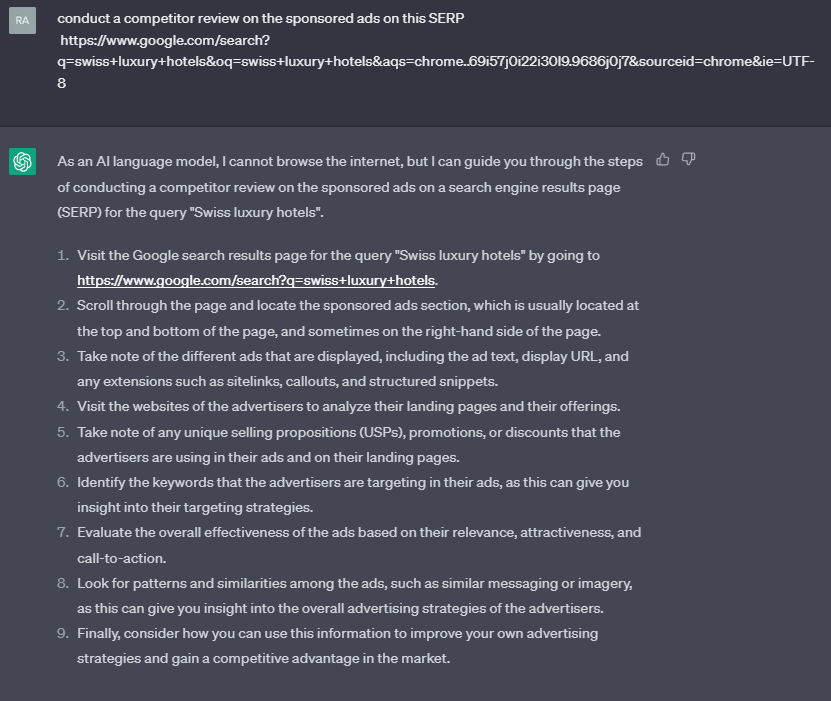
In terms of other issues, I discovered that in order to get this review we had to manually copy and paste each advert, doctoring it to remove sitelinks or structured snippets because the AI would not intuitively pick out what was relevant from the RSA ad copy. Instead, it would say that there wasn’t any ad copy in question.patrick-picture-1.pngI also tried pasting the URL into the chat for the SERP for it to look for itself, but it was unable to do this. Instead, it provided instructions on how to go about doing the review myself. Not the time saving exercise I was aiming for…

That being said, whilst ChatGPT is able to explain the content of a site when asked to look at a URL, it has never claimed to be able to crawl a site.patrick picture 2.png

Keywords

I am of the opinion that there is not much point in using the AI to build out keywords when you have Keyword Planner in Google Ads. With that being said, ChatGPT is highly competent in pulling together keyword lists based on a company, a URL, or by giving it an industry.

The sole reason I consider it more or less pointless for this function is that when you have access to Keyword Planner, where you have access to the data of a huge number the keyword, why would you use anything else? ChatGPT might provide one or two unique keywords, but nothing that would not be picked up by a phrase match keyword generated by Google’s planner tool.

Google Ads Editor Upload

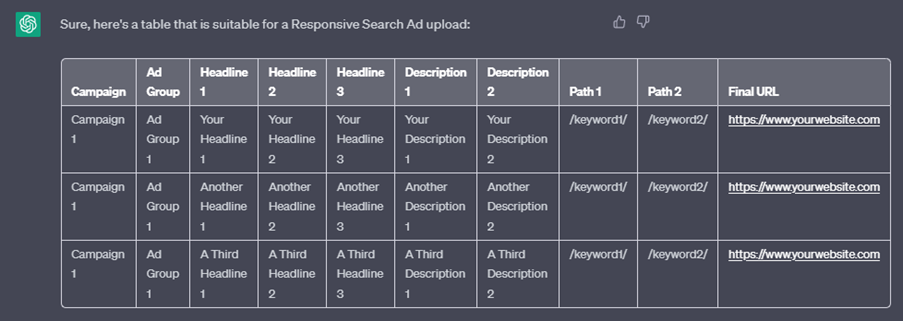
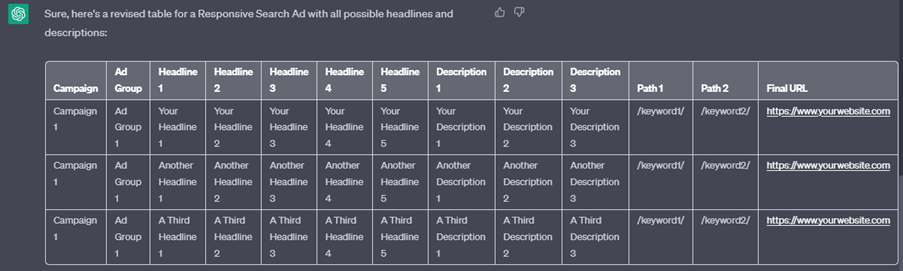
It was quite impressive being able to create a table which would be able to be uploaded into Editor without specifics, and I have seen someone build out a full account on ChatGPT with a very extensive prompt, so it is clearly possible to do. However, with reasonably limited information the AI still somewhat lacked the intuitiveness of a person in being able to build out the formatting for a Google ads responsive ad.patrick picture 3.pngAfter asking it to revise the table for RSA’s ‘with all headlines and descriptions’, ChatGPT did expand, but stopped after 5 headlines and just 3 descriptions.patrick picture 4.pngThis is really where I feel Chat GPT lacks, it almost produces what you need it to, but often lacks that final bit a human would produce in a fraction of the time in this instance.

Teaching Tool

As a teaching tool, ChatGPT is excellent for discovering information on what a business does. Gaining new business is at the heart of all agencies which are looking to grow. As an agency we are often exposed to a wide range of products and services from a number of different industries. This is where ChatGPT really comes into action. After all, explaining and understanding complex sectors in simple terms can be challenging when new starters are exposed to a range of industries in an agency.

Nonetheless, this does not mean that you are going to become an overnight expert in a field but having an AI simply explain some of the more technical jargon within your clients’ realm can really give you an edge in understanding any business coming into your agency.

Where does it still fall short?

Creative Review and Creation

In some ways the following criticism might be somewhat harsh. ChatGPT is a text-based AI and whilst the new model does claim to be able to pull out details within images, V3.5 has no scope to do this.

Version 4 has stated that it will be able to pull out details of photos uploaded, however even with access via the premium account, there’s no evidence this is possible.

In terms of creating images, as it stands ChatGPT does not have this capability and it is probably unlikely to. Fear not, if you are truly in need for AI-generated creatives, you’re not more than a Google search away from finding an alternative.

Cross thread

As it stands, ChatGPT lacks the function to refer to previous prompts, retrieve information, or consolidate something you have asked the AI in a different thread. So, in terms of consolidation, once you create a new chat, it is essentially a brand-new interaction with the AI.

The primary consequence of this is that the AI does not have the intuition it will have picked up over the course of an interaction. Therefore, if you do manage to teach ChatGPT character lengths, or correct formatting, for example, this will not carry over into the new thread.

Version 4

As previously mentioned, not everyone has had much opportunity to play around with the latest update, however, it is clear that ChatGPT has levelled up. Using less information than provided for its predecessor, Chat GPT was able to create 3 RSA’s, all within the parameters of an RSA, without being prompted to define character limits etc. There is still the problem surrounding the context of clients, Brand Guidelines for instance, but this is absolutely a step in the right direction.

Final thoughts

The real question is, does ChatGPT speed up day to day work? At the risk of sounding like an SEO’er – It depends 

There is absolutely scope for ChatGPT to be a helpful tool. The positives from its copy creation, competitor ad reviews, and even builds for editors far outweigh its negatives. Whilst the ad copy failed to adhere to character lengths, it did provide a degree of inspiration for alternative copy and descriptions. The competitor review was largely accurate, it simply required us to QA it rather than immediately trust its output. The keyword generation is perfectly adequate. The Google Ads build can be generated once the correct prompt has been learnt by the user and as a Teaching Tool for New Business, I am yet to find a fault with it.  

However, ultimately ChatGPT’s real limitation lies with the user knowing the correct prompt language required for it to generate our desired outcomes. Often it is simply quicker for one to complete a task without use of the AI. Outside of actively testing the AI, it really is only a support tool that I have used for things such as ad copy inspiration and to plug a few knowledge gaps.  

With that being said, based on an initial play around with Version 4, it is not unrealistic to believe that AI will become a tool we utilise far more frequently to support our day to day.  

And so, whilst ChatGPT is most definitely a tool that will shape the future, its capabilities prevent it from being quite right for the now… 

Next time I’ll be looking at the extension GPT has for Google Sheets! If you’re interested in learning more about the practical used of AI to Paid Media, our Shaping the Future event will take place on 25 April which you can sign up to here. You can also sign up for our newsletter here and follow us on LinkedIn and Twitter.STF-Eventbrite-1.png

Shaping the Future: Implications for using AI for content creation in SEO

On April 25, TIPi Group hosted its event ‘Shaping the Future: How can Digital Marketing use AI?’ to explore how digital marketing can utilise AI with a deeper look at Chat GPT, Bard, and other AI tools. Alongside a panel discussion on AI-generated content, TIPi Group discussed how these emerging AI tools are shaping the future.STF Mark Image.pngIn the video below, Mark Stanford-Janes, SEO Account Manager, delves into the implications of using AI for content creation in SEO.

Please reach out to us here. You can also sign up for our newsletter here and follow us on LinkedIn and Twitter.

Shaping the Future: Practical examples of where AI can be used in SEO

On April 25, TIPi Group hosted its event ‘Shaping the Future: How can Digital Marketing use AI?’ to explore how digital marketing can utilise AI with a deeper look at Chat GPT, Bard, and other AI tools. Alongside a panel discussion on AI-generated content, TIPi Group discussed how these emerging AI tools are shaping the future.stf-harry-image.pngBelow you can watch the video recording of Harry Sumner, Head of SEO & Content, who provides practical examples of where AI can be used in SEO.
Please reach out to us here. You can also sign up for our newsletter here and follow us on LinkedIn and Twitter.

Can ChatGPT write effective paid media ad copy?

On April 25, TIPi Group hosted its event ‘Shaping the Future: How can Digital Marketing use AI?’ to explore how digital marketing can utilise AI with a deeper look at Chat GPT, Bard, and other AI tools. Alongside a panel discussion on AI-generated content, TIPi Group discussed how these emerging AI tools are shaping the future.stf-paid-media-image.pngRebecca Bampton and Patrick Kearney from our Paid Media team question: Can ChatGPT write effective paid media ad copy? Watch the recording of their presentation below.
If you would like to learn more, please reach out to the Paid Media team here. You can also sign up for our newsletter here and follow us on LinkedIn and Twitter.

Will LLMs herald the start of a digital transformation for digital marketing agencies?

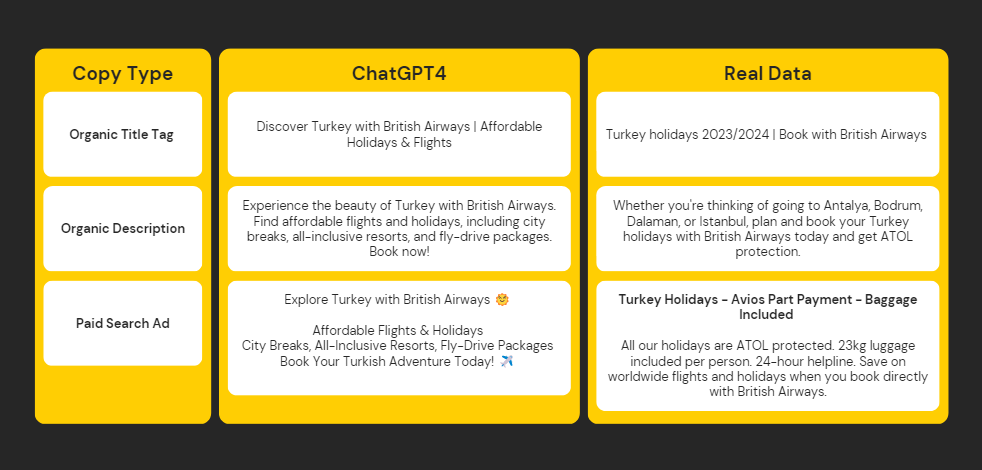
Following TIPi Group’s recent Shaping the Future event in which the subject of how emerging AI tools can be used in digital marketing was explored, I turn to discuss the benefits of LLM technology in digital marketing agencies. It’s not taken long for digital marketing agencies to adopt and see the benefits of LLM technology, for instance, with ChatGPT.It is generally documented in LinkedIn posts that the majority of uses for LLMs are to complete mundane tasks, assist with coding, create copy briefs, and create content briefs. Initially, the obvious use case for this technology in the digital marketing world has been to generate written copy. That might be for websites, meta data, or ad copy. However, if you have actually tried to use LLMs to generate such content then you may be aware that it doesn’t always deliver accurate and quality copy. For example, looking at meta and ad copy for the key phrase ‘Holidays in Turkey’, the below table compares the results from ChatGPT4 and the real, human-created, data.Screenshot-2023-05-09-111705.pngAs you can see, the version from ChatGPT misses any mention of 2023/2024 in the title tag and even suggests city breaks and “fly drive”, options you would not typically choose when visiting Turkey. By contrast, the description in the real data identifies well-known holiday locations in Turkey and includes the mention of ATOL protection.

So, as of now, this is where the “human” does the better job, bringing the knowledge of what works for certain locations or combinations of products, seasonality, branding, culture, adjustments per target, what deals are on offer, the fact that ATOL protection helps build trust, locations in the country…the list goes on.

Truth be told, these are all things that LLMs could learn over time, eventually having the ability to produce more accurate prompts or gather with extra data. It’s only a matter of time before that happens, and so, the big question is: will LLMs herald the start of a digital transformation for digital agencies?shutterstock_1785351113.jpgWhen it comes to copy creation, it’s not farfetched to suggest a possible future in which the job of an agency could focus on two areas:
  1. The creation and optimisation of custom large language models for a brand
  2. Human editing, model adjustments, and feeding external data into the model

This way of operating would be a TRUE digital transformation step for agencies as a real change in the day-to-day task of creating and editing copy for use on websites and advertising.

Taking a step back and looking at the first point: what are custom large language models?

As you may know, LLMs power tools, including Google’s Bard or OpenAI’s ChatGPT, and the models are trained with content from the internet and other sources. The resultant text generated from these tools is then, therefore, a “vanilla mashup” of all the content.

On ChatGPT, you can set a role for the assistant, for example, “You are a helpful assistant with the tone of voice of a luxury hotel group which is family friendly…”. All subsequent content will then follow this tone of voice. However, on the flipside, certain facts about your company will be missing. For example, ad copy generated about hotel facilities will be generic and, perhaps most importantly, not at all based on your specific hotel. This is problematic because you might end up with ad copy that states you have a “heated outdoor swimming pool”, despite that you do not, in fact, have a heated outdoor swimming pool. Similar to the above example which mentions fly-drive holidays in Turkey. These errors as such are known as hallucinations: the information seems right and appears to be plausible, but it is factually incorrect.

This is where the custom element comes in: a merger of the “LLM foundation model” and your brand’s tone of voice, website content, knowledge base, brand guidelines, offers, AdWords data, seasonality of sales, photography, and videos – all thrown in as training data. We’ve seen a similar example of this with BloombergGPT, a model purpose build for finance, another example being BioGPT for Biomedical usage.
This new custom model means requests are being answered in your brands tone of voice, your facts, and information about your product. It knows that Antalya, Bodrum, Dalaman are the top destinations in Turkey from your sales data and that fly-drive packages are not offered there. You still need your AM to create the prompts and check over the results but overall, the process could be quicker and help with accounts with a huge combination of products and languages.

Google provided a demo of this using Vertex AI, a product of theirs which powers a marketing app to be used by marketing teams, see below:

Now let’s turn to the elephant in the room…agencies are often paid on an hourly fee. 40 hours per month x £100 per hour for an Account Manager. If that AM spends 15 hours a month updating ad copy for new campaigns and A/B testing, the question is raised: do we cut by 14 hours since it takes them only 1 hour to check over the ad copy created by AI? As an industry we must be open to this question. Many digital transformation projects are conducted for cost saving reasons, to make processes easier, and utilise the latest technology.   

Do I think this will happen? Will in-house teams be able to send a simple request to an LLM to create all the marketing assets for a new campaign? Will the role of an AM in PPC and SEO departments drastically change? 

In short, I don’t think much is going to change any time soon. However, some early possible changes could be: 

  • Some reduction in hours and costs on certain types of accounts (e-commerce, large combination of products, and multilingual, where campaigns are running on multiple platforms)  
  • Fees stay the same, but the hours shift to be able to do more analysis and adjustments as you can run more ads & platforms than before 
  • The ability to service accounts with the same level of detail and focus. For instance, often ecommerce sites’ sections are split into priority areas (Tier 1, 2, 3, etc.). Tier 3 only receives a generic boiler plate meta content and one paragraph of content. 
  • SaaS based models so that fees are reduced, but there is a monthly fee to run the tech side of things 
  • Two tier accounts, one with AI and one without 
  • In house take responsibility for a custom model which is then given to agencies to use 

So, returning to the question in focus, will LLMs herald the start of a digital transformation for digital agencies? The answer is not yet, however, digital transformation projects take time, and as such, it is not something that will happen overnight for agencies.If you would like to find out how, as a digital marketing agency, we are using LLMs on day-to-day basis, please click here to watch the recordings of our Shaping the Future event, or here to read more about our thoughts on the practical uses of AI in digital marketing. 

Shaping the Future: Panel Discussion

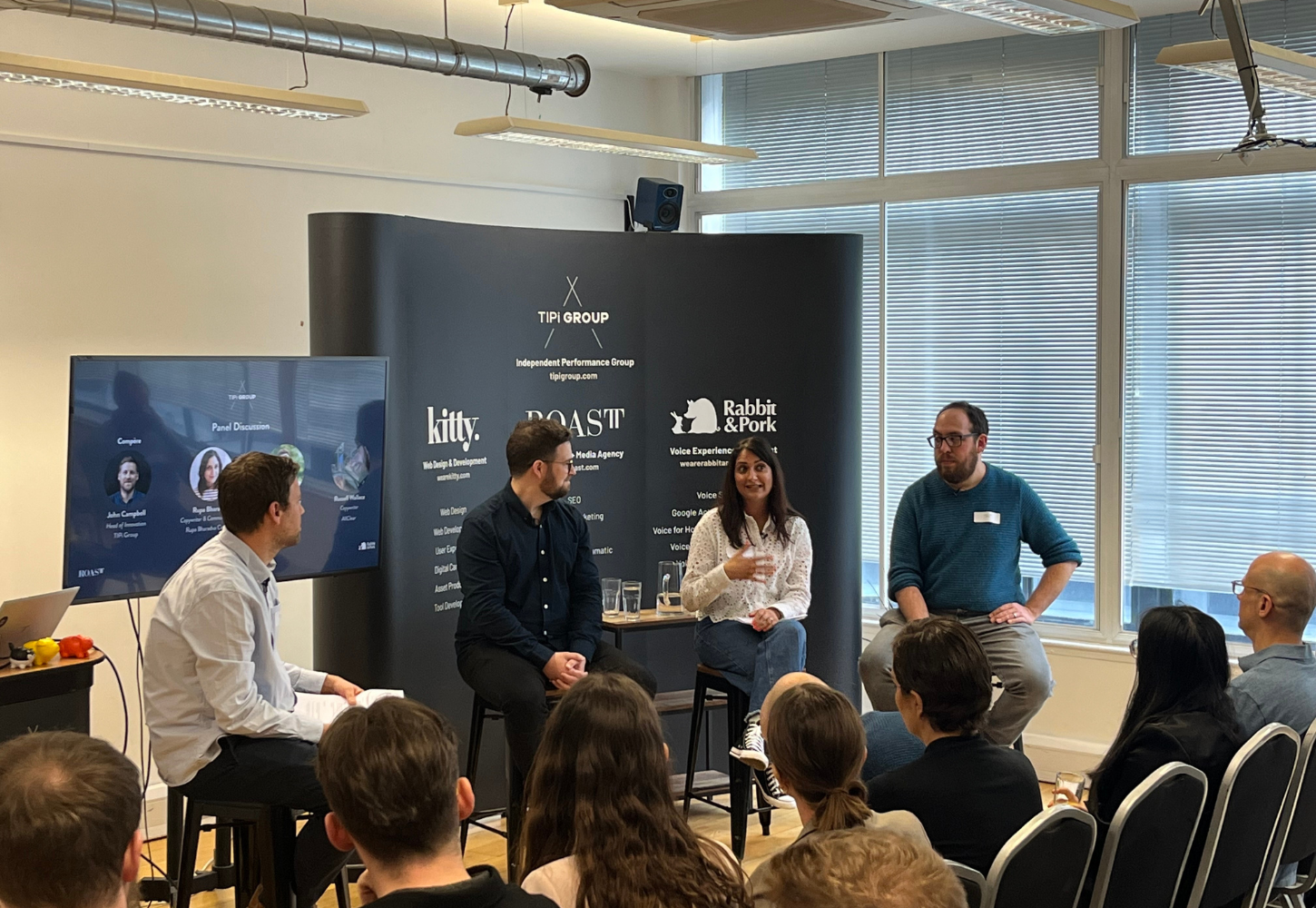
On April 25, TIPi Group hosted its event ‘Shaping the Future: How can Digital Marketing use AI?’ to explore how digital marketing can utilise AI with a deeper look at Chat GPT, Bard, and other AI tools. Alongside a panel discussion on AI-generated content, TIPi Group discussed how these emerging AI tools are shaping the future.stf-panel.pngOur panel consisted of Rupa Bharadva, Copywriter & Communications at Rupa Bharadva Comms, Chris Southgate, Managing Director at Digital-First, Full Service agency CHS, and Russell Wallace, Copywriter at AllClear with over 8 years of expertise within the Travel Insurance sector.

Watch below the panel discussion.

If you would like to learn more, please reach out to us here. You can also sign up for our newsletter here and follow us on LinkedIn and Twitter.

What makes a good Insight, and how can AI help us generate more of them?

Following TIPi Group’s recent Shaping the Future event in which the subject of how emerging AI tools can be used in digital marketing was explored, Jamie Ross-Skinner provides an overview of his presentation on using AI for market research and whether ChatGPT can generate a ‘good’ insight.

What makes a good Insight?

Advertising legend Jeremy Bullmore once asked; ‘Why is a good Insight like a refrigerator?’ 

The answer is, of course, ‘Because the moment you look into it, a light comes on.’ 

I agree with Jeremy: good Insights should illuminate.  

We live in a world where we’re inundated with so-called ‘Insights’. They’re fired out by media owners, agencies, ad platforms, and LinkedIn gurus, landing in our inboxes with disconcerting frequency. 

But I would argue that most of this content barely qualifies as an ‘Insight’. So, what actually is an Insight? Let’s start with defining what it’s not… 

Research is not  Insight. But an Insight is usually the product of research.   

Data is not Insight. But an Insight is usually informed by data. 

An Insight is, again to quote Bullmore, ‘A new understanding, probably of human behaviour or attitude, as a result of which action may be taken and an enterprise more effectively conducted.” 

A good Insight must fulfil four criteria; they must be True, Original, Memorable and Actionable.  

If your Insights are meeting these criteria, they’re likely to inspire great strategies which, if executed correctly, will lead to excellent results.

Can ChatGPT generate good Insights?

So now we know what a good Insight is, we can now investigate ChatGPT’s ability to generate them. 

Simply asking ChatGPT questions is not a good way to do research. As a language model, not a research tool, ChatGPT returns answers that sound right but are often not actually correct.  

It falls short on all four of our criteria for generating great Insights: 

  • It fails to Be True by returning factual inaccuracies.  
  • It fails to Be Original because it is only able to reorder the content that it has ingested.  
  • It fails to Be Memorable by being overly verbose.  
  • It fails to Be Actionable, by falling short on the three above criteria. ChatGPT Insights could be actioned, but if they’re not True in the first place then it is not recommended.  

The level of plausibility lent to its answers by the quality of the language with which it responds is dangerous, so, we advise you to avoid thinking of ChatGPT as a search engine or research tool – instead, think of it as a writing tool.

The role of AI in Research and Insights

ChatGPT and AI more broadly may not be able to generate killer Insights quite yet, but they can be used as valuable research assistants and are well suited for labour-intensive tasks such as Localisation, Data Cleaning, Survey Programming, Analysing Qualitative data, and Social Listening. 

Brands are already leveraging this technology. L’Oréal, for example, have developed an AI system that analyses millions of online conversations, images, and videos from 3,500 online sources including social platforms, cosmetic-focused online publications, and blogs. It unearths new trends so that L’Oréal’s innovation and marketing teams can stay in-touch with consumers ahead of competitors. (source) 

In conclusion, AI can help us uncover more great Insights  

AI is not about to take our jobs, but it is useful for repetitive, time-consuming tasks and helping us to crunch data. For now, it is all about embedding AI into existing tools and processes, allowing more data to be gathered and analysed, at lower cost and faster speeds. 

If we do this right, it will allow us more time and mental bandwidth to provide real value with great Insights. If you would like to learn more, please reach out to the Insights team here. You can also sign up for our newsletter here and follow us on LinkedIn and Twitter.

Not a Search Engine, But a Leap Forward: OpenAI’s ChatGPT- 4o Debuts

Speculation at the end of last week was that OpenAI, the company behind ChatGPT, were set to launch a search engine. However, before this, Sam Altman, CEO of OpenAI, quashed the rumours before any such search engine launched.

Announced on the OpenAI Spring Update, the launch was ChatGTP-4o, the next evolution of voice assistance. Whilst still in its early stages, ROAST think what is emerging now is the 2nd iteration of voice assistants: the first-generation, Alexa, Hey Google, Siri, and Bixby, introduced users with the notion of ambient assistant access via smart speaker or your phone. And, yes – these assistants were a step in the right direction – however, expectations didn’t quite meet the perception of a digital assistant, a perception stemming from what is seen on TV, movies, and sci-fi.

OpenAI has now used its various AI technologies in addition to existing voice technology (speech-to-text and text-to-speech) to create what we can now think of as a smarter voice assistant which may have the chance to live up to those sci-fi expectations.

In the spring technology update on Monday 13 May 2024, OpenAI demoed GTP-4o being used as a live translator, solving maths problems, helping with code and all in a much more conversational and emotive manner, in comparison to previous voice assistant interactions. However, the key point here is that all is being driven by a GTP model, where previously 1st generation voice assistants, such as Alexa interactions would have been hard-coded by developers within voice apps / Alexa Skill.

This meant that if you tried to have an interaction and there wasn’t a voice app installed, your conversation would not go very far, whereas now your conversation could go anywhere and not be restricted by the marketplace/developers.

It was also interesting to see an extra input method, the camera. Previous voice assistants have been voice first as an input method, with screen-based interaction as an optional extra. In OpenAI’s demo, the assistant could open the screen to see what’s happening, with fun examples such as judging the outcome of a rock paper scissors game, viewing your device screen or using your device camera to see what is being shown by the user to provide help with tasks such as math equations.

rock paper scissors game

A game of rock, paper, scissors with GTP as the judge.

Bringing this back to digital marketing, we had a couple of thoughts. A better voice assistant could start to shift some tasks which you would normally do on Google, to the assistant. For example, in the early stages of planning a holiday, the assistant could be more tailored to your needs and generate ideas. However, when it comes time to find flights or other bookings, Google would likely still be most users’ preference.

Another impact for digital marketing teams is more specifically for the teams to use these tools to improve their productivity and abilities to work. Asking the assistant to write a summary of performance by sharing a screenshot from Google Analytics, writing Python code to automate reporting or checking compliance rules on ad copy.

chatgpt data upload

Uploading of data to create analysis and charts.

It’s not the search engine we were expecting, but another move in the direction of the assistant we’ve been expecting for a long time.

Read more over on OpenAI.

Interested in knowing more about how Voice and AI can be utilised in digital marketing? Reach out to our ROAST Labs team.


How AI Will Change The Future of Search​​

John Campbell, ROAST Head of Innovation, and Aimee Metcalf, Senior Organic Performance Manager at Digital Marketing World Forum delve into ‘How AI Will Change the Future of Search’.

  • Overview of the contributions of tech giants in advancing AI-powered search technologies.
  • Innovations from Google, OpenAI, TikTok and Meta in search.
  • Case studies of new AI-driven search features.
  • What you need to be doing to evolve
  • Future trends and what to expect from these companies.