Have we reached Peak Social? If so, what’s next?

Have we reached Peak Social?

Advertising legend Les Binet (of Binet & Field fame) recently shared the above image on Linkedin, asking if we had reached ‘Peak Social’:

It sparked a lively debate on Linkedin and got us thinking hard about whether social is really in decline.

The data, sourced from the IPA, is pretty convincing; it shows that Brits are spending 25% less time on social media than they did 3 years ago.

But one graph almost never tells the whole story.

So to see if Binet’s theory was right, we needed more data.

First off we dug into GWI for some data which could show the trends by market.
As the graph above shows, time spent on social media has been running pretty flat since 2016. However, the high time-spent in countries such as Brazil points to huge potential growth in emerging markets.

Perhaps even more interesting for advertisers than time-spent though is reach.

Hootsuite have estimated that half a billion new users joined social media in 2020, taking the total number to 4.48 billion – 57% of the world’s population. Sure, some of these users are bots or duplicates, but the total number and the consistent growth are both pretty staggering.

As the internet and smartphones continue to spread across the world it seems inevitable that social media will follow.

So even if time-spent per person is no longer increasing in developed countries, total global time spent on social media will continue to grow steadily.

A lot of people on the comment thread were asking what the data would look like split out by age, so heading back to the UK and the US (where most of our clients are right now) we’ve pulled that data as well.
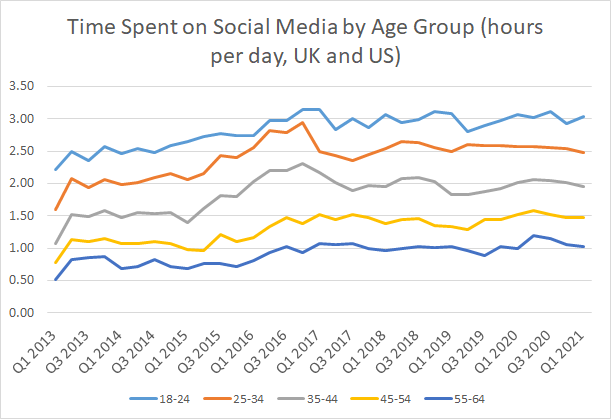
For the younger groups, it looks like usage time has been declining amongst 25-44s since 2017, but it has been running pretty steady for 18-24s and 45-64s.

The slow tailing off of use amongst 25-34s is unsurprising considering that age group’s widespread disillusionment with social media. Only 26% of UK and US 25-34s think social media is good for society. 29% worry they spend too much time on social media and 22% feel it causes them anxiety.

So it does seem that Binet is right, social media consumption is flatlining in terms of time spent per user in mature markets.

But what’s been stealing attention as social media stands still?

Streaming is the big one, and it’s shown huge growth since 2017, the latest data from GWI shows that 63% of UK and US 16-64s have watched Netflix in the past month, and 55% have watched YouTube.

Gaming is also incredibly wide reaching, with 77% of this group playing a game on any device in the past month. This number goes up to 88% if we zero in on 16-24s.

Other app categories, such as Dating, Exercise and Investment have also imitated some of the stickiest product features of social media to take attention away from social media itself.

So what’s next for social?

Sure, TikTok is huge with Gen Z and has offered great opportunities to advertisers. But realistically it’s just Vine (remember Vine?) with a way better algorithm.

If you ask Mark Zuckerberg what the future of social media looks like, as The Verge recently did, he’ll tell you it’s all about the metaverse, which he believes will be the next phase of the internet.

I’ll let him explain the metaverse in his own words:

“You can think about the metaverse as an embodied internet, where instead of just viewing content — you are in it. And you feel present with other people as if you were in other places, having different experiences that you couldn’t necessarily do on a 2D app or webpage, like dancing, for example, or different types of fitness.”

The metaverse is a new vision for the internet which is far more immersive than what we currently have. It’s your work, your social life, your exercise, your everything – all linked together and instantly accessible, enabled by VR, AR and all of your devices.

Immersion is key. Instead of surfing the web, you’re swimming in it.

Interestingly, social media companies aren’t currently leading the way when it comes to the metaverse. Games like Fortnite, Minecraft and Animal Crossing have come closer to delivering it, as have fitness products like Zwift and Peloton.

In Conclusion

As Binet has suggested, social media usage per day has stagnated in the UK. However, from an advertiser’s perspective, there are now more users using more viable social platforms than ever before. The reach is huge and with the growth of alternative social media means there is more choice of context than ever before. The key is getting the right creative, which fits the grammar of the platform, served to the right audience in the right context.

Social media certainly isn’t going to disappear overnight, but in order to keep consumers engaged long term it may have to morph into something altogether more ‘metaversey’.

Facebook certainly have the resources and the user-base to make the metaverse a reality, and if the metaverse is made by Facebook then you can bet on it being funded by ads.

So what will advertising look like in the metaverse?
If you enjoyed reading this, make sure to check out our other blog here giving insight into privacy in a post-cookie world.
Boxing Day & Beyond – Consumer Trends and Implications for Marketers for the Post-Christmas Period

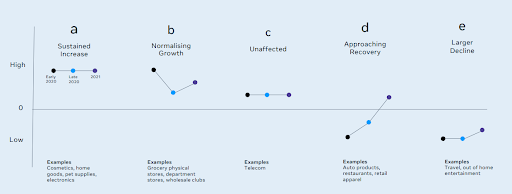
The ‘cancelled’ Christmas last year left a hollow feeling, but with increasing vaccination efforts and continuous scientific progress, people are feeling more optimistic for 2022, even with the rise of the Omicron variant. This year we have seen consumers shopping earlier for the holidays due to fears of supply shortage and in anticipation of a well-deserved reunion (Think with Google). The impact of Covid on consumer behaviour continues to take twists and turns, especially for industries like home goods, cosmetics, and electronics.

Source: McKinsey & Company Survey 2021. Consumer sentiment and behaviours during the coronavirus crisis. 

The shopping shift towards omnichannel purchase journeys that emerged during the start of the pandemic looks like it’s here to stay, but what else can we expect from the coming months?

The desire to shop is set to stay high, even after Christmas

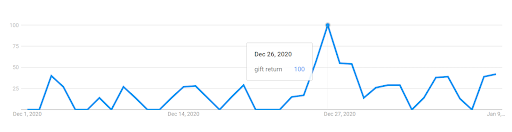
Christmas is the biggest gift-giving period of the year, and the post-Christmas period sees a surge in gift returns and voucher spends. A recent report from Facebook finds that consumers’ purchase intent will continue into the new year and people will be spending their gift cards and vouchers from returned Christmas gifts. Due to a continued impact from job losses and uncertainties during the pandemic, price is an important consideration in consumers’ minds (McKinsey & Company Survey). Purchase intent may be high, but they’re also looking for sales or discounted items.

Source: Google Trends Report. Search Term: gift return, Dec 2020 – Jan 2021.

Rise in app downloads due to new devices coming online.

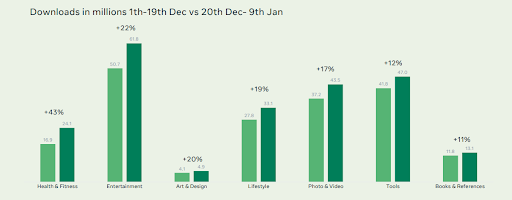
We also expect to see a high volume of app downloads after Christmas as people are gifted new devices or upgrade their old ones. A high percentage of apps downloaded are in the entertainment and tools categories, but a notable volume also comes from lifestyle, health and fitness (Facebook Meta Insights 2021).  This could result from the strong desire for lifestyle changes that comes every beginning of a new year (The Ozone Project).

Source: App Annie, Downloads Change 2019-2020.

Time spent on social networks increases during the holidays. 

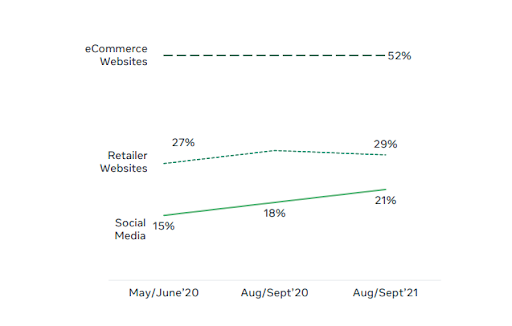
People typically have more time to spend on social media in the post-Christmas lull and are likely to want to share their festive celebrations with the world. They are also likely to discover new brands and purchase items through social A report by Facebook finds that social commerce usage has grown by 40% over the year, and it’s soon to catch up with retail websites (Facebook Meta Insights). Consumers are finding brands they love on social media and they’re expecting more shoppable content from those brands (Think With Google).

Source: Industry Micro-Shifts monthly tracker by Kantar Profiles. Actions taken in the pandemic.

Shifts to online shopping, hybrid work, and ordering groceries online are just a few examples of lifestyle changes we made during Covid. Usage of social media, digital workouts, and online games accelerated greatly in the past three months, with gen Z and millennials showing the most dramatic shifts. A McKinsey & Company survey reports that one in four people have returned to routines before the pandemic, while the rest expect it to happen much later.

How can brands adapt to these behavioural changes?

  1. Be prepared for supply chain disruptions. Labour shortages, inflation, and country-specific restrictions will continue to disrupt businesses. More consumer demand after Christmas means more burden on the supply chain. To navigate this, brands can reflect their stock availability and delivery time estimation on ecommerce networks to drive brand satisfaction and long-term loyalty.
  2. Get in front of high-intent app users through ads. People are most likely to download new apps when they get a new device, so the post-Christmas period is a huge opportunity for app businesses to drive downloads by using Apple Search Ads or Google App Ads.
  3. Increase brand communications on social media. Brands can use this opportunity to highlight brand offerings and engage customers with shoppable content. Lifestyle/wellness brands could also use this chance to introduce new habits.
  4. Enhance customer experience online. For some industries, the shift to online has proved itself to be permanent. People expect both in-store and online options, so brands should continue improving experience across every touchpoint, especially digital.

With continuing uncertainties around new restrictions, the future remains unpredictable. Brands should treat the coming weeks as a period of close observation and adapt to new changes as they happen. Gathering customer insights and creating a controlled test plan for new campaigns can help inform better strategies and drive better results.

Sources:

Facebook Meta Insights 2021. Driving Q1 Growth.

Think with Google. 3 early holiday shopping trends for the 2021 festive season. https://www.thinkwithgoogle.com/intl/en-gb/consumer-insights/consumer-trends/festive-season-retail-holiday-shopping/

McKinsey & Company Survey: UK Consumer sentiments during coronavirus crisis. https://www.mckinsey.com/business-functions/marketing-and-sales/our-insights/survey-uk-consumer-sentiment-during-the-coronavirus-crisis

The Ozone Project 2021. www.ozoneproject.com/blog/medical-health-surges-on-omicron-fears-we-12th-dec

Valentines & Galentines: Is your brand ready to be loved-up?

The celebration of Valentine’s Day has evolved from being only for couples to being a more inclusive form of love celebrations – one of family, friends, and also oneself. The concept of ‘Galentine’s’ on February 13th is a great depiction of this evolution; It started gaining traction in early 2010 and it is a day to celebrate friendship of all forms. Brands picked up on the change and started altering their Valentine’s campaign messages to be more inclusive, from Niluu’s ‘fall in love with you’ campaign on self-love to Yowie’s ‘Love is Family’ campaign focussed on family love. 

Before Covid, most people would book fancy dinners and activities for Valentine’s with their loved ones. Last year, as restaurants were closed and activities were limited due to lockdowns, Valentine’s, as well as many other celebratory occasions, were spent at home or virtually. Online shopping became a norm and gift purchasing was commonly done online. 

This leaves us wondering, what will Valentine’s look like this year? How will it vary across different generations? And, most importantly, how can brands successfully launch their Valentine’s campaign?

How early will people start thinking about Valentine’s plans and gifts?

buying behaviour
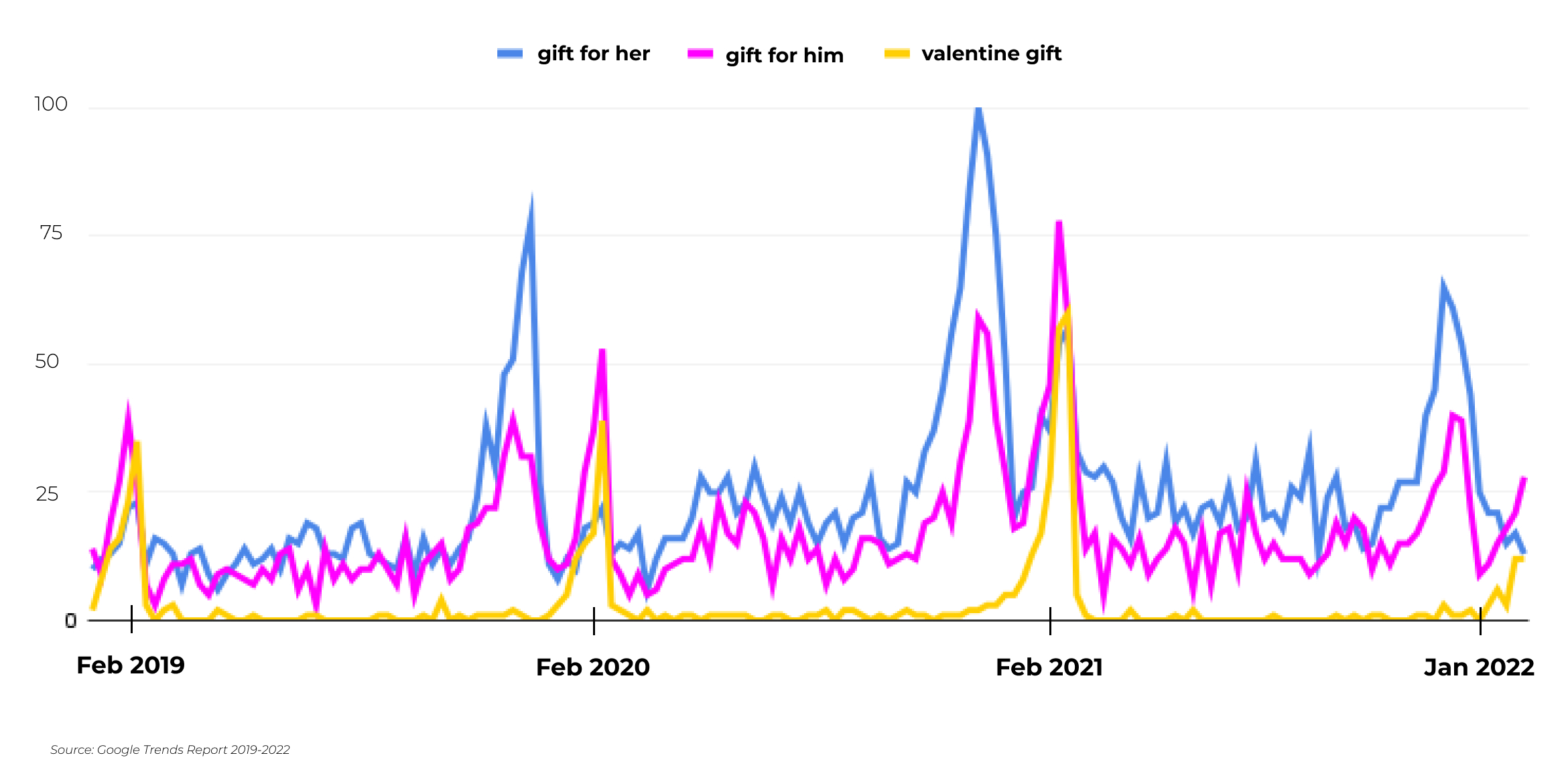
Search patterns show that before Covid, Valentine’s planning often started about one month prior. However, due to lockdown boredom and experiencing late deliveries during the pandemic last year, people started thinking of gift ideas much earlier. This year, we see the behavioural patterns closely resembling pre-pandemic; Searches for Valentine’s gift ideas only started around mid-January and search volume is much lower than this time last year. This is an indication that people may be making more last-minute plans this year than last year. 

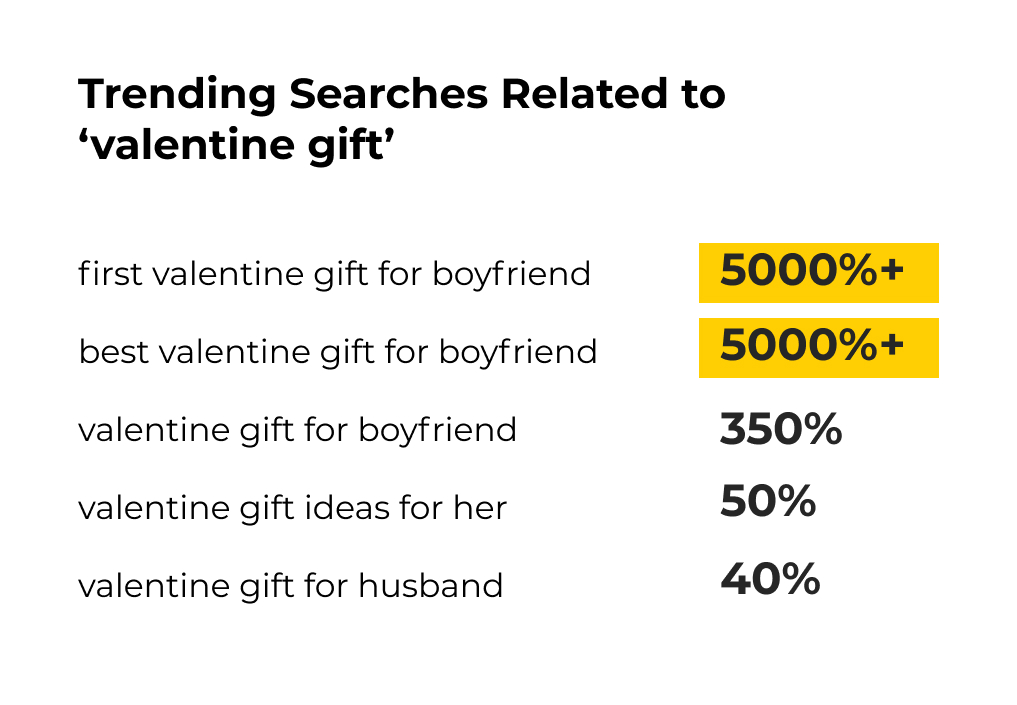
trending searches

Source: Google Trends Report, 2019-2021. Breakout Searches.

Another notable insight from search tells us that gift-buying for men started closer to Valentine’s than gift-buying for women. Searches for ‘gifts for him’ scored the top three places for the most trending searches in the valentine’s category in early February, while searches for ‘gifts for her’ peaked up since mid-January. 

How do Valentine’s Day plans vary by generation?

How do Valentine’s Day plans vary by generation

Source: Global Web Index, Zeitgeist December 2021, UK.

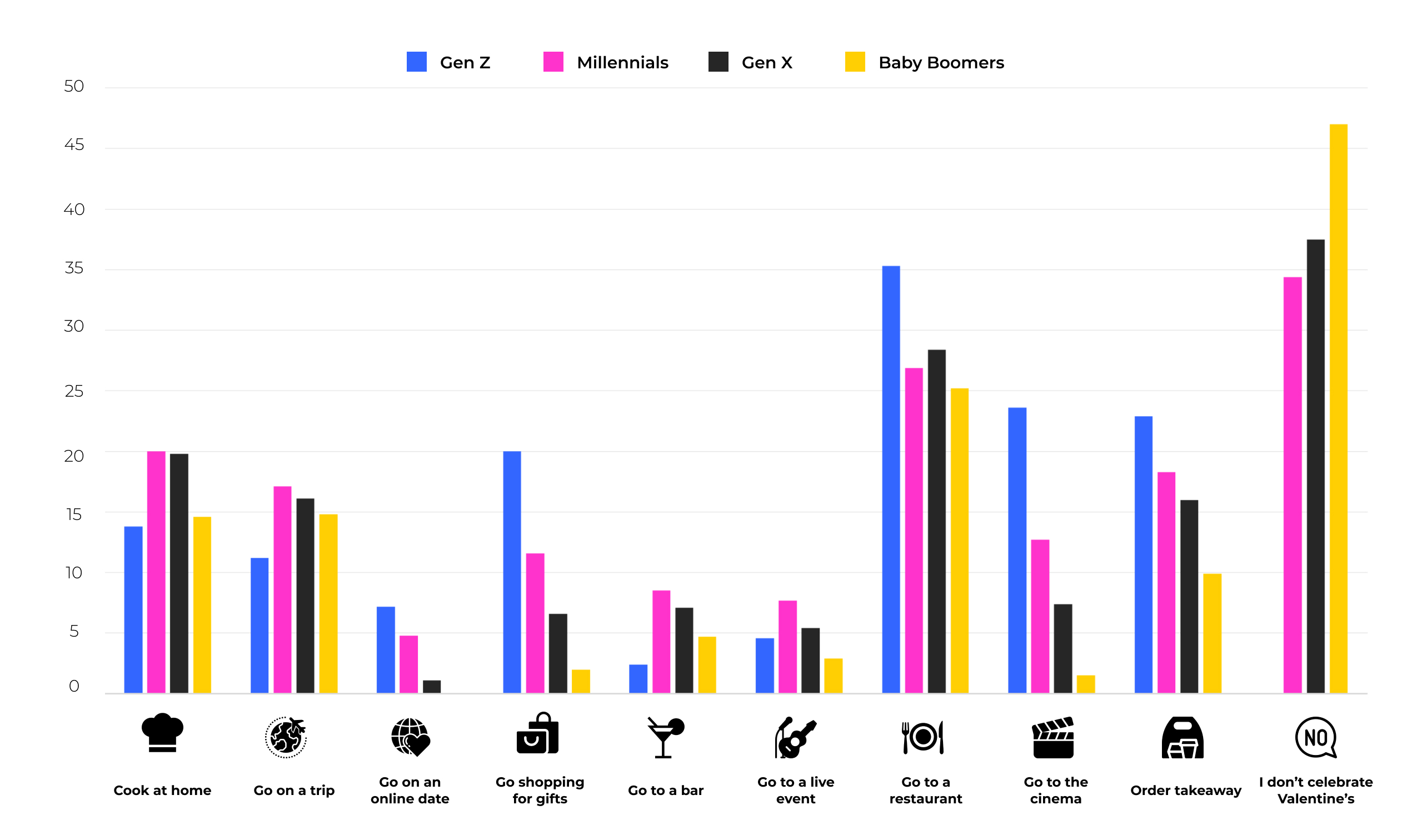
When it comes to ideal Valentine’s celebrations, Gen Z would favour spending the day outside, going to the cinema, restaurants or shopping. Millennials and Gen X share many similarities in celebration ideas; for starters, they seem to prefer spending this romantic occasion at the comfort of their own homes, with more than 38% saying they’d prefer to cook at home or order takeaway. Conversely, they are also the most likely groups to go on holiday for Valentine’s.

Many of us are on the hunt for a life full of romance, but when it comes to gift-giving, the spark certainly seems to go as couples get older. Almost half of Baby Boomers say that they don’t celebrate Valentine’s, and among those who do, 25% of them would go to a restaurant. It’s also fair to say that they’re the group that never fully bought into the idea of Valentine’s Day; after all, it only started becoming commercialised in the early 80s

What does gift-buying look like for Valentine’s this year?

gift buying in 2022

Source: Global Web Index, Zeitgeist December 2021, UK.

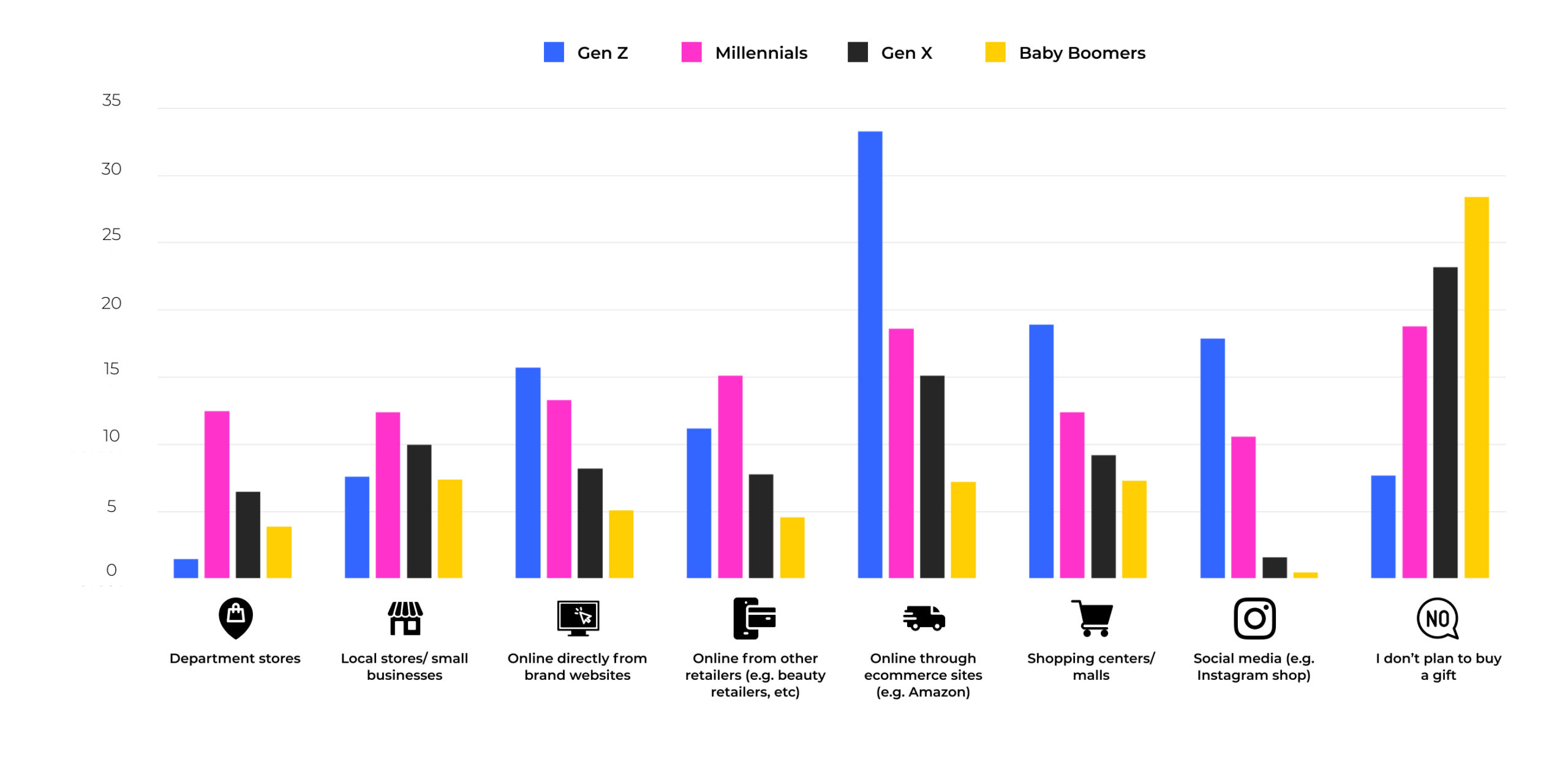
What is known to be true is that shopping for gifts online will continue to dominate this year. 33% of Gen Z intends to buy gifts through online retail websites like Amazon, and 18% through social media commerce platforms. Millennials are most likely to buy gifts via a mix of different platforms, mainly online retail websites and department stores. While both Gen Z and Millennials have their hearts set on gift-giving, Gen X and Baby Boomers are less enthusiastic about the prospect. The majority of them don’t plan on buying gifts, and for those who do, they would prefer buying on offline channels like local stores or shopping centres.
Quick tips for campaigns this Valentine’s:

  • Valentine’s is not just for lovers – Think outside the box and test creatives. Make your campaign stand out by getting creative with formats and colours, targeting different audience groups, and leveraging emerging technologies. Maybe your product is more appropriate for ‘Galentines’ than Valentine’s? Perhaps your audience would engage with Valentine’s-themed Snapchat filters? The possibility is endless!
  • Most Valentine’s shopping happens last minute – Ensure delivery times are highlighted in ad creativeS and stock levels are up-to-date, if you are selling through Amazon, then being available through Prime will increase conversion rates.
  • Valentine’s Day is about more than just gifts –  Events, restaurants and even recipes will be in high-demand. How does your brand or product fit in, if at all? 
  • Valentine’s Day means different things to different people – How does your audience feel about Valentine’s Day, and what will they do to celebrate? Commissioning some Insights work will help you guide your strategy for next year.

Interested in gaining tailored insights for your brand? Reach out to our dedicated Insights team at [email protected]

Marketing in the Metaverse | Insights from AdWeek Europe

The concept of a metaverse has received a lot of traction over the past few years. According to Google Trends, searches for ‘metaverse’ showed a huge uplift since October 2021, and the conversations surrounding the topic have since evolved in many ways.   


For starters, Facebook changed its name to Meta, whilst Microsoft announced its acquisition of a large gaming company; Activision, for 69 million dollars to help bring its metaverse vision to reality. Millions of pounds have been invested in metaverse-related start-ups in the seed and pre-seed stage, and companies like Wendy’s and Gucci have already started advertising in a virtual reality world. 


What exactly is a ‘metaverse’? While its definition differs from case to case, its core definition as defined by VICE is ‘a shared virtual space that is interactive, immersive and hyper-realistic’. It would also likely include your own customised avatar and digital assets. Matthew Ball, a venture capitalist and angel investor who’s written a series of essays on the structure of the metaverse, terms it as ‘a 3D version of the Internet and computing at large’. 


The metaverse experience has great implications on marketing and the customer journey. Whether the metaverse is a myth or already happening, marketers need to update their toolkits and get ready. ROAST recently joined Advertising Week Europe and collated some of our key findings from the metaverse sessions below: 


1. Gaming is a gateway to the metaverse. What is the opportunity for marketers? 

There are many speculations surrounding the correlation between the metaverse and gaming. While this is not entirely false, Johnathan Troughton from Frameplay brought some further insights into this topic. He believes that gaming is a gateway to the metaverse. The infrastructure needed to build a metaverse is similar to that needed for gaming, starting from the rollout of 5G and mass adoption of VR devices. He also believes that their similarities provide a chance for marketers to get a glimpse of the metaverse before it becomes widespread.  


2. Marketers can dip their toes in the ‘metaverse’ through immersive content experiences like AR or VR. 

From experience, we know that people want to try new things and explore new innovations, so this curiosity will be triggered by the metaverse, and adoption will be inevitable. The metaverse experience could alter marketing as we know it, and consumers will exercise more power on what they want to see from brands. There are small things marketers can do to get a head start on metaverse marketing. Firstly, they can create innovative ad experience through immersive content using AR/VR, and secondly, they can experiment with running in-game ads. Experiences cultivated from these activities will act as a test and learn period for marketers to enhance their success in future iterations of the metaverse.  


3. For now, metaverse activation must sit alongside current media activities. 

For marketers, the existence of a metaverse shouldn’t require them to reinvent the wheel. Hannah from Tug explained that brands currently use the metaverse to help amplify their media activities rather than treating it as a channel.  However, as simple as this sounds, it also comes with challenges. Carmen from Poplar Studio believes that the main challenge of marketing in the metaverse is onboarding consumers onto Web 3.0. How can marketers enable a smooth onboarding process for their consumers? Education will be a big part in the success of the metaverse, and marketers will play a big role in its activation. Marketing in the metaverse also means there’s another data source for marketers. How the audience interacts with brands in the metaverse and how this affects their purchase is currently a mystery. How can marketers efficiently integrate data from different touchpoints to draw meaningful conclusions about the new and improved customer journey? 


What does advertising in the metaverse currently look like?  

Balenciaga and Fortnite 

Balenciaga partnered with Fortnite to let users purchase digital outfits inspired by real-life designs from its boutique in the virtual world. Players could also try on outfits in the changing booths and interact with other players. Balenciaga also activated this campaign on DOOH through this brilliant 3D billboard experience.   

Gucci Garden 

In 2021, Gucci recreated their real-world garden installation in Florence in a virtual world. They partnered with Roblox to set up a two-week art installation where visitors can view, try on, or purchase Gucci products to dress their avatars. Check out the full showcase here. 


ROAST attended three sessions that inspired this article.  

  1. Metaverse: What Is Possible Now And How Marketers Can Stay Relevant – presented by Advertising Week Europe, joined by panelists from Hearst UK, Epic Games, and iCrossing 
  2. The New Age of Experience: New Technologies, The Metaverse, and Shaping Virtual Worlds – Presented by Tug, joined by panelists from MediaCom, ViewersLogic, Poplar Studio, and Tug.  
  3. Will gaming and metaverse be mutually exclusive? – Presented by Frameplay and joined by their CEO. 

Meta IAB Upfronts 2022: Takeaways

This year’s Meta event in the IAB Upfronts series covered a range of insightful subjects, from marketing in an age of uncertainty to the future of the Metaverse. The theme of uncertainty only grew in importance as Liz Truss resigned on the same afternoon as the event. While the months ahead certainly look challenging, Douglas McCabe and Pete Buckley painted a guide of how marketers can succeed in a cost-of-living crisis.

The impending situation for consumers is scary, 85-90% of people are deeply worried and changing the way they live – and this means changing their purchase behaviour and forcing businesses to shift how they market themselves. Not only are businesses facing the challenge of reduced consumer spend, which at its core is integral to a successful economy, but there is also a real distrust in advertising as a sector with banking, energy and even telecoms seen as more trustworthy. So how can businesses win the trust of consumers and convince CFOs that healthy marketing budgets are essential to success in a time of financial turmoil?

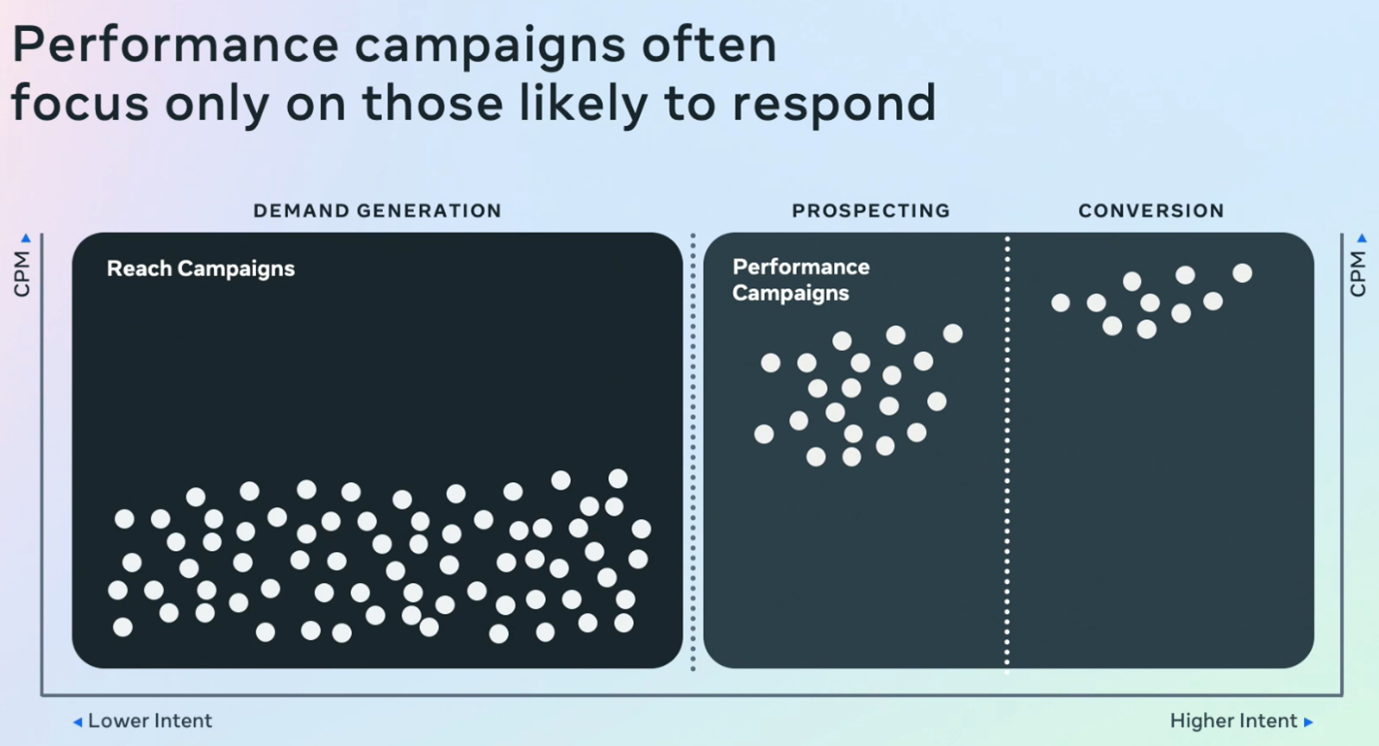
Your brand is going to be your key to success. Pete Buckley argued that a focus on brand isn’t just going to drive your long-term, awareness-building strategy. Meta’s research shows that to drive short-term results, you will need a combination of both brand and performance:

Meta IAB

Source: Pete Buckley, The Next Era of Growth, Meta IAB Upfronts 2022

The businesses who invest in building their brand are driving more profits overall and this was shown by the success of eCommerce companies using offline stories on TV during the pandemic as it became the best channel for brand building. This can be transferred to the online marketing sphere, which hasn’t yet fully capitalised on this opportunity, and as internet advertising is heading towards 80% market of spend – brands shouldn’t let inflation levels and ever-changing Prime Ministers stop them from building their brand to bring in that crucial short-term income.

The market will be challenging, and no one is doubting that. To succeed in driving brand awareness in a highly competitive period, investing in creative and planning has never been more important. To win back that consumer trust in advertising, your audience need to know that you’re offering genuine value for money, authenticity and haven’t lost that all-important creative quality.
Interested in learning about the insights ROAST can provide you with? Reach out to our Insights team here.

New Year New Me: How do the changes in popularity of New Year’s Resolutions reflect the underlying consumer mood?

It can seem hard to keep up with the fast-moving consumer landscape in the UK, but by comparing New Year’s Resolutions intended for this year compared to last year, we gain insight into how consumer priorities are shifting as we simultaneously emerge from a pandemic and enter a recession.

How do New Year’s Resolutions for 2023 compare to last year?

consumer resolutions
Source: GWI November 2021 Zeitgeist, December 2022 Zeitgeist, New Year’s Resolutions, Location: UK

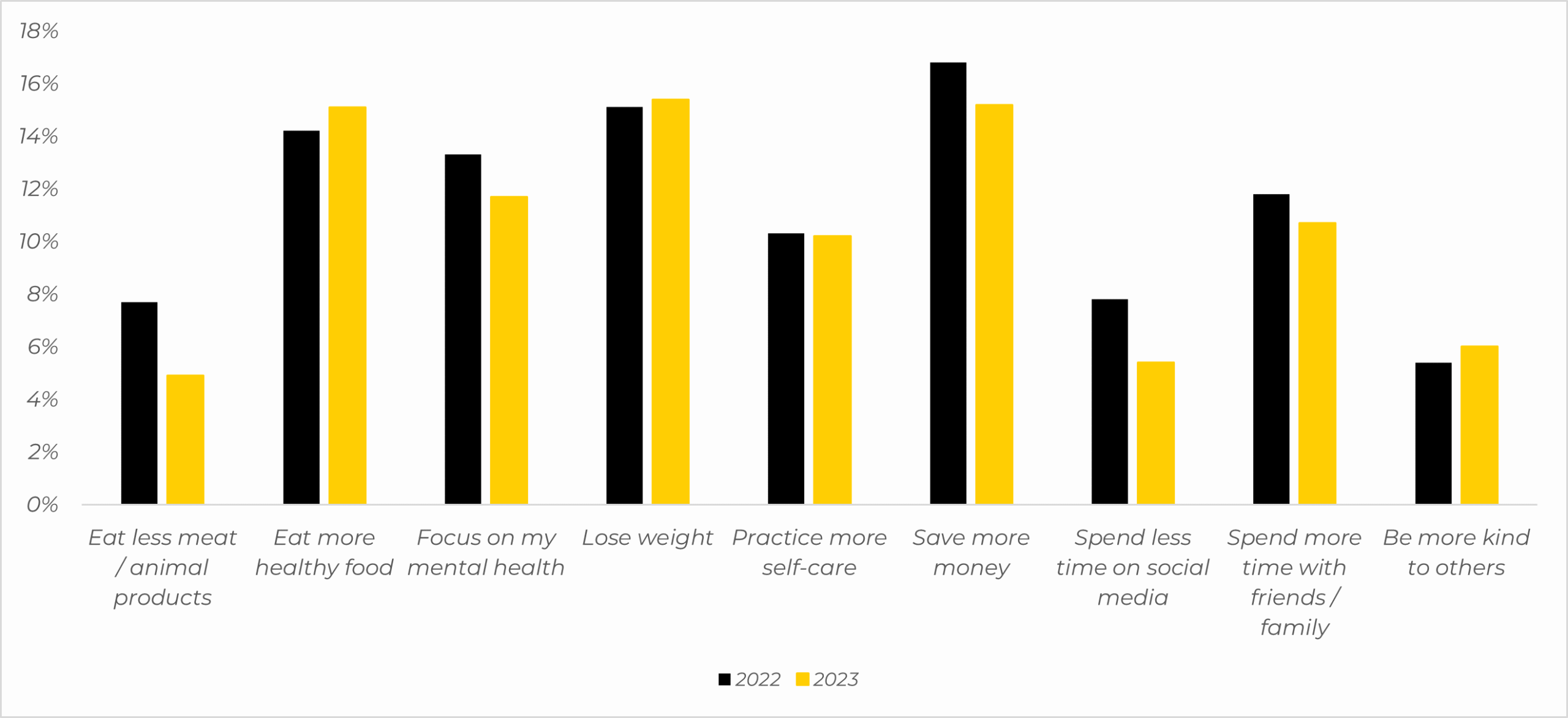
he number of consumers making New Year’s Resolutions in on the decline. Those consumers who don’t usually make resolutions, but did so for 2022 and 2023, is down from 14% to 12%. The pressure mounting on consumers, especially financially, means they are increasingly avoiding adding to this pressure, and this includes making resolutions. They are thereby preferring to either avoid resolutions altogether or choose more achievable goals for the upcoming year. This is reflected in GWI’s December 2022 Zeitgeist with resolutions such as ‘be kinder to others’ and ’watch less TV’ are more popular when compared to goals for 2022.

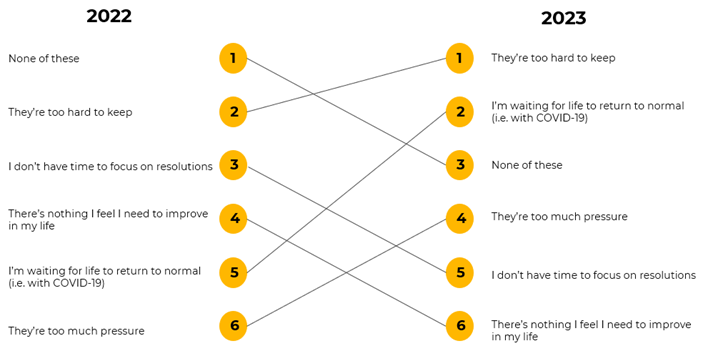
When looking at the reasons why consumers aren’t making resolutions, in comparison to last year, the fact that they are difficult to keep has become the top reason, with the reason that they’re too much pressure also creeping up the list. This reaffirms the view that there’s a trend of consumers wanting to be realistic, both if they are making resolutions or not. Consumers also want a degree of normality to be in the headspace to make new resolutions. Whether it is the pandemic or a financial crisis, an unpredictable UK landscape continues to turn consumers away from embarking on new resolutions.

You said you’re not planning to make any New Year’s Resolutions for 2022/2023. Why is that?

Source: GWI November 2021 Zeitgeist, December 2022 Zeitgeist, New Year’s Resolutions, Location: UK

Rank based on the % of reasons for not making resolutions


why no resolutions
Source: GWI November 2021 Zeitgeist, December 2022 Zeitgeist, New Year’s Resolutions, Location: UK

While consumers may feel more positive about this year, without fear of multiple lockdowns and an inability to travel abroad, consumer aspirations for saving money have dropped with economic attitudes looking negative. The rise in the cost of bills, groceries, and mortgage rates as well as the continued desire to travel and make the most of post-pandemic life have diminished a lot of consumer positivity towards saving money throughout the upcoming year.

In the next 6 months, how do you think the following will change?

16% believe that the economy will get better

65% believe that the economy will get worse

26% believe that their personal finances will get better

Source: GWI, Wave: Q3 2022, Attitudes: Future Outlook, Location: UK

To still feel a sense of success and personal growth, 2023 looks to be the year of achievable goals. Resolutions such as eat more healthy food, lose weight, and drink less alcohol have increased since 2022 as consumers want to improve their lifestyles in a realistic and affordable way.

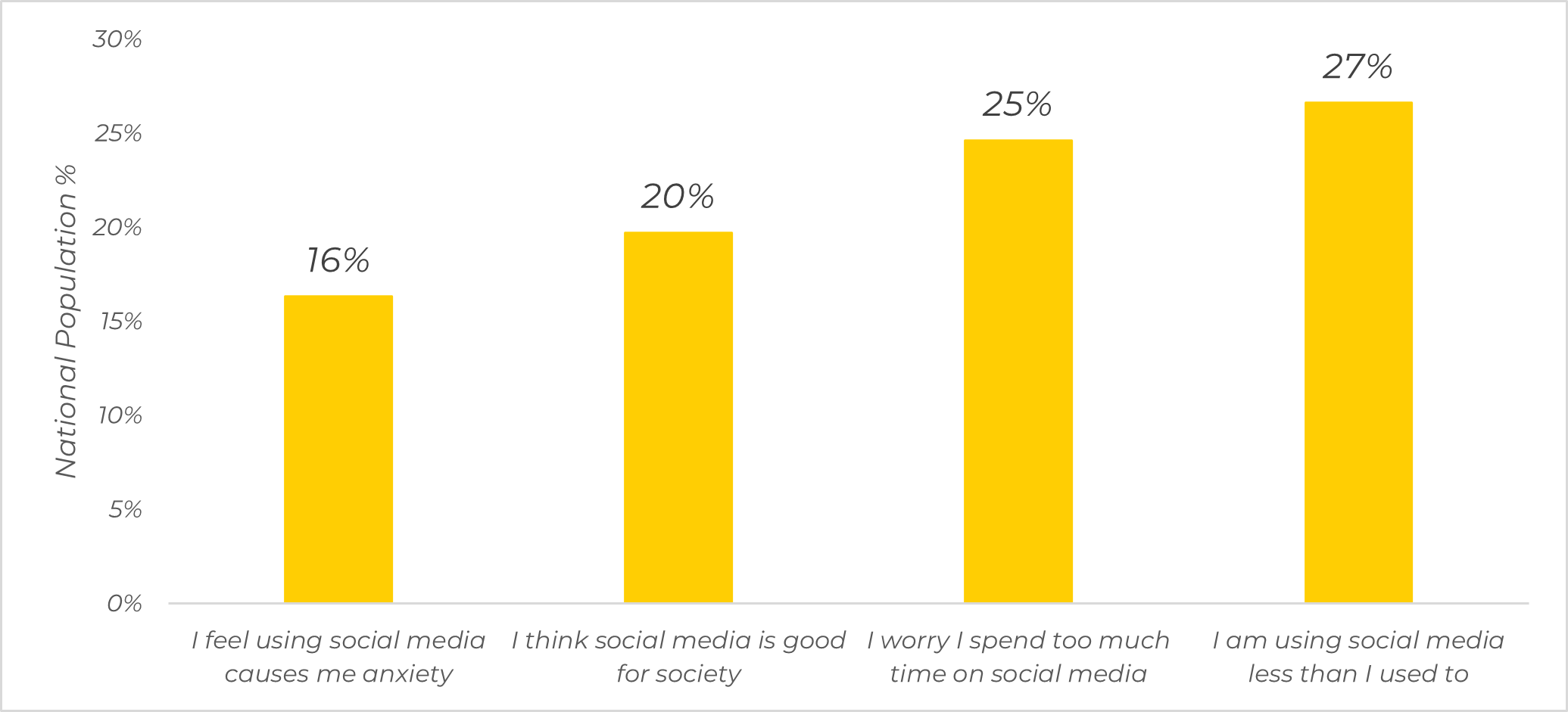
This attitude is also reflected in the intentions towards social media usage. Even though scepticism towards social media is on the rise, with just 20% of the UK population believing that social media is good for society, the resolution to spend less time on social media has declined from 8% to 5% of UK consumers. People are realistic and know that the likelihood of spending less time online is a lot lower than eating more healthy food and upping their exercise.

How do consumers feel towards social media?

social media views
Source: GWI, Attitudes: Tech & Trends, Wave: Q3 2022, UK

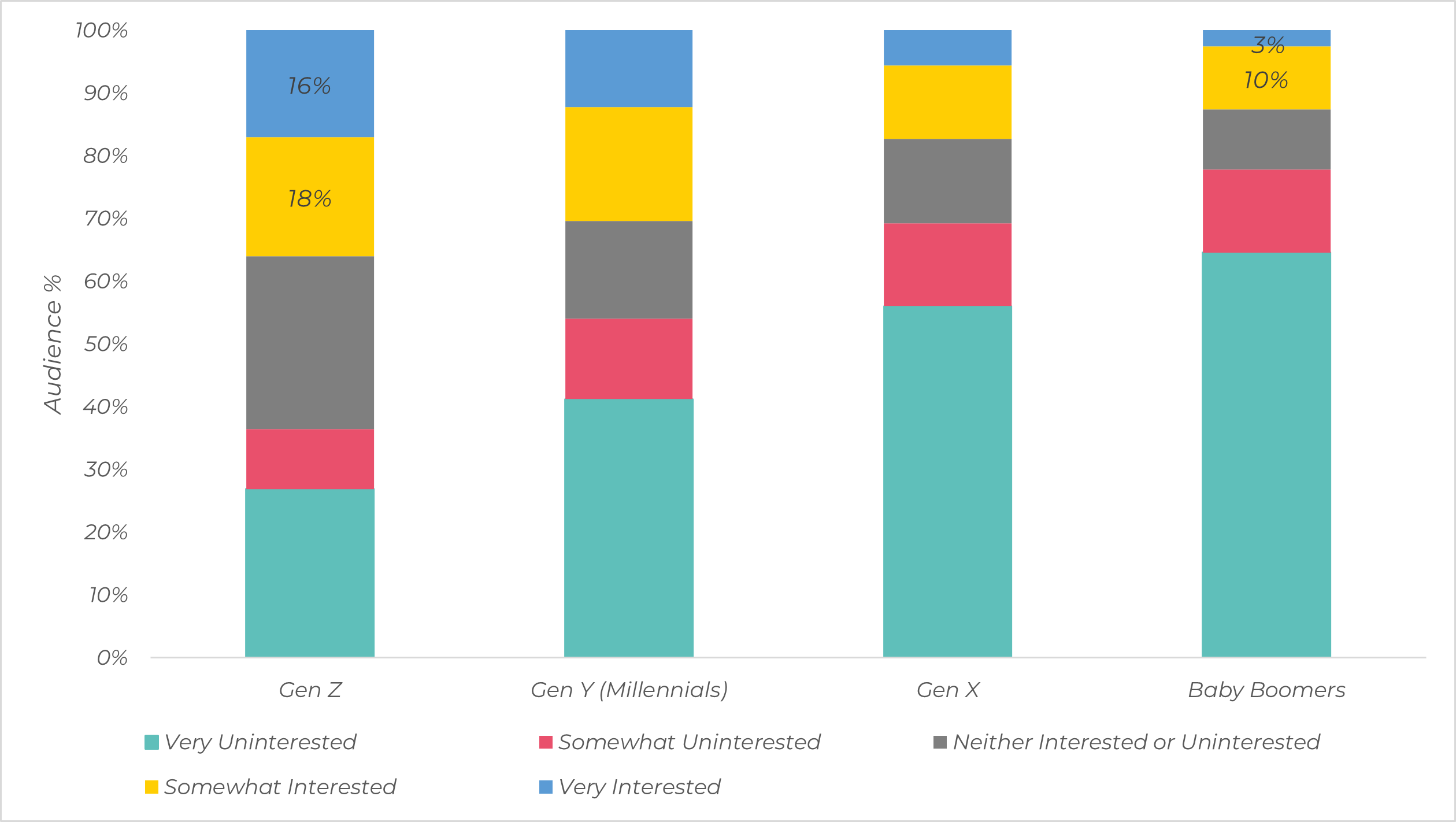
Surprisingly, a fewer number of consumers are planning on going vegan or eating more vegan food this year. In comparison to 2022, those planning on eating fewer animal products has dropped by 36%. In addition to this drop, just 19% of Britons are interested in challenging themselves and trying Veganuary, with Gen Z and Gen Y making up the majority of those likely to try and go plant-based. As consumers are prioritising their finances and protecting their disposable income more than ever, the perception of veganism as an expensive lifestyle change has come to the fore, with consumers choosing to pursue seemingly more achievable goals to reach a healthy lifestyle.

Are you interested in participating in Veganuary in 2023?

interest in veganuary
Note: Respondents are currently not vegan | Source: GWI, December 2022 Zeitgeist, Interest in Veganuary –UK

What does this all mean for marketers as 2023 starts to gather pace?

As we have entered the new year, consumers are fragile, financially conscious and in need of reassurance and support. The prioritisation of health and the protection of finances shows what consumers are caring about as we have entered 2023. Healthy lifestyle shifts are always front-of-mind as we enter a new year but with a tough year for many ahead, Brits are being careful to set achievable goals.

By making your brand helpful, whether this is through advice, supportive messaging or deals and discounts, will not only be appreciated but also assuredly win consumer favour. These attitudes mean that consumers are keen to focus on mindfulness, self-care, and health and wellness. If brands can help with this for free, that’s even better. Focusing on small and achievable activities such as sharing content on healthy recipes, the best reads or even the picturesque places to go for walks can help consumers with the realistic goals and sense of achievement that they are looking for this year.

The question now is, how many of us will stick to our resolutions this year, and for how long?

A version of this article is featured on The Drum.

Valentine’s Day 2023: Financial Realism or Spending Big – How are consumers approaching Valentine’s Day this year?

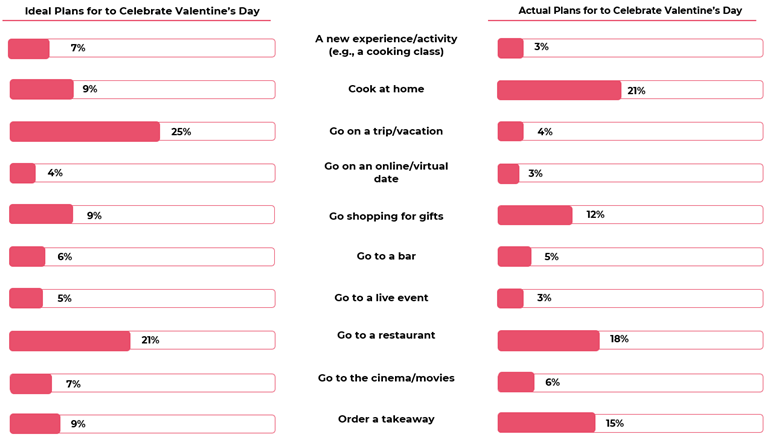
It appears that, perhaps in the midst of geo-political turmoil and financial struggles, Brits have largely fallen out of love with Valentine’s Day, as 45% of consumers are not celebrating this year. Despite this, as we look at those who do wish to celebrate their loved ones or friends, we can gain an understanding into current consumer priorities and attitudes. Through analysing ideal plans versus actual plans, financial concerns are stopping British consumers from celebrating Valentine’s Day how they would really want to this year.  

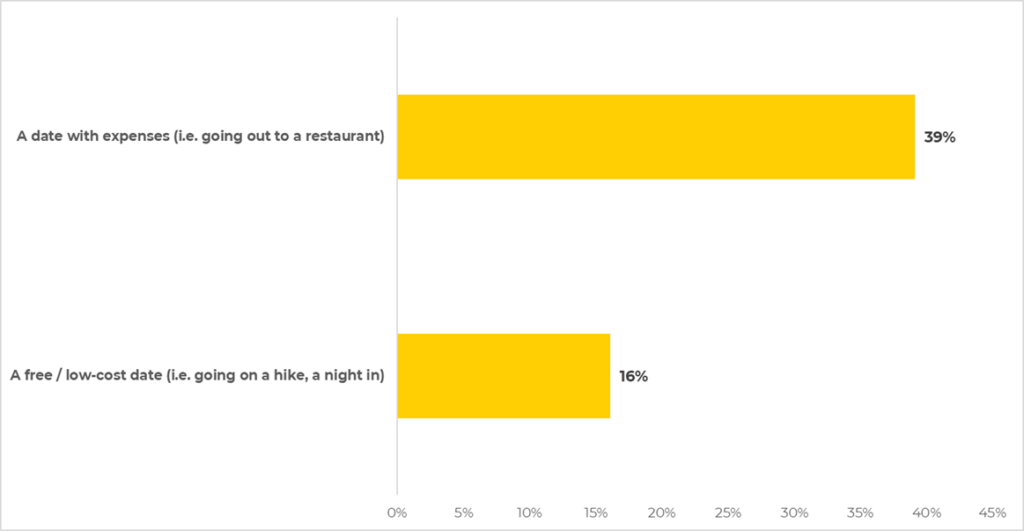
Graph 1.pngIf money was not an issue, which of these would you prefer to go on? 

Source: GWI January 2023 Zeitgeist, Valentine’s Day, Ideal date to go on, Q3 2022, UK 

British consumers want to spend this Valentine’s Day. In a world with no financial concerns, 39% of consumers would prefer to pay for a date, including going to a restaurant or bar, while only 16% would be happier with a free or low-cost date. Despite this intent, when we look at desired versus actualised plans, the reality is that lower cost date-nights are taking priority this year.  

A desire to travel remains a priority at the forefront of consumer mindsets, even on Valentine’s Day. 25% wish to go on a trip or vacation to celebrate this year but actual plans show that this is only realistic for 4% of consumers. More affordable plans are the most popular choices with lower-cost dates like cooking at home, going to a restaurant, and ordering a takeaway looking to be the way that most Brits choose to celebrate.  

Graph 2.pngIf money was not an issue, what would be your ideal way to celebrate Valentine’s Day? 

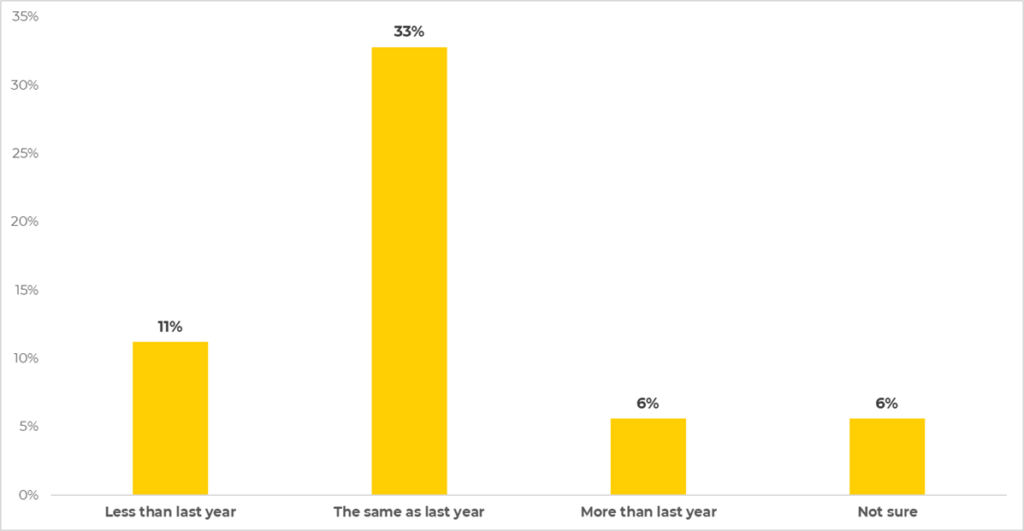
Source: GWI January 2023 Zeitgeist, Valentine’s Day, Ideal Plans to Celebrate Valentine’s Day, Q3 2022, UK These attitudes to spending on Valentine’s Day appear to be long-term shifts in consumer priorities. Intentions surrounding spend mirror those of last year as 33% look to celebrate in a similar way and just 6% see themselves in a viable position to spend more.  As 11% are going to be spending less, it appears that there is even more financial unease in the air and consumers are more money conscious.  Graph 3.pngCompared to last year, how much do intend to spend on Valentine’s Day this year? 

Source: GWI January 2023 Zeitgeist, Valentine’s Day, Q3 2022, UK In an ideal world, consumers want to take the opportunity to experience new destinations or exciting restaurants to celebrate their loved one. Despite this, actual plans tell us that consumers are intent on being realistic and personal finances are just too much of a current concern for Valentine’s Day to be a big-spending event this year.  

We know price is king, but what other brand and product attributes are attracting consumers in 2023?

The current market landscape offers an abundance of brands with a range of products or solutions for any one thing. Brands have a multitude of channels at their disposal to market themselves, with an ability to convey highly personalised messaging, call-out their niche innovations or offer discounts, loyalty schemes and free delivery. Brands need to cut through this saturated market in a period when consumers are being careful with their finances.
So, aside from cheap prices, what do shoppers genuinely want from brands? And how can brands leverage these purchase drivers to appeal to consumers?Picture1.png

The Value of Convenience

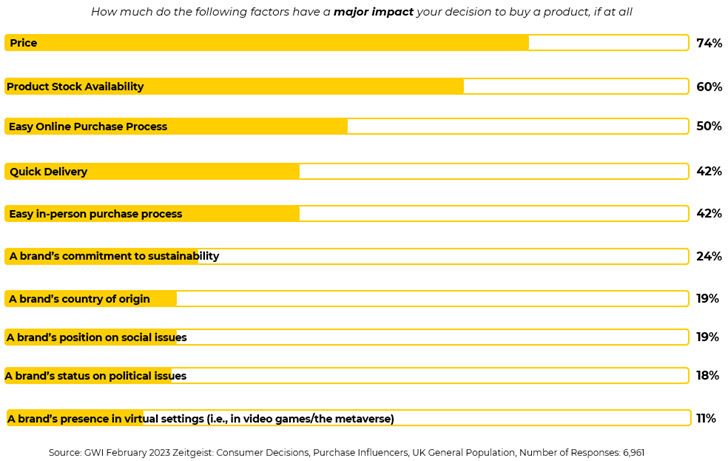
When it comes to making purchases, price is undoubtedly and unsurprisingly king for well over half of UK consumers. Despite this, the lives of everyday working Brits are busy and if a brand can offer convenience across a customer’s purchase journey, it’s a sure way to win consumer favour. Whether the product is in stock ranks closely behind price when it comes to the top purchase influencers for brands, keeping those shopping feeds up to date will be paramount. Consumers do not want to waste time. An easy online purchase process, quick delivery as well as an easy in-person purchase process are key factors for around half of UK consumers, so user experience and efficient delivery services need to be priority investment channels.

Amazon are a key example of winning big by providing customers convenience at every stage of their purchase journey. From offering a large range of low-price products to providing same or next day delivery at little to no cost, Amazon’s consumer-centric strategies keep their brand front-of-mind at the start of almost every buyer’s journey. Their customer-first approach to ecommerce has without a doubt played a large role in their reported net sales of over 149.2 billion USD in the final quarter of 2022.

Despite all the chatter about the Metaverse, only 11% of Brits cite a brand’s presence in virtual settings as a deciding factor. As inflation drives the price of products up and disposable income is squeezed, consumers are more likely to spend their money with a sense of security. The recent decline of NFTs, with sales dropping 83% from 2022-2023, shows how consumers are preferring to stick to reliable purchases. Brits want to spend without risk and avenues like the Metaverse or NFTs are not currently filling consumers with reassurance.Picture2.png

The Appeal of ‘Green’ Brands

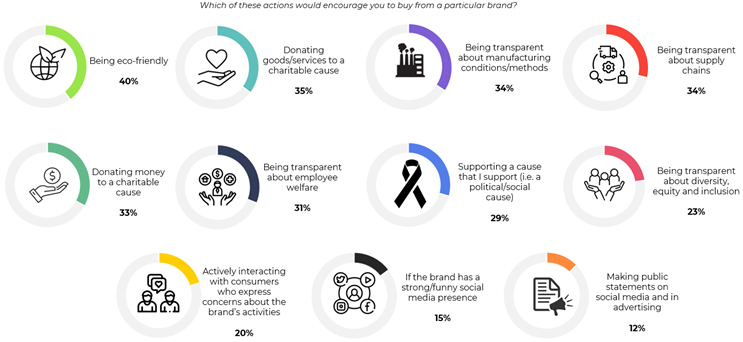
We know price is the top purchase consideration, but not all brands have an ability to simply lower their prices to compete, especially if a commitment to sustainability tops their agenda. But environmentally friendly brand actions can be key in acquiring new customers.

Awareness of over consumption and its detrimental impact on the environment has resulted in ‘being eco-friendly’ as the leading brand action for almost half of UK consumers. This mentality has driven the desire for brand transparency with a third of consumers wanting clarity across manufacturing conditions/methods and supply chains. As personal finances are stretched, trends of conscious consumerism and prioritising quality over quantity have emerged. Brits want to know that their money is being well spent on a quality product from a brand that operates ethically and sustainably. To drive awareness of these practices, brands do not need to shout across their socials as only 12% of shoppers cite public statements across socials and advertising as purchase drivers but, brands need to be sure to follow ethical and sustainable practices and convey them in their content.

Patagonia put protecting the planet at the centre of their ethos with their prioritisation of purpose over profit. Their use of recycled and ethically sourced materials means that their price point is not cheap, but this does not deter customers. Their genuine commitment to eco-friendly practices and quality clothing appeals to those looking to avoid fast-fashion and make long-term investment purchases.

A Shift towards Social Responsibility and Locality

The emergence of conscious consumerism and desire for brand transparency showcases how a brand’s commitment to social responsibility is a top consumer consideration. Consumers want to invest in a quality product from a brand that cares about social causes and employee welfare. These prove to be crucial brand actions as over a third of Brits want to purchase from a brand that makes charitable donations and for 31%, transparency surrounding employee welfare is important.

Patagonia might also be industry leaders across social responsibility but as are Ben & Jerry’s, proving that global brands can still hit the mark when it comes to social causes. To raise awareness of issues such LGBTQ+ rights, climate justice or voting rights, Ben & Jerry’s partner with non-profits to build support with its customers. Their foundation also regularly donates to businesses that facilitate social change. Consumers are often willing to pay more for a product, and the purchase tends means more, if they are supporting a business who take social responsibility seriously.

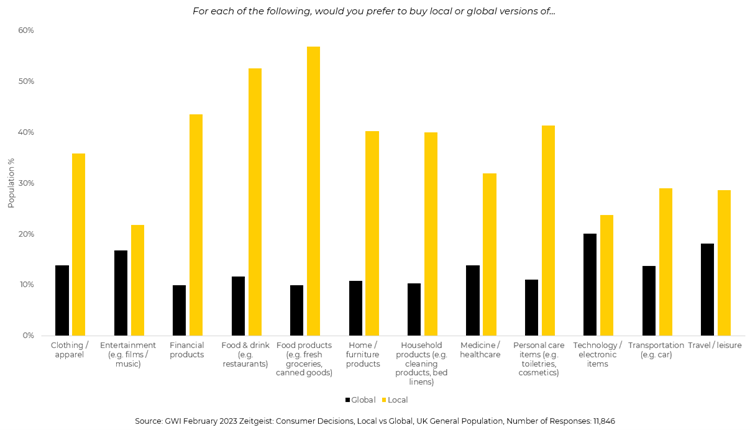
This also extends to the rising trend of locality as consumers look to prioritise purchases made in the UK versus those made globally.Picture3.pngAcross all purchase groups, consumers are preferring to shop local. Food is the number one area where shoppers are prioritising locality with over 50% seeking out UK food products. Brits are keen to consider where their purchases are coming from, seeing food as a key sector where they can shop consciously. Technology, entertainment, and travel are purchase areas where we do see a higher number of consumers preferring products made outside of the UK but even across these areas, local remains the priority.
We all know price is the most important purchase factor, but it is not the only consideration for consumers. Brands can still win by giving customers what they want: convenience and a commitment to sustainability and social responsibility. Almost half of Brits want to shop from brands that are eco-friendly and a third want transparency about supply chain and production methods. This does not mean that brands need to start making frequent public announcements of their sustainable production methods or their prioritisation of UK products but, if a brand’s approach can be conscious and environmentally aware, it will be a key driver in attracting new customers this year.Reach out to our Insights team here.

What makes a good Insight, and how can AI help us generate more of them?

Following TIPi Group’s recent Shaping the Future event in which the subject of how emerging AI tools can be used in digital marketing was explored, Jamie Ross-Skinner provides an overview of his presentation on using AI for market research and whether ChatGPT can generate a ‘good’ insight.

What makes a good Insight?

Advertising legend Jeremy Bullmore once asked; ‘Why is a good Insight like a refrigerator?’ 

The answer is, of course, ‘Because the moment you look into it, a light comes on.’ 

I agree with Jeremy: good Insights should illuminate.  

We live in a world where we’re inundated with so-called ‘Insights’. They’re fired out by media owners, agencies, ad platforms, and LinkedIn gurus, landing in our inboxes with disconcerting frequency. 

But I would argue that most of this content barely qualifies as an ‘Insight’. So, what actually is an Insight? Let’s start with defining what it’s not… 

Research is not  Insight. But an Insight is usually the product of research.   

Data is not Insight. But an Insight is usually informed by data. 

An Insight is, again to quote Bullmore, ‘A new understanding, probably of human behaviour or attitude, as a result of which action may be taken and an enterprise more effectively conducted.” 

A good Insight must fulfil four criteria; they must be True, Original, Memorable and Actionable.  

If your Insights are meeting these criteria, they’re likely to inspire great strategies which, if executed correctly, will lead to excellent results.

Can ChatGPT generate good Insights?

So now we know what a good Insight is, we can now investigate ChatGPT’s ability to generate them. 

Simply asking ChatGPT questions is not a good way to do research. As a language model, not a research tool, ChatGPT returns answers that sound right but are often not actually correct.  

It falls short on all four of our criteria for generating great Insights: 

  • It fails to Be True by returning factual inaccuracies.  
  • It fails to Be Original because it is only able to reorder the content that it has ingested.  
  • It fails to Be Memorable by being overly verbose.  
  • It fails to Be Actionable, by falling short on the three above criteria. ChatGPT Insights could be actioned, but if they’re not True in the first place then it is not recommended.  

The level of plausibility lent to its answers by the quality of the language with which it responds is dangerous, so, we advise you to avoid thinking of ChatGPT as a search engine or research tool – instead, think of it as a writing tool.

The role of AI in Research and Insights

ChatGPT and AI more broadly may not be able to generate killer Insights quite yet, but they can be used as valuable research assistants and are well suited for labour-intensive tasks such as Localisation, Data Cleaning, Survey Programming, Analysing Qualitative data, and Social Listening. 

Brands are already leveraging this technology. L’Oréal, for example, have developed an AI system that analyses millions of online conversations, images, and videos from 3,500 online sources including social platforms, cosmetic-focused online publications, and blogs. It unearths new trends so that L’Oréal’s innovation and marketing teams can stay in-touch with consumers ahead of competitors. (source) 

In conclusion, AI can help us uncover more great Insights  

AI is not about to take our jobs, but it is useful for repetitive, time-consuming tasks and helping us to crunch data. For now, it is all about embedding AI into existing tools and processes, allowing more data to be gathered and analysed, at lower cost and faster speeds. 

If we do this right, it will allow us more time and mental bandwidth to provide real value with great Insights. If you would like to learn more, please reach out to the Insights team here. You can also sign up for our newsletter here and follow us on LinkedIn and Twitter.

Stop Scrolling: Is YouTube Officially the Most Versatile Social Channel?

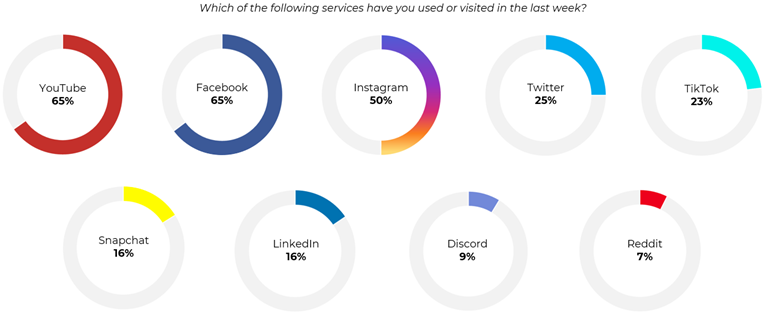
The average European consumer spends just over 2 hours per day on social media. Long periods of scrolling through a range of content have become the norm, making social an essential channel for marketers to leverage at all stages of the marketing funnel. Despite YouTube being the first social platform to gain real traction in the 2000s, when we now think of ‘social media’, our minds tend to jump to the likes of Facebook and Instagram and increasingly TikTok. But the vast range of content on YouTube has enabled it to remain consistent in its popularity, usage and in terms of both the most used platforms and which platforms offer users the most diverse content, YouTube comes out on top.YouTube sits in a unique position. It is often classed as a video service due to video being the sole content type on the platform, but social media, as defined by the Oxford English Dictionary, includes ‘websites and applications that enable users to create and share content or to participate in social networking’, YouTube can undoubtedly be classed as a social network as well. The platform provided the first real content creators and whether YouTubers and influencers are now sharing reviews, vlogs, clothing hauls, or tutorials, the creation and sharing of content are at the centre of the platform. So, while some aspects of YouTube do fall into video services rather than social media, it has the core characteristics of a social platform – content creation from users, interaction, and personalisation.Picture1.pngSource: GWI April 2023 Zeitgeist, Social Media Platforms, Europe, Number of Responses: 13,460When it comes to the most visited platforms over a weekly basis, European consumers find themselves using YouTube the most, with Facebook a close second. Usage does differ between generations with Gen Z and Millennials using Instagram the most while Gen X and Baby Boomers are more likely to have visited Facebook. Despite these demographic divergences, with content matching all types of search queries, YouTube usage is high across the board.
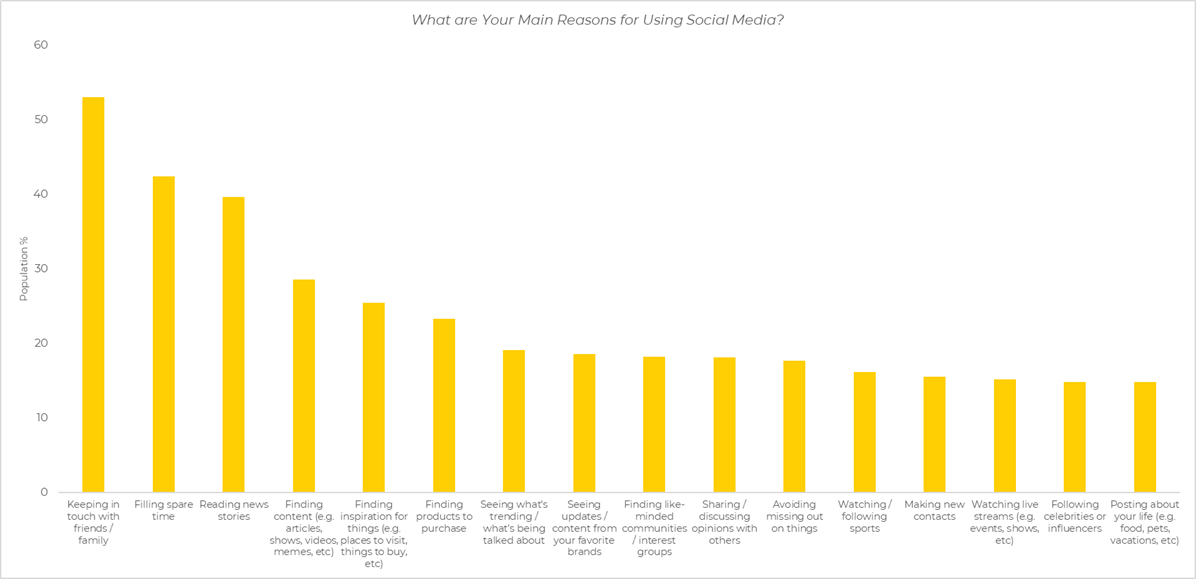
YouTube’s position as the most used platform is perhaps more impressive when we examine what consumers use social media for. For over half of Europeans, they want to stay in touch with friends and family, which is why photo sharing platforms like Facebook and Instagram are both popular and accessible for all generations. TikTok has become synonymous with sharing funny or interesting content with loved ones and friends for Gen Z in particular. YouTube is not such a natural platform for communication with friends or family, especially in comparison to the likes of Facebook or Instagram, but it’s the range of content that keeps users engaged with the platform.Picture2.pngSource: GWI Core, Wave: Q1 2023, Reasons for Using Social Media, Europe, Number of Responses: 1,030,418Yes, consumers do want to use social media to keep in touch with friends or family but filling spare time is also a top driver for social media usage, and this is where YouTube shines. Data from GWI’s latest zeitgeist on ‘Social Media Vibes’ gives us additional insight into what type of content consumers actually want from the main social platforms they use, and we can therefore understand why YouTube has stayed at the forefront of the social channels.
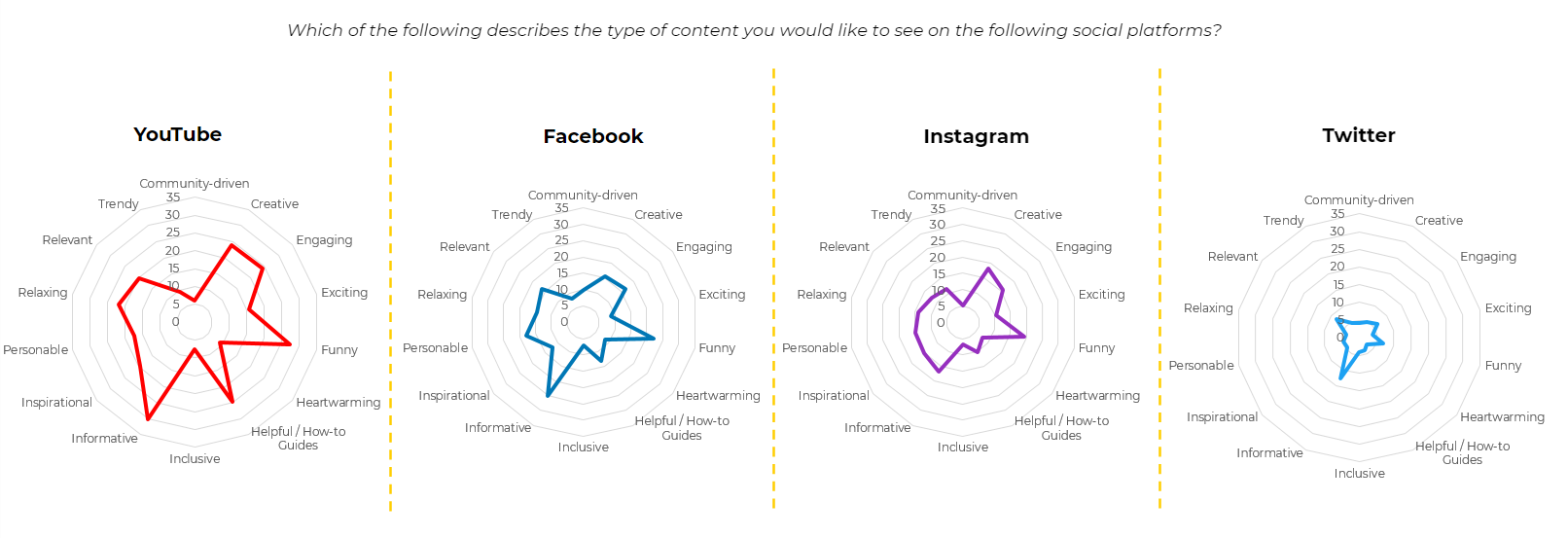
Content is what fundamentally drives consumers to social media and in the case of YouTube’s popularity, it comes down to the range of content on offer. Consumers might turn to Instagram or Pinterest for clothing and lifestyle inspiration and TikTok for funny content but whether its content from prominent vloggers or someone else entirely, YouTube ticks all the content boxes. Users want informative content when they access almost all the social platforms and just under a third of Europeans expect this from YouTube. As well as this, 28% expect funny content, 25% turn to the platform for helpful/how to guides and 24% like the engaging and creative content on offer. Instead of sifting through the various platforms, no matter how engaging or funny the content may be, users like the convenience of YouTube’s never-ending array of material.new-picture.pngSource: GWI April 2023 Zeitgeist, Social Media Vibes: YouTube, Facebook, Instagram and Twitter, Europe, Number of Responses: 13,460For brands creating content and running ads on YouTube. It is important to think about not only who is using the platform and how often, but also why they are using it. Whether your audience are there to learn, laugh, or simply relax.

Find the mindset you’re trying to tap into, and then create content which complements it.

What does this look like in practice? It looks like Nissan’s four hour long lo-fi mix to promote their new ‘powerfully peaceful’ Ariya model.

There are millions of different reasons people come to YouTube, so there are millions of contexts that brands can target. Our advice would be, don’t try to target them all at once.

Sources

GWI Core, Social Media Attitudes and Behaviours

GWI 2023 Zeitgeist: Social Media VibesIf you would like to learn more, please reach out to the Insights team here. You can also sign up for our newsletter here and follow us on LinkedIn and Twitter.