Reactive PR: Why is it important for brands to be on the ball?

The latest data from Global Web Index suggests that the COVID-19 pandemic has led two thirds of consumers to increase their news consumption. As consumers gravitate towards news content the brands with the strongest PR strategies are staying front and centre in consumers’ minds. In an ever-shifting news landscape, being agile is critical and brands who are adapting their messaging with reactive PR campaigns, newsjacking and social commentary strategies are keeping consumers engaged.

What is the public perception of brands at the moment?

In a recent survey conducted by Censuswide, 58% of the British public said that the way a  brand is acting at the moment is impacting their purchasing intent – some going as far as to say that the way brands behave now will impact whether or not they buy from them in the future, too. This suggests that there is the potential for serious long-term impact for brands, if they don’t react appropriately to the crisis. People are looking to brands to spread some positivity and lead the charge. People want to see that brands understand and are spreading the message that this is a crisis to be taken seriously, by everyone.

How are brands reacting to Covid-19?

But what does a brand reacting to the current global pandemic look like? Not all brands can afford to launch a global relief campaign or donate products to our NHS heroes. A brand being reactive to the situation can be effective on any scale – but the worst thing a brand could do is nothing. Nearly 50% of Brits said that they would trust a brand less if they were to ignore the current situation, not reacting at all. It’s not BAU for anyone and by not acknowledging that things are difficult right now, brands could be significantly damaging their future.

So what makes a good reactive PR campaign at the moment? Ordinarily, brands can have some real fun when it comes to reactive PR, take KFC’s ingenious response to their nation-wide chicken shortage in 2018 (see below).
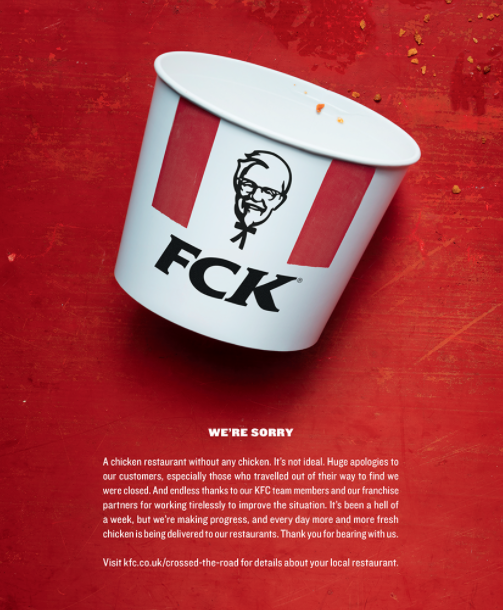
KFC react to news of a chicken shortage across the UK.

But during this time of uncertainty and stress, when a lot of people are losing loved ones and worried about the future, brands need to tread carefully when it comes to their reactions. And most are doing just that. Some of the world’s biggest brands have redesigned their logos to abide by the new social distancing rules, not only showing the world that they are taking the crisis seriously but also engaging consumers with their brand ingenuity. The likes of McDonalds, Coca-Cola and Zara have all done it; Zara’s newly socially distanced logo playing out alongside a reminder about the importance of social distancing when you open the app, with Coca-Cola doing the same with a huge billboard in Times Square (which people are being encouraged to share on social, not go and visit in person!)

View this post on Instagram

Respecting social distancing but staying closer than ever

A post shared by ZARA Official (@zara) on


Coca-Cola rebrand with a huge billboard in Times Square to encourage people to social distance.

But what about smaller brands who don’t have those budgets?

These are great examples of brands reacting to situations that will really resonate with people, staying at the forefront of consumer’s minds when the normal day-to-day triggers brands use to initiate sales aren’t available. But even when we’re not in times of crisis, consumers want to engage with brands who have strong brand personalities, to feel as though they know the brand better and are part of its story. And this kind of reactive strategy isn’t just a huge benefit to a brand story, but to SEO as well and something that can be implemented by brands of any size.

Through establishing a quick-fire reactive newsjacking strategy and a strong rapport with consumers on social, a brand can secure links and coverage on high authority sites and publications, offering expert comment and advice on topical issues and events, supporting the technical website rankings but also solidifying that consumer engagement by being conversational and interested in the same things consumers are. And most importantly – engaging with them. This is a great strategy for smaller brands who want to respond to something – whether it be Covid-19 or something less sinister – and to do it in a way that continues to solidify their brand image. You don’t need the global reach to do that – you just need to be reactive to – and conversational with – what’s going on.

Take London’s Crosstown Doughnuts – usually supplying London’s hungry office workers with tasty treats for meetings and afternoon lulls, their demand fell by the wayside when work from home rules were introduced. So, adapting to the conversations around them, they took a U-turn in their business offering and teamed up with local food suppliers, taking advantage of their delivery structure to deliver essential foods instead. The Crosstown Collective now delivers eggs, dairy, bread and fruit and veg, pivoting their business to react to the crisis and staying relevant.


Stay relevant in the right way

So by staying on the ball and ensuring that your brand is talking to your consumers, acknowledging in the news the same things that a consumer is reading about, a brand can earn loyalty from their consumers – a loyalty that pays its dues in a time of crisis. These are tough times for any brand but all brands, no matter how big or small, can use reactive PR methods to stay relevant in the right way: spreading the right messages and by doing so, staying on the right side of public perception.
Want to read more about Digital PR? Try our recent blog post on How to PR a brand no one has ever heard of, with Content Marketing

Organic Discoverability Framework: Connecting SEO, GEO, Content & Digital PR

As consumer journeys become increasingly fragmented across traditional search, social, AI platforms and peer-driven recommendations, organic visibility is no longer an SEO-only challenge.  

At brightonSEO, Haider Ali, Head of Organic Performance at ROAST, spoke on how brands can build visibility through the Organic Discoverability Framework better connecting organic channels from GEO, Digital PR, Content and Technical SEO. 

Download the Organic Discoverability Framework

Why Organic Discoverability Matters More Than Ever 

Organic discovery has changed. 

Take your average researcher. He’s watched the London Marathon and now he’s decided to take up running. He’ll do a search for running shoes, which might start on Google, then comparing recommendations on social, validate reviews in forums, explore AI-generated answers, then convert days later through a completely different touchpoint.  

That growing complexity means discoverability is no longer just about ranking in search. It is about ensuring your brand appears consistently across every organic touchpoint that influences decision-making. 

For brands still treating SEO, content, Digital PR and social as separate workstreams, that creates a clear gap. 

Organic Growth Cannot Happen in Silos

A core theme from the session was the need to align organic channels. 

Technical SEO remains the foundation. Without strong crawlability, indexability and site health, visibility becomes harder to scale. 

Content and Digital PR help brands build authority, surface in relevant searches, and create stronger audience relevance. 

Social plays a key role, extending reach and supporting discoverability, particularly as younger audiences increasingly adopt social-first search behaviours. 

GEO also becomes stronger when foundational organic signals are in place. Strong technical SEO, authoritative content, digital trust and external visibility all contribute to stronger AI visibility and citation share. 

Growth compounds when channels support each other instead of operating independently. 

A Practical Framework for Discoverability 

The Organic Discoverability Framework that Haider introduced in his talk focused on six factors that brands should assess before scaling activity: 

  1. Demand: Is there genuine interest in the area you are trying to grow? If not, can social or Digital PR help create it? 
  2. Winnability: Is the opportunity realistic, or is the space dominated by stronger institutional or competitor visibility? 
  3. Indexability: Are technical issues preventing content from being discovered? 
  4. Visibility: Are you appearing in the channels that matter most to your audience? 
  5. Differentiation: Do you have a clear, consistent message that separates your brand from competitors? 
  6. Social Proofing: Are reviews, sentiment, and external conversations strengthening trust or weakening it? 

Together, these factors create a stronger view of where visibility gaps actually exist for brands. 

Better Measurement Drives Better Decisions 

Another key point was measurement. 

Organic reporting often stays too narrow, relying heavily on clicks and impressions but as discoverability becomes more fragmented, brands need a wider lens. 

Here are four things that should be incorporated into organic reporting: 

  • Have an overall organic forecast bringing in your Digital PR, social and content teams all aligned to the same KPI’s and forecast  
  • GEO visibility and citation tracking  
  • Testing to isolate impact  
  • Layering SEO, referral, direct and brand data into one clearer view of growth  

The goal is not more reporting. It is better strategic decision-making. 

What This Means for Brands 

Organic discoverability is increasingly a business growth issue, not just an SEO challenge. 

As users move between search engines, social platforms, AI tools and trust-based communities, brands need connected strategies that reflect how discovery now happens. 

The strongest opportunity lies in aligning channels, improving measurement and building visibility where audiences are already searching, comparing and validating. 

Key Takeaways 

  • Organic discovery now spans search, social, AI and peer-led channels  
  • SEO, content, Digital PR, GEO and social should support one another  
  • Visibility should be measured beyond rankings and traffic  
  • Trust, differentiation and consistency are becoming stronger growth drivers  
  • Discoverability is now a strategic marketing challenge, not a siloed channel issue 

Contact us about Organic Performance services.

Contact us

ROAST Appoints Nicole Palmieri as Head of Digital PR to a Lead AI-First Generative Engine Optimisation (GEO) Offering

Independent Performance Media agency ROAST has announced the appointment of Nicole Palmieri as its new Head of Digital PR.

Nicole Palmieri joins to lead a specialist Digital PR department, specifically designed to navigate the shift from traditional link-building to the era of Generative AI and LLMs (Large Language Models). Palmieri joins ROAST following a highly successful tenure at Rise at Seven, where she transitioned from Digital PR Strategist to Head of International PR. During her time there, she scaled the international department, overseeing multi-market strategies for global brands including Sixt, Wayfair and SharkNinja.

With a career spanning global media across multiple sectors, including luxury fashion at Farfetch, Palmieri brings a unique blend of journalistic storytelling and technical SEO expertise.

John Barham, Managing Partner at ROAST said: “Nicole’s appointment is an exciting one and marks a strategic move for us to more tangibly integrate Digital PR into our organic structure, moving beyond legacy static search models toward GEO.”

The new department will leverage ROAST’s internal innovation team, working alongside ROAST’s Head of Innovation, John Campbell, to utilise proprietary AI tools. This collaboration allows the agency to fuse high-level storytelling with data-driven technology, ensuring clients remain at the centre of trending conversations.

AI is redefining the rules of Digital PR, particularly in how brands surface across generative search,” says Nicole Palmieri, Head of Digital PR at ROAST. “That’s what makes this the perfect time to launch our refreshed offering – one rooted in GEO expertise and designed for where search is heading, not where it’s been. We aren’t just pitching stories; we are creating brand authority for the AI era.”

By integrating with SEO, Paid Media, and Social Listening, Palmieri’s team will focus on multi-dimensional performance marketing, helping brands become the ultimate authority in their niche.

Palmieri adds. “By fusing our proprietary AI tools with high-level storytelling, we ensure our clients aren’t just part of the conversation – they are the source of it.”

The announcement of our Head of Digital PR was featured in several publications including Little Black Book, Marcomms News, PR Week, NewDigitalAge, Performance Marketing World and Affiliate Leaders. 

Digital PR is booming, but what is Digital PR? And why you can’t ignore it in the age of AI

What is Digital PR?

Digital (Digital Public Relations) is about earning authority, coverage and links by placing brands in the trusted sources people and AI look for answers. It is earned media that places your brand at the centre of conversations that matter, built on credibility rather than paid placement.

It has come a long way from what we used to call link building.

The old playbook was transactional: get a link, hit your link KPI, move on. The new one is strategic. We are building brands into credible, authoritative sources that journalists return to and reference, audiences trust, and AI systems recommend when answering queries.

How does Digital PR work?

The model is simple in principle and demanding in execution. We identify search behaviour trends, newsworthy moments, trending cultural conversations or proprietary client data which is valuable to journalists because they cannot access it themselves. We then craft a story so relevant or data-rich that publications want to cover it without being paid to do so because their readers are genuinely interested in it.

In practice, that means monitoring news cycles and social platforms for emerging trends, identifying angles that align with a client’s expertise or product offering, and building a story, a press release anchored in exclusive data, expert commentary or timely analysis.

From there, we construct a targeted list of journalists who actively cover that beat, pitch them directly, secure the coverage and report the results. Every stage of that process requires judgement and expertise of the media landscape. It is not something that can be templated and repeated. It’s also not a one size fits all approach. Every market is different.

One detail worth emphasising is that journalist lists must be rebuilt for every campaign. People move constantly, and a reporter who covered fashion at Vogue last quarter may now be writing travel pieces for Harper’s Bazaar. Recycling old lists is a reliable route to low response rates or worse potentially being blocked.

The right approach is to go directly to each publication, search the topic you want to cover, see who is actively writing about it now, and build the list fresh so it’s hyper relevant.

What is the difference between Digital PR and Traditional PR?

Traditional PR is built around broadcast, effective in a media landscape where attention is concentrated in a handful of (offline) channels, think about TV, magazines, radio and events. Success is measured in metrics that are sometimes hard to tie back to commercial outcomes, such as brand sentiment. Traditional PR focuses on the brand and what they want to share from a brand point of view, whereas Digital PR focuses on what’s newsworthy and what journalists want to cover and places the brand at the centre of that.

Digital PR bridges both, earning high-authority media coverage that drives traditional and AI search visibility, referral traffic, brand mentions and trust signals across the channels. When done properly, it supports SEO, GEO, brand positioning and commercial outcomes simultaneously, not as separate workstreams, but as a connected result of a combined strategy.

Digital PR builds authority in a world where audiences are fragmented across the web and where AI systems are synthesising that web to answer questions on their behalf. A brand covered in a high-authority online publication is not only reaching that publication’s readers. It is becoming part of the indexed, referenceable web that tools like ChatGPT, Google’s AI Overviews and Perplexity draw on when constructing answers. That is a fundamentally different value proposition.


Category Traditional PR Digital PR
Channels TV, radio, print, events, wire services Online news, blogs, podcasts, newsletters, social platforms
Measurement Circulation, reach estimates, AVE Links, brand mentions, referral traffic, keyword rankings, conversions
Audience Interaction One-directional broadcast Two-way: shareable, searchable, referenceable by AI

What kind of Digital PR Strategies are there?

Digital PR examples span a wide range of formats – data-driven reports that give journalists exclusive numbers they cannot source elsewhere, consumer surveys that tap into cultural attitudes.

Interactive tools and calculators that earn links by being genuinely useful, newsjacking and reactive commentary that positions a brand inside a breaking story.

Concept-led creative campaigns that spark emotion and generate coverage through sheer originality.

Reactive PR: Newsjacking and Expert Commentary

Reactive PR means moving quickly when a story breaks and reacting to it with unique insights.

A brand in the fashion space might offer commentary on sustainability claims trending on social media, or a fintech client might provide expert analysis when the Bank of England announces a rate decision.

The format is consistent: identify the trending moment, craft the angle, pitch within hours. Speed is essential, but so is genuine relevance.

Journalists receive more pitches than ever while working in smaller newsrooms, which means only commentary that is strategically aligned and genuinely useful cuts through. That requires knowing what a journalist has written recently, understanding their audience and delivering something they can use without significant additional work.

The Benefits of Digital PR

Done well, the digital PR benefits compound across multiple channels where their audience gets their information from.

  • Improved SEO/GEO and search visibility: earned links and brand mentions from trusted publications signal relevance and authority to search engines and LLMs at scale which improves their rankings and AI search visibility.
  • Enhanced brand awareness and trust: audiences are increasingly sceptical of advertising and more receptive to coverage that is earned rather than bought. When a trusted publication refers to a brand’s website it will signal credibility and trust to readers
  • Referral traffic with high intent: a reader who clicks through from a relevant article or publication arrives already engaged, with context and genuine interest meaning they are more likely to convert

Digital PR for GEO in the age of AI: Why it matters now

The most significant shift in digital PR strategy is not happening in newsrooms. It is happening in search.

AI tools like ChatGPT, Perplexity and Google’s AI Overviews are increasingly the touchpoint for consumer research, services and brands. These systems do not simply crawl links. They synthesise information from across the web, drawing on brand mentions, product reviews, listicles and expert commentary to construct their answers.

A brand that is rarely mentioned by credible third-party sources may be less likely to appear in AI-generated recommendations. Technical SEO improves discoverability, but external authority and reputation signals often play a major role in whether AI systems recommend a brand.

Google traffic is dropping and is being replaced by AI search, meaning that being ranked well in traditional search is no longer sufficient. Brands need to be referenceable by appearing in “best of” roundups, product review articles, expert commentary pieces and trend analysis, with journalists citing their data and mentioning their name in contexts that signal authority and relevance, often without a link at all.

Product PR has become a visibility strategy in the most direct sense: if a brand is not featured in the content that AI systems are indexing and referencing, it is invisible to a growing share of its audience at precisely the moment that audience is making a purchasing decision.

What good measurement looks like in Digital PR

Measuring digital PR by coverage volume or domain authority scores alone is no longer adequate, and clients are right to expect more.

The metrics that matter connect earned media to commercial outcomes, whether campaigns are driving visitors to the pages that actually convert, whether sales or leads can be attributed to specific placements, whether the brand is winning share of voice in the publications that reach its target audience, and whether there is a demonstrable uplift in rankings, traffic or engagement that can be pointed to when coverage goes live.

The difference between strategic digital PR and a vanity exercise is not the number of placements secured; it is whether those placements move the needle where it counts.

Digital PR integration is everything

When connecting SEO, GEO, Content, Social and Digital PR, the latter becomes a major driver of growth across multiple channels.

The rise of AI search makes this integration more urgent, not less.

The brands that will win in this new landscape are the ones being talked about, referenced and recommended, and Digital PR is one of the most powerful tools we have to make that happen.

ROAST’s approach to Digital PR

At ROAST, we start with understanding where a brand sits, its current backlink profile, their current AI visibility score, the publications that matter in its sector, and where competitors are earning coverage that it isn’t.

Every campaign is built around content that journalists want to cover: original data, expert angles and timely stories that earn placements without being paid for. Our team is made up of PR specialists and SEO strategists, people who understand what makes a story land and moves the needle in search. Increasingly, that means thinking beyond traditional search, as AI Overviews, ChatGPT and Perplexity pull from across the web to construct answers. Brands that appear in authoritative publications become the sources those systems reference.

Our digital PR work is built to earn the kind of coverage that signals credibility to search engines and AI platforms alike.

If you’d like to explore how Digital PR could work harder within your marketing strategy, get in touch with the team at ROAST.