
How to Use Ideal Customer Profiles (ICPs) for Keyword Research
An ICP-based approach to keyword research starts with the customer, not the keyword. Before building a keyword list, look at what the ideal customer searches for, how they search for it and where they search for it. Search volume, GSC metrics and intent still work as proxy metrics. ICPs decide which keywords matter in the first place.
What Is an ICP in SEO Keyword Research?
ICP stands for Ideal Customer Profile. In keyword research, building an ICP means answering three questions before opening a keyword tool: what they search, how they search, and where they search.
How Do You Build a Buyer Persona for SEO Keyword Research?
Gather Industry Understanding from industry reporting and behaviors from tools like GWI, also take a look at product offerings, gaps, and competition and finally social listening.
Find other behavior metrics such as internal data, this can be in the form of customer conversations, data from sales teams and site search. Another behavior metric that is important when building your buyer persona is intuition. Take time trying to understand the different people that are interested in what you provide.
Looking at an Example: Building an ICP for Deal-Finder Dana
- Primary Intent: cheapest or best-value flights.
- Psychographics: practical, skeptical, deal-sensitive, comparison oriented, and proud of finding smart savings.
- What They Needs From Us: the lowest realistic fare and flexible dates.
- Typical Searches: cheap flights to [destination], cheapest month to fly to [destination], best time to book flights, nearby airport cheap flights.
- Questions They Need Answered: When is the cheapest time to fly? Should I book now or wait? Are fees included in this price? Is this provider safe to book with? Is the cheapest flight worth the layover or restrictions?
How Do You Expand ICP Data for SEO Keyword Research?
Start to gather data in order to expand the ICP value. Capture data such as:
- Seed keyword lists
- Competitor rankings
- UGC and review rankings
- GSC keyword data
This is your keyword universe providing background data, then start categorizing and clustering based on your ICP.
How Can AI Help Cluster Keywords by Persona?
Here is a useful prompt that can be used to classify keywords based on their persona and stage in customer journey:
“Here are 4 customer profiles and their defining needs. [paste ICPs] Classify each keyword below by persona, journey stage, confidence 0 to 1. Return CSV only. If a keyword fits no persona, say NONE.”
When analysing the output, everything under a 0.75 confidence score is where the errors live, including the occasional wrong persona.
What Data Attaches to a Keyword Cluster?
For Deal-Finder Dana Fare Timing cluster:
- Who’s Ranking: Skyscanner, Kayak, Momondo, Expedia, Reddit.
- Keywords: 7,896.
- SV: 08.5K
- Top PAA: When is the cheapest day to fly? Do flight prices drop on Tuesdays? How far ahead should I book?
- Impressions: 30.5K
- Clicks: 700
- CTR: 2.3%
How Do You Map Keywords to the Customer Journey?
Dana’s Prompt Taxonomy:
- Awareness: When is the cheapest time of year to fly to Portugal? How do airlines actually set their prices?
- Consideration: Skyscanner vs Google Flights for finding cheap fares. Is it cheaper to book direct or through an OTA?
- Decision: Should I book this Lisbon fare now or wait? Are Ryanair’s fees included in the price I see?
- Post-Purchase: Can I change my booking date without paying twice? What if I miss a connection on a self-transfer?
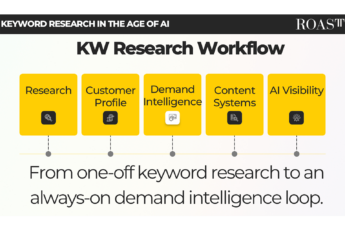
What Does an ICP-Based Keyword Research Workflow Look Like?
- Research
- Customer Profile
- Demand Intelligence
- Content Systems
- AI Visibility
This takes keyword research from a one-off project to an always-on demand intelligence loop. The AI Visibility stage is where this work overlaps with Generative Engine Optimisation (GEO), ensuring the same clusters and personas inform how a brand shows up in AI-generated answers, not just traditional search results.
How Does Cluster Data Inform Content Opportunities?
The cluster and data helps to inform the following:
- Keywords and prompts for tracking
- Content opportunities on site and offsite
- Demand estimates for prompts
- Customer value potential
- Current search performance
How Do You Find Content Opportunities Beyond Your Site?
One content opportunity from Deal-Finder Dana is to route pages with “cheapest month” and “best time to book” modules, pages with nearby-airport comparison copy and price alert education and CTAs.
There are other informing opportunities to expand beyond site details such as understanding offsite. This can be done through cluster keyword and prompt ranking signals for UGC and review sites. Offsite competitors can inform strategies such as understanding what videos rank in the cluster, Reddit and UGC discussions, and travel blogs and listicles.
It’s Not Just One Profile!
With Deal-Finder Dana their primary intent was to find the cheapest or best-value flights. That points to route and fare timing pages as the main SEO asset type. It also reveals an AI search opportunity in direct answers for cheapest month, booking timing and nearby airports.
This can be replicated for multiple other personas: people who want flexible destinations or family vacation logistics, or even those clusters planning a major international trip.
…Or One One ICP Focus
- Price and Value Travelers: find the best value with confidence and transparency.
- Inspiration and Flexible Travelers: discover where to go next based on budget, mood, timing, and travel style.
- Trip-Type Planners: plan the right trip for the specific reason you are traveling.
- Hotel and Experience-Led Travelers: find stays and destinations that match the experience you want.
- Big-Trip Researchers: compare route, timing, destination, and stay choices before making a high-cost decision.
This piece is adapted from Michael’s talk, “Keyword Research in the Age of AI,” delivered at DMWF New York and brightonSEO San Diego 2026.