Brighton SEO Review

This month ROAST’s SEO team made the trip down to Brighton to enjoy the sea, the sun and Brighton’s bi-annual SEO conference. We regularly encourage our staff to attend external events to keep up to date with the latest industry innovations.

Below, the team have pulled together some top tips and key insights from their day in Brighton, covering subjects from API’s to JavaScript to Advanced Keyword Research.

Javascript & Frameworks – Bartosz Góralewicz 

Bartosz Góralewicz provided some useful insights in his talk, Can Google properly crawl and index JavaScript? SEO experiments – results and findings revealed,  in which he concluded that that even Google itself, is still not perfect at crawling Javascript, but he gave some top tips as to how to get the most accurate outcome.

The below table, taken from Góralewicz’s research, provides an insight into which frameworks to use if you have developer’s keen to use JavaScript. As you can see, React, jQuery, Vue.js and Vanilla/Plain JavaScript passed all four stages of indexation and therefore would be the best options to test.
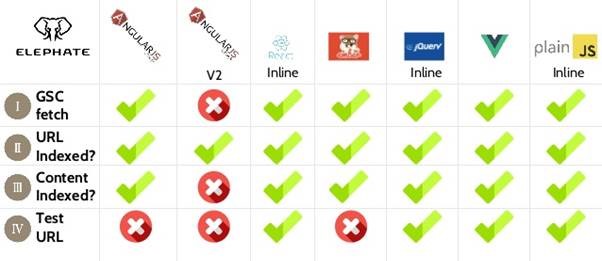

Making sure your JavaScript is inline rather than external, can also make a huge difference as to whether Googlebot crawls the page because;

  • ‘Not all JavaScript frameworks are crawled and indexed in the same way’
  • ‘JavaScript generated links aren’t always crawled’
  • ‘Inline vs. External JavaScript makes a huge difference’
  • ‘Angular JavaScript two must always be server rendered’

We also should remember that Google is not the only search engine out there, and through using JavaScript, support will drop off from search engines such as Bing, Yahoo, AOL. etc.
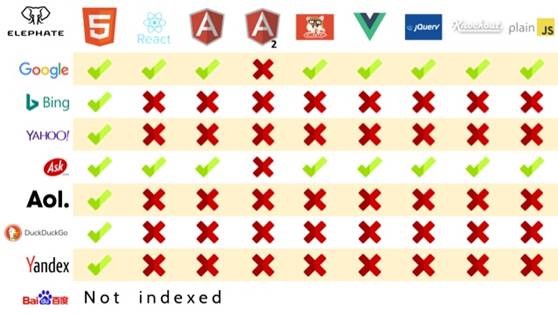
The best approach to using JavaScript in SEO, is through employing Isomorphic JavaScript, on React and Angular.

Despite Góralewicz’s guidelines being useful for those planning on using JavaScript, remember that Google still might not be able to read the JavaScript perfectly, and it is always worth considering all of your options before making a final decision. If it’s too late for you, and your site is already JavaScript-heavy, you can use a service such as  Prerender.io which will create a HTML snapshot of your site to the search engines.

Final tip; Chrome 41 is the same as rendering as GoogleBot, which is great for de-bugging!

API’s In Search – Yiğit Konur, Kostas Voudouris & Stephan Solomonidis

In the next sessions, various speakers provided insights on how to take advantage of APIs, without the need to learn a new coding language or utilise the skills of a dev (too much).

The talks focused on recommended tools to use to simplify and improve your confidence when working with API requests. All the suggested tools pave the way for insightful applications in SEO, and could even potentially be expanded into further reviews and processes outside their suggested applications.

Yiğit Konur, in his talk, Connecting APIs without Coding Skills to Create Your Own Dashboards, suggested the use of drag and drop workflow creation through using data mining tools RapidMiner and Knime, to help simplify your GET request and output data filtering. Such tools can also be used in other applications, such as to create automated workflows for data mining and processing.

Kostas Voudouris walked through the creation of performance based monitoring and optimisation using the search console API and Google Sheets in his talk Performance-based optimisation using Google Search Console API. Doing this enables you to monitor your visibility for new search queries, and it also provides a large data source for large scale content analysis and keyword optimisation.

Stephan Solomonidis suggested using IBM Whatson to allow for simplified API requests for NLP reviews. This tool allows you to identify common themes with SERP listings and keyword sets, or, if you’re feeling brave, can enable you to build your own knowledge graph using IBMs knowledge Studio.

At ROAST, we have a selection of tools that utilise APIs to gather data at scale, such as page speeds, knowledge graph data to name a few.

Advanced Keyword Research – Kelvin Newman

Kelvin Newman, the founder of Brighton SEO, gave an interesting talk, Scary SERPs (and keyword creep), on keyword research and how we as SEOs, need to think differently about the future of keywords and keyword targeting.

A few years back, keyword targeting was as simple as replicating a keyword onto the page as many times as possible, in the hope that Google would think ‘Okay, ‘car insurance’ has been mentioned 50 times on this page, it must be about car insurance and therefore worthy of ranking’, and nine out of 10 times, it would have worked.

Now though, Google recognises so much more than this and is constantly improving its algorithm to understand intent and a sense of what the user is really searching for, many based on IA. So, when creating a page about a topic it’s about including all the phrases within the topics semantic field and enough content that a user and Google would expect to see. As well as incorporating “off the shelf” options (such as machine learning/NLP tools), Newman suggests taking the top ten search results for the query of your topic, and extracting the text from the pages. Once you’ve done this, take all the words from the pages and put them into a word cloud, which will give you a visual prioritisation of how often words are being used for the given query:
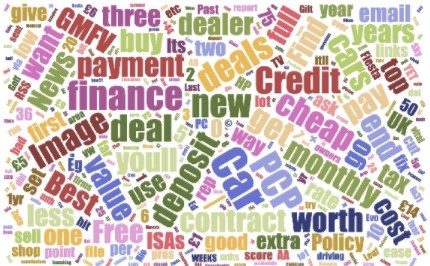
Once you’ve done this, it should help you better understand what keywords and phrasing you should be including on your site.

As clever as Google is, Newman hones in on voice search, particularly the Google home voice assistant, and the ‘one true answer’ trend, which is when featured snippets go a tad wrong.

When you search for something on Desktop, you’re presented with the traditional 10 listings on page one, with a featured snippet appearing in “position zero”. You’re then given the choice between clicking the snippet, or any of the other 10 listings. If you can see that the snippet is misleading or incorrect, there is an option to give feedback about the result, which Google would quickly see to.

However, when searching with a voice assistant, you’re only given the ‘one true answer’, which in some cases can produce inaccurate results as can be seen in the example below:
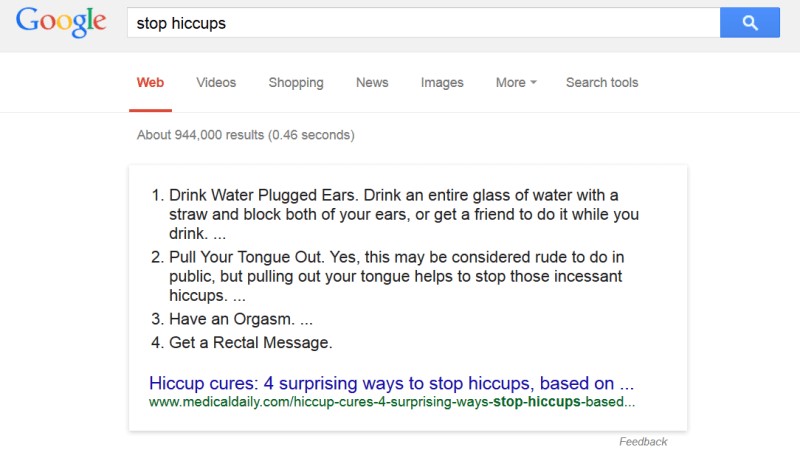
Don’t always trust what Google says…

Newman also spoke on machine learning, and as mentioned earlier, Google’s continued efforts to understand what it is we’re searching for. For example, if you were to search for ‘computer game with Italian plumbers’, Google is now able to recognise this as Mario:

This means that not only does Google understand the keywords, but it understands the whole context of a given query, and sees the connections below the surface, to make sure you’re served the best result. Today’s keyword research is all about understanding our clients’ needs and motivations. This, will help us figure out how to create the best keyword targeting strategy.

AMP – Aleyda Solis

On average, 60% of searches are now conducted via mobile. As page speed is a large user experience factor for mobile users, there is now a high demand for optimising site speed to reduce bounce rate.

Google released AMP to help improve page speed for both big sites which have restrictive legacy systems, and small businesses with too little resource to improve their speed. AMP uses simplified HTML, with optimised resources, to server stripped down versions of pages. In her talk, Setting AMP for Success, Aleyda Solis shed light on successfully implement AMP in web design.

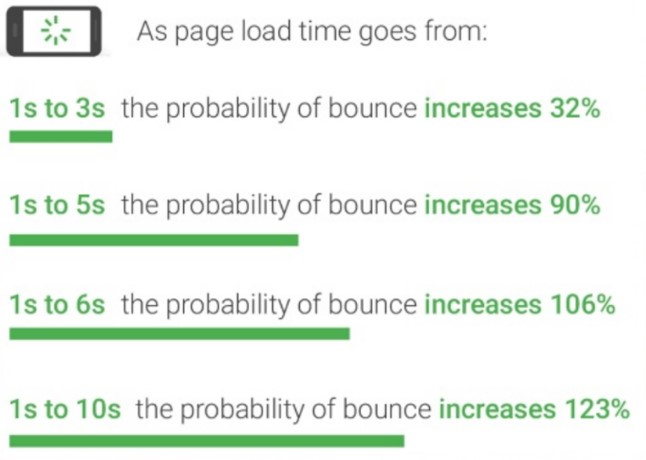
According to studies into site speed, people expect pages to load within two seconds and sites must abide by this to avoid customers from leaving mobile sites which in turn will decrease conversions.

For e-commerce companies, the consequences can be devastating. According to Qubit, ‘Online retailers lose an estimated £1.7bn in global sales each year due to slow loading speeds.’ The image below shows the bounce rate as the seconds tick by:
AMP gives everyone a way to create lightweight and fast pages for mobile users.

Technical SEO IA – Dominic Woodman 

In his talk, Advanced Site Architecture – Testing architecture & keyword/page groupings, Dominic Woodman explained that Site IA refers to the structure of internal links that search engines use to understand relationships across a website, but more importantly, IA represents a huge opportunity to match up templates and pages with a specific user intent.

Answering some simple questions about the expected steps in your customers’ journey on your website, and how to reach them, should provide important cues about where pages should sit and which keyword(s) they should include.

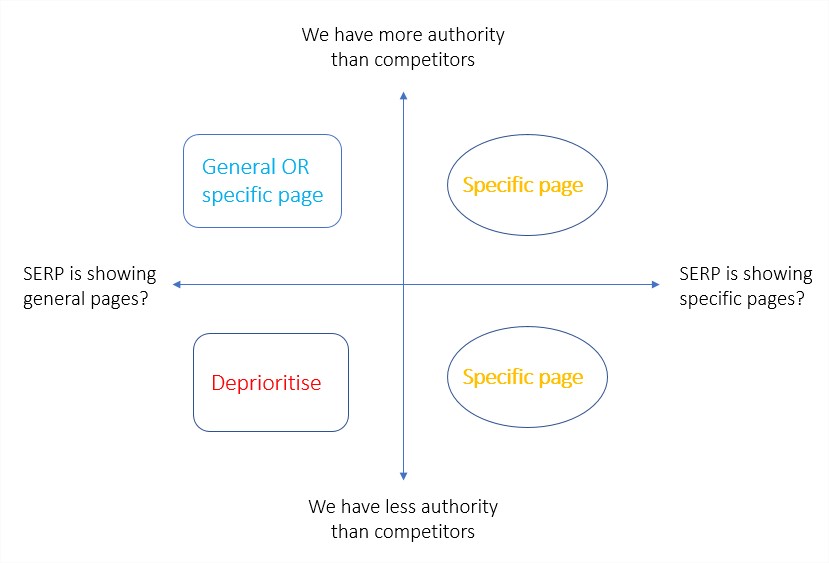
Matching keywords and their intent to a page template can be done through semantic analysis and a good deal of iteration. Identifying the need for new template creation can be as simple as looking at SERPs and asking yourself the following questions;
GTM for SEO – Sebastian Monnier

In Sebastian Monnier’s, How Google Tag Manager Can Help your SEO, he explained that one of the benefits of using Google Tag Manager (GTM), is that it allows ad-hoc injection of JavaScript strings and bypasses the need to hardcode everything and therefore makes the code “lighter”. So, if you are not able to implement changes to your clients’ website you could use GTM to make those changes.

Monnier argued that it is in fact possible to rank for keywords that have been injected into the title and description tags with GTM, even though they don’t appear in your HTML code. One reason for injecting keywords through JavaScript, would be for websites that have faceted navigation (e-commerce), or for campaign pages for example. GTM makes it possible to scrape parts of the HTML code and push that into the meta tags and Monnier has showed case in point that it wouldn’t prevent your pages from appearing in SERPs.

Final tip; this also works for injecting nofollow tags, noindex tags and canonical tags.

In the coming months, the team will be at STAT’s City Crawl event and Google’s AMP Roadshow, keep an eye out for the write ups.
Stat City Crawl Manchester & iAB Search Trends Seminar

Last week was a busy week at ROAST as we had two speaking engagements and released our latest voice search white papers.
First up was a visit to Manchester to speak at the Stat City Crawl Manchester at the iconic Whitworth Art Gallery. It’s the second time we’ve spoken at a Stat City Crawl event and it was a pleasure to be asked to return.

A slightly different format from other “conference” events, it takes place on a work night, food is provided and then there are four talks from agencies / in-house SEO teams. All the ticket sales go to a local charity, in the UK Stat picked Code Club UK.  In this year’s Crawl the tour visited San Diego, Vancouver, New York and Manchester, we picked Manchester to speak at!

Alexander Darwin – twentysix

Alexander spoke about what your links say about your website, there was good examples of finding spam backlinks with misspellings, a comparison of the various link index tools for conducting your audit and ways to assess your site on an ongoing basis.

Derek Gleason – Workshop Digital

Derek’s impressive talk was about how SEO working with brands has evolved over time and how to approach SEO for brands. There were some very smart ways to visualise user demand and rankings which would help you understand the requirement for content marketing. A very slick presentation with great thinking interwoven into patents from Google.

Laura Hampton – Impression Digital

Laura spoke about her work on marketing Impression Digital. The campaigns over the years, how they have evolved as the size of the company changed and the result from that work. It was interesting to compare the approach of another company to ours, the tactics used and times they have pushed out into the industry with a view point on a specific topic.

John Campbell – ROAST

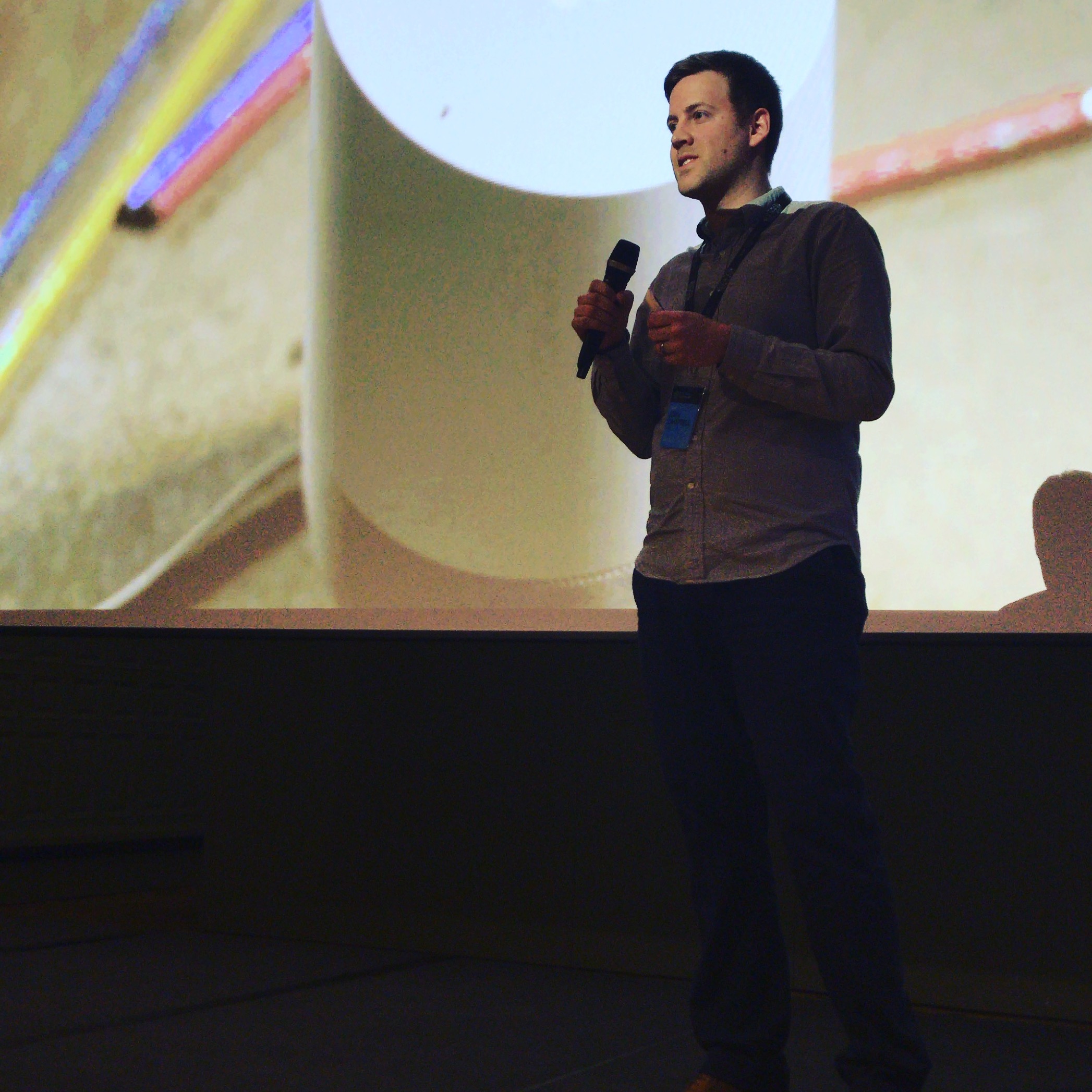
Finally I spoke about Voice Search, an overview of the market at the moment, things that marketers could be doing now, creating actions, using the SDK, possible paid options in the future and then onto the findings from our Voice Search Ranking Reports which we ran on 22 verticals.

You can download the vertical voice search reports from our website.
More information from the day can be found over at https://getstat.com/manchestercrawl/
 

With one conference done the team then jumped back on the train down to London for the iAB Search Trends Seminar.

This time a little more of a conventional session with 8 speakers in one afternoon at the iAB’s Event and Training space just around the corner from us in Holborn.


Peter Giles – Google

Peter spoke about how automation in PPC will change the role of the PPC team in the coming years, but also about how account structures might need to change to get the most out of Google’s automation tools in the future.

Mark Williams – iCrossing

Mark spoke about integrations between PPC and SEO, explaining how using a consumer first approach can bring both teams closer together in serving a client.

Nick Beck – Tug

Nick injected some energy in the room talking about how humans will always be a part of marketing and explaining ways to get the best out of those working on accounts. Nick also showed some good examples of elevating search data and insights to inform bigger brand and ATL decisions.

Louisa Mennell – Mindshare

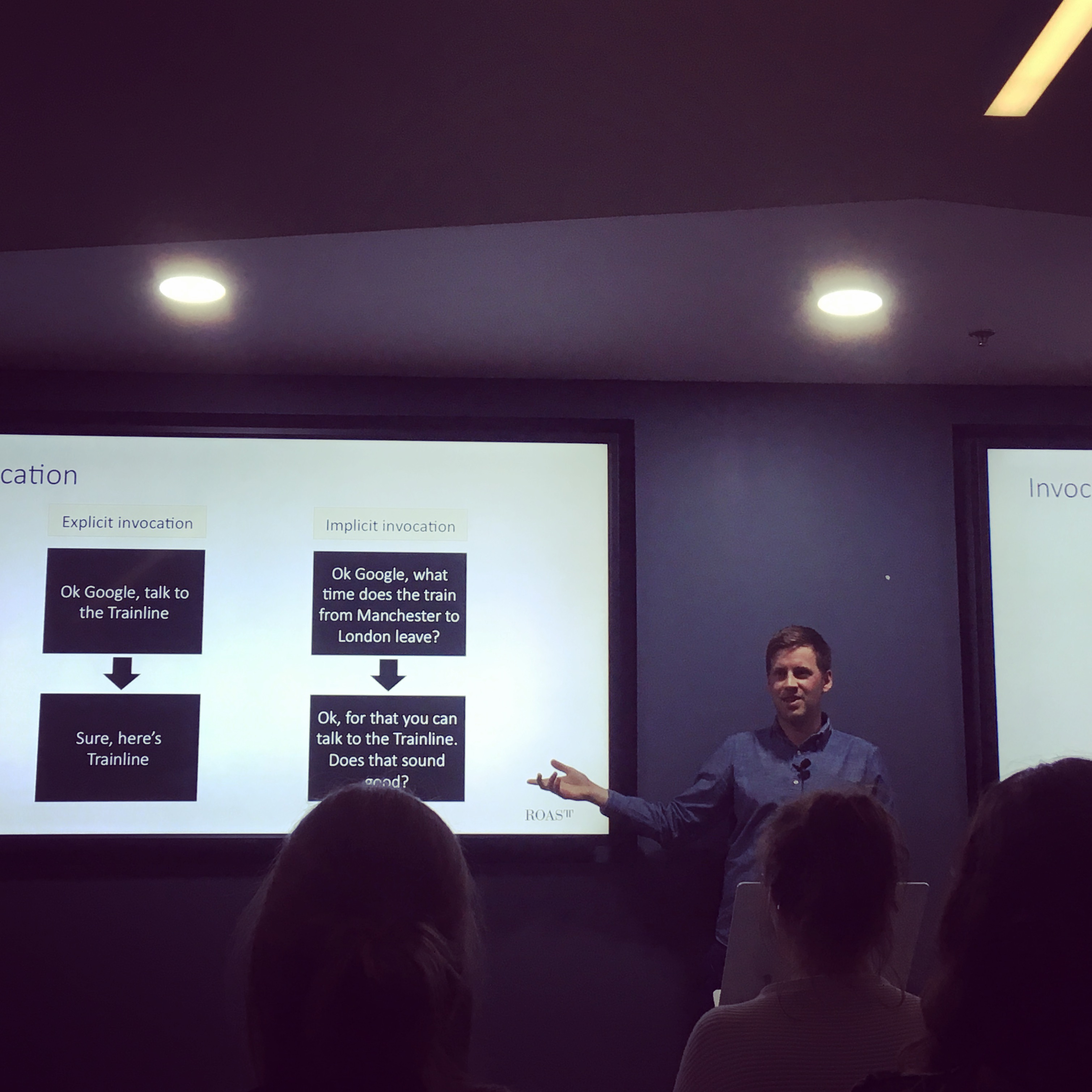
Louisa and I shared a 30-minute slot to talk about voice search. Louise spoke about how various factors that have developed over the years has brought us to this point in time where voice search is breaking through into the mainstream. Data from research Mindshare conducted show how our brain functions while performing a normal web search in comparison to a voice search; it turns out a Voice Search is much less taxing. The second half focused on practical elements brands need to think about when developing for voice.

John Campbell – ROAST

Following on from Louisa I spoke about specific actions brands could be taking on voice, and once again gave an overview of the results of the vertical voice search reports.

Jenifer Branley and Andrea Haaser – Performics

Jenifer and Andrea spoke about SEO integrating with PPC. Some of the tactics they use and where search should sit in the planning for a campaign.

Kerstin Reichert – TSB

Kerstin who works at TSB explained to us all about featured snippets, how they worked, how to create them, the benefits and voice search implications.

Darius Carne and Piotr Lobaczewski Bing

The last talk of the afternoon was from Bing who showcased some example of AI and Machine Learning that are already live on Bing. The image search function being the pick of the bunch.

The iAB host multiple events over the year, head over to https://www.iabuk.com/events-training/ to see future events.

Five Things We Learned at Big Data LDN

Some of our Data & Analytics team went down to Big Data LDN to network and learn about the big talking points in Data today, here are the key insights that they came away with:
Insight: Know when to compromise between complexity and time
Talk: Your next basket – A Bayesian approach to relevancy modelling using WPS analytics (Jeff Ahrnsen, 8451/ World Programming)
With different models, platforms and vast parameters to consider when analysing data we are constantly weighing up the pros and cons of each to get the best output in a timely manner. In the talk on a Bayesian approach to relevancy modelling using WPS analytics, we discovered there is a constant balancing act when juggling different aspects of a project.
Insight: Keep innovating and creating POCs
Talk: Enabling data-driven decisions with automated insights (Charlotte Emms, Seenit)
Sharing ideas and putting them into practice is the start of formulating a POC, and it is important to do this as soon as possible in the thought process. Hearing about one analyst’s journey from dealing with the lack of engagement of her dashboards, leading her to think of an initial idea of insightful email type reports (POC), to learning Python to create a more robust e-mail template (MVP), to finally putting this to practice. This has been developed further since to a slackbot to return key metrics and graphs at your fingertips.
 
Insight: People are ready for “new nudges” and are more and more are comfortable with AI
Talk: New nudges – the next revolution in customer influence (Alastair Cole, Partners Andrews Aldridge)
With the new era of AI looming round the corner, we are slowly accepting it and moving along with it. Alistair Cole believes we’re ready for the next leap in creative thinking. Adding technology and data is the natural evolution and AI can design emotionally engaging experiences. From this we can create intelligent tools that will generate unique experiences.
Insight: Sometimes it’s best to let the robots do the work for us
Talk: Using AI and time series modelling to improve demand forecasting (Lukas Innig, Datarobot)
With the platform DataRobot, there are already pre-built models created by leading data scientists to reduce the laborious work we would have to do.We were exposed to a working example of how its time series model can help with forecasting with minimal error and allow us to minimise the compromise between accuracy, time and size of the dataset.
Insight: Integration matters, nobody has all the pieces
Talk: Automatic machine learning with guided analytics (Christian Dietz, KNIME)
As analysts we are constantly dealing with multiple data streams in order to get more insight, automating as many of the processes as possible – from pulling the data to producing actionable results. Automation can take out the drivers but it can then also take away their expertise. However, guided automation allows us to automate the tediously long pieces but keep the expert in the loop.
Find out more about our Analytics & Attribution Services here.

Key Takeaways from IAB Engage 2019

ROAST SEO Account Executive Evelyne takes us through the key insights from her three favourite talks of IAB Engage 2019

1) Google Creative Lab

Four basic ways to make creativity go further:

1 – Be the stage, not the star.

When it comes to technology, the most important thing is not the shiniest. More often than not, the stage around the star is what makes the show spectacular.

When we focus on the stage, the users will have with a lot of things to interact aside from the star. More interaction = more leads or conversions.

2 – Diversity = Creativity

The more diverse is the environment we surround ourselves with, the more we get in touch with creativity. Different always brings out ideas and mindsets we have yet to experience.

3 – Naivety + Invincibility

When working on a project, be naive. Don’t mind if it doesn’t work. That will make your creativity and productivity invincible, in order to create a result that will make a difference.

4 – Spend 99% of your time MAKING

When you spend most of your time into creation, just for the sake of creation, the result will be a success.

Google is always pursuing collaborations that will make a difference. Even with industries that doesn’t seem to be directly connected to them like Google Jacquard and Levis where Levis created a jacket special for bikers. (see youtube video, that jacket is awesome).
They have a specific interest in arts and culture, where they collaborated with museums around the world ( Including Natural History Museum of London) and they are bringing back to life virtual reality all the historic creatures.
They also share a big portion of their campaigns dedicated to women empowerment. Grow with Google (women will) where tech skills are being taught to women around the world, to empower them and develop their passion through internet.
Side Note:
Google is brilliantly taking advantage of every opportunity they have to expand. And they do it with the way SEO works. Data and appeal to emotion. (Don’t they have enough already!?)

2) Creating For The Future

What separates good from great?
Huge companies that started from small businesses and developed to multi billionaire industries, didn’t only offer a solution to a problem.
They changed MINDSETS.
Airbnb changed the way we are thinking when we now go for holidays, by offering accommodation (not something new) with an approachable price to a home away from home.
Sometimes the original solution may not be something innovating, but taking them to a step further, creates a new mindset to something we already know.
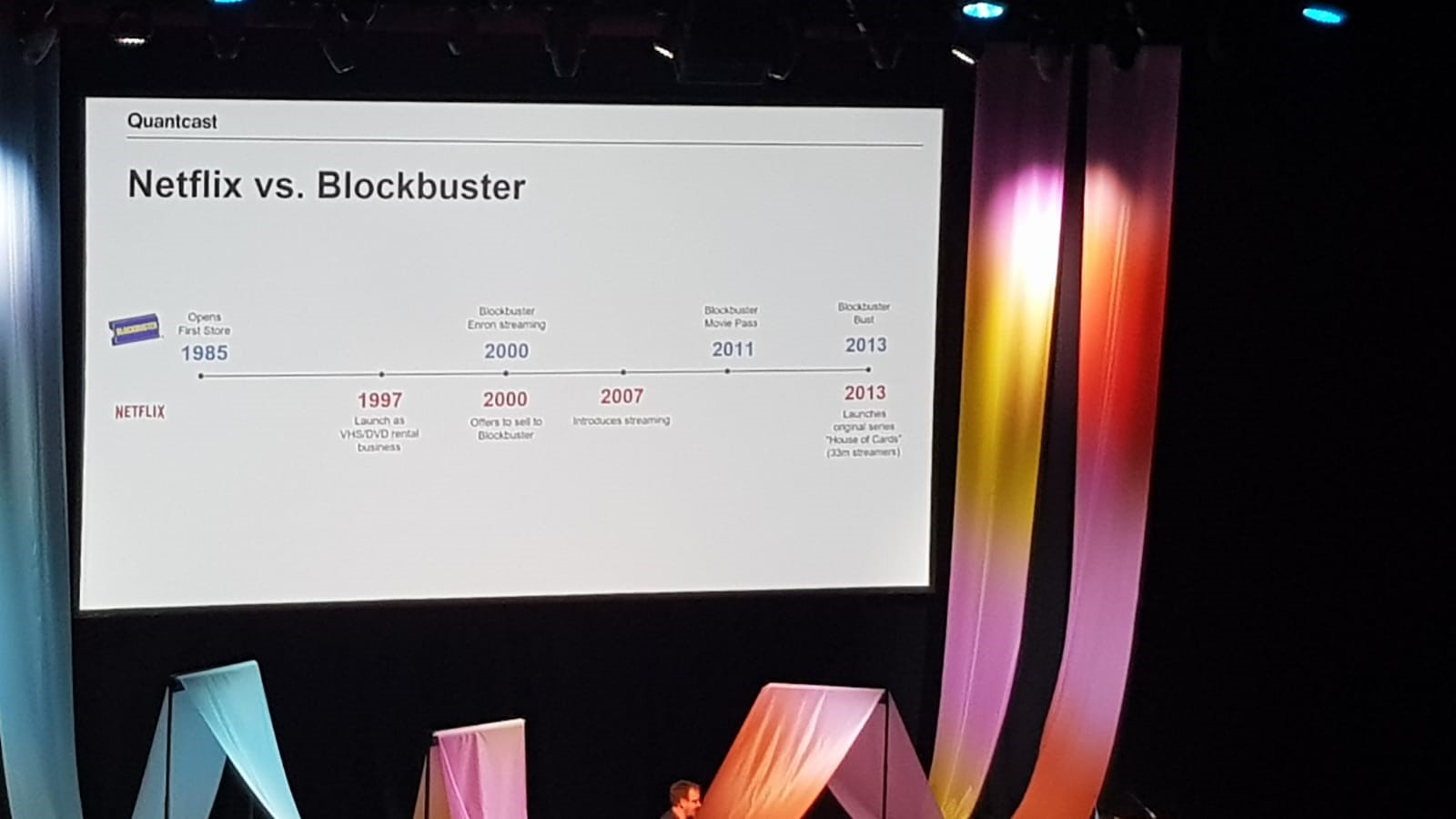
Followed by an example of Netflix and Blockbusters, with the history of Netflix and how it hit major success:

Surprisingly, Netflix offered to sell to Blockbuster in 2000, only to introduce streaming in 2007. And with one solution within the already well-known solution, MOVIES, Netflix, from a small struggling company became a massive industry.


3) Making Digital Creative Again


There is a claim that  “Attention is a diminishing Commodity’’.
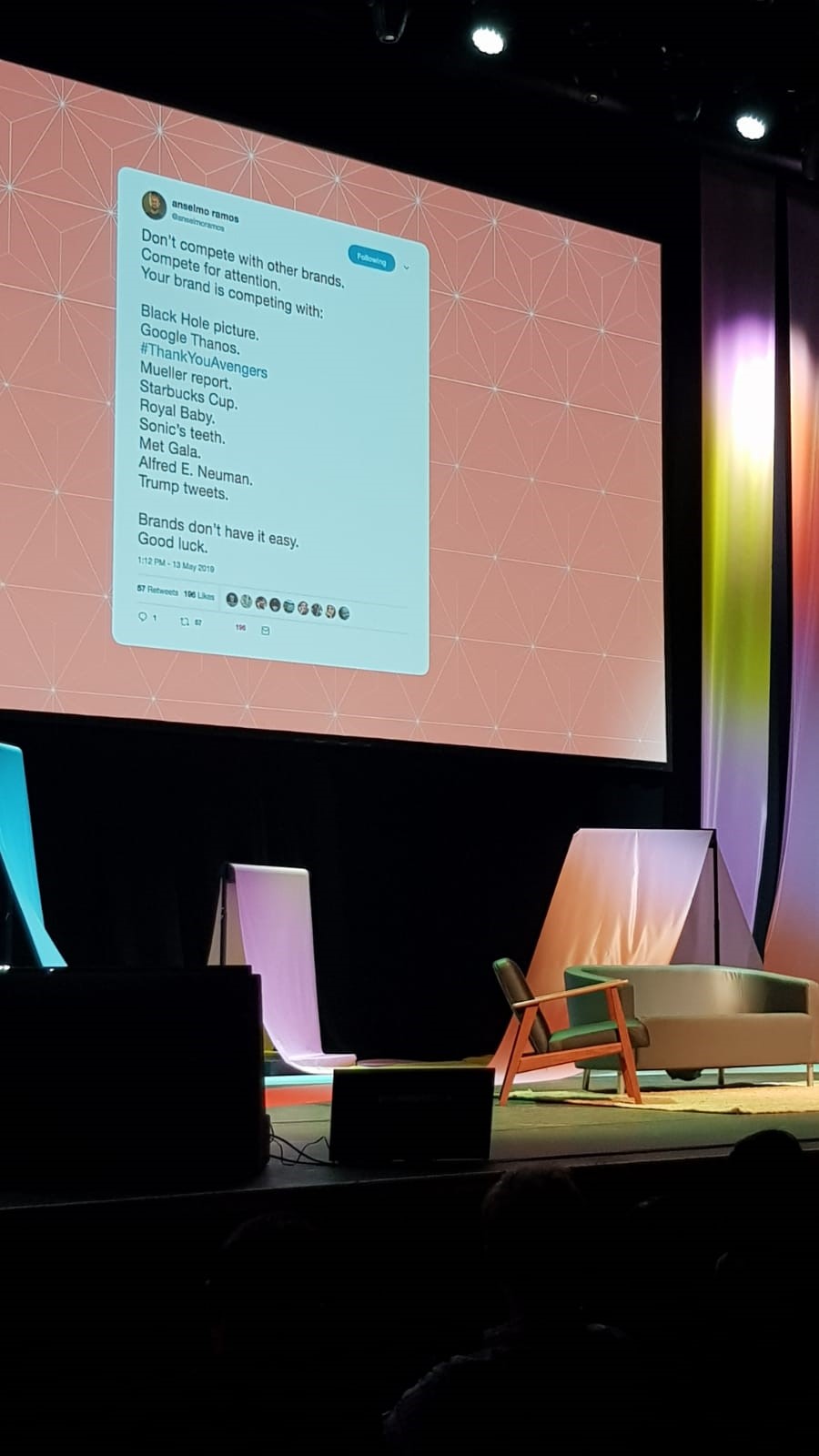
But when we analyse human behaviour, we can clearly see that people don’t have a short attention span, they just choose where to pay attention.
This is a huge opportunity for Brands, to compete for the user’s attention and not with other Brands.

33% of every hour online is dedicated to watch videos, with the prime time being around 8 pm. (SEO opportunity for links)
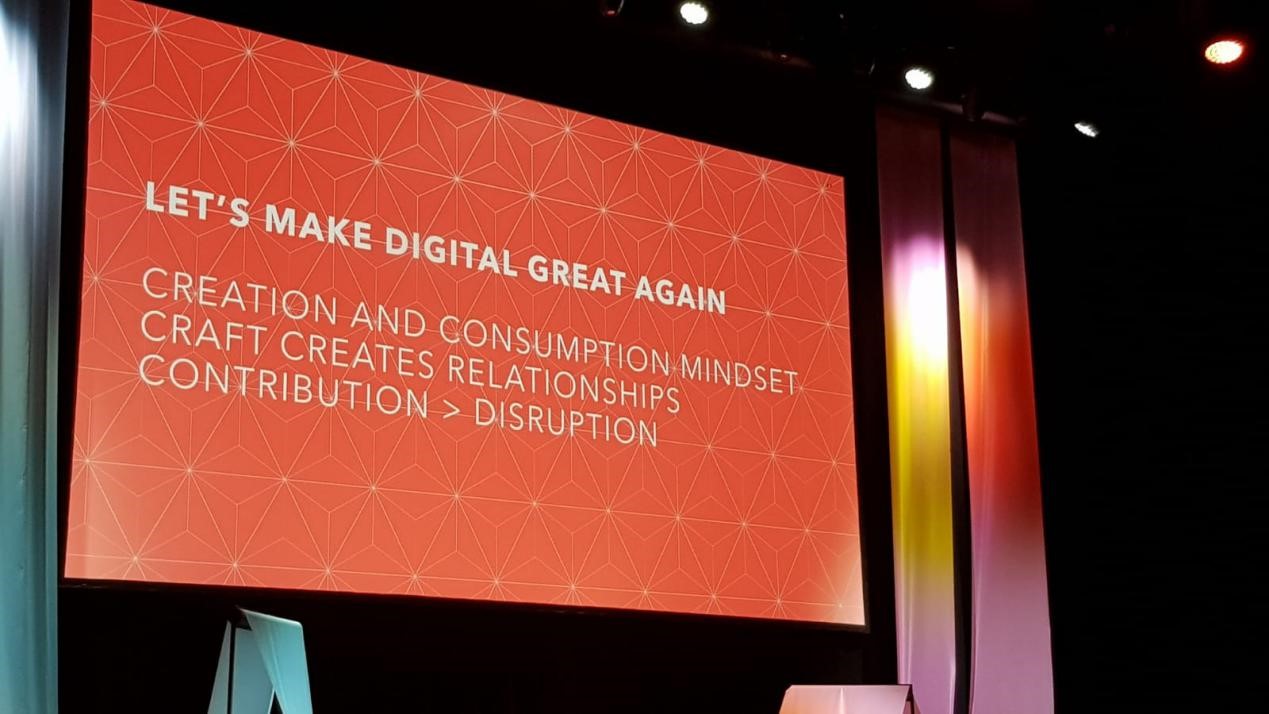
When you use powerful language (content is king after all) combined with the ideal imagery, we can create intense emotion to the user, which will not just create relationship, but experiences.
Contribution > Distribution
Because people will spend more time experiencing. And more time means more opportunities.

BBC Global News – IAB Digital Upfronts

The IAB Digital Upfronts are a series of presentations by major media owners designed to give brands and agencies a taste of what’s to come in the next year. We headed across to New Broadcasting House to check our what the BBC has in-store for us in 2020, as well as catching an interview with documentary legend Louis Theroux. 
“The BBC is Open for Business”
The above statement comes across a bit strange for us Brits who think of the BBC as a being funded by license fees. In fact, the BBC has a global reach of over 400 million people per week, and much of the Global side of the business is funded by advertising – so they are constantly working with brands and agencies to find new and exciting ways to reach consumers through BBC ecosystems.
The session, hosted by Lucy Hockings (Journalist and BBC World News Presenter) went on to cover Products, Research and Innovation.
The BBC finds its Voice
Andy Webb, Head of Product for Voice and AI, spoke about his role in trying to imagine what the BBC will look like in the future.
He spoke about how we are used to interacting with content through screens (or window-based interaction), but the way that people are accessing and experiencing content is changing. We are now moving away from flat surfaces into an era of ambient computing, complete with everything from smarthomes to smartwatches. In this new IoT paradise, our interaction with the digital world is likely to be facilitated by voice.
The BBC’s plan to create their own voice assistant called ‘Beeb’, has been public knowledge since August,but Andy’s team have also been working on a companion piece of tech – a synthetic speech-generation product called Songbird.
The BBC produce 3,000 articles a day worldwide and Songbird has been given the mission of bringing them to life in speech. AI and Machine Learning also allow it to translate content, making it scalable across the globe.
Beeb and Songbird will work together to answer questions, pulling answers from the BBC vast store of content. For example, if you wanted to know “what is the G7?” Beeb will source a sentence from a BBC article and Songbird will turn the text into speech and read it out for you.
Beeb and Songbird are both set to come to market in 2020, bringing with them global commercial opportunities.
Getting Real with Louis Theroux

The theme of the entire upfront was ‘The Power of an Authentic Voice’, so what better guest to have on than interview-master Theroux.
He spoke about how early in his career, when he was directed by Michael Moore, he was told to always be expanding the frame of enquiry, and how he believes his success has come not so much from any skill, but simply from being able to give an authentic appearance – as a goofy, awkward, but genuine person rather than a professional ‘interviewer’. Louis views himself as an ‘audience surrogate’ and he always tries to bring universal emotions (Fear, Awe, Love, Grief) into his programmes.
He believes that intimacy is pivotal in a good documentary, but he has found in the past that this made it hard to let go of his subjects – he constantly felt obliges to stay in contact.
Theroux spoke of his transformation from the naive (or faux-naive) young interviewer getting naked and dancing in Weird Weekends to the more hard-hitting, thick skinned figure he was forced to become in later works on Scientology and the Westboro Baptists.
During his interview he was at times funny, at times philosophical, but always entertaining as he leapt from topic to topic, explaining his guilt at not being able to spot the reality of Jimmy Saville by quoting a text by Nietzsche, before finishing poignantly by arguing for impartiality – saying that moral certainty is both the enemy of truth and the enemy of entertainment. In an era where biased media is often to blame for fanning fire of extremism, this message really resonates. If you want the truth, you must leave your preconceptions at the door.
Engaging the Next Generation
Amanda Ruggeri is the editor of Future Planet and Future You, two new BBC projects aimed respectively at tackling Climate Change and promoting Wellness. Grounded in research, these platforms aim to engage the next generation with a new type of solutions-based journalism aimed to drive social change. Future Planet aims to be the first-carbon neutral platform, cutting back on air miles by hiring local journalists, which also allows them to empower authentic Global voices.
Future You is a smart-wellness platform launching in early 2020, based in audience research and geared towards young women. It aims to inspire people to live better lives by tapping into three pillars of wellness: mind, body and social.
Both platforms will be well-suited to branded content – a key commercial area for the BBC.
Bringing the Brand-Safety back to Programmatic
Emily Roberts (Programmatic Trading Manager) explained how the BBC’s core values of accuracy, impartiality and fairness are reflected in their attitude to programmatic.
A recent survey of brands showed that concerns around brand-safety have risen sharply over the past year, so a rigorous approach to programmatic is essential to ensure that the right content is being seen by human viewers in a brand-safe environment.
The BBC have now also started working with Acast to allow brands and agencies to but programmatic inventory on podcast .
Using Neuroscience to Measure Audio Effectiveness

Dr Hamish McPharlin, the BBC’s Head of Insight, presented an impressive piece of research on Audio which made the case for the power of branded podcasts. Branded podcasts clearly offer a great way for brands to become a part of the consumer day, but how can we accurately measure their effectiveness?
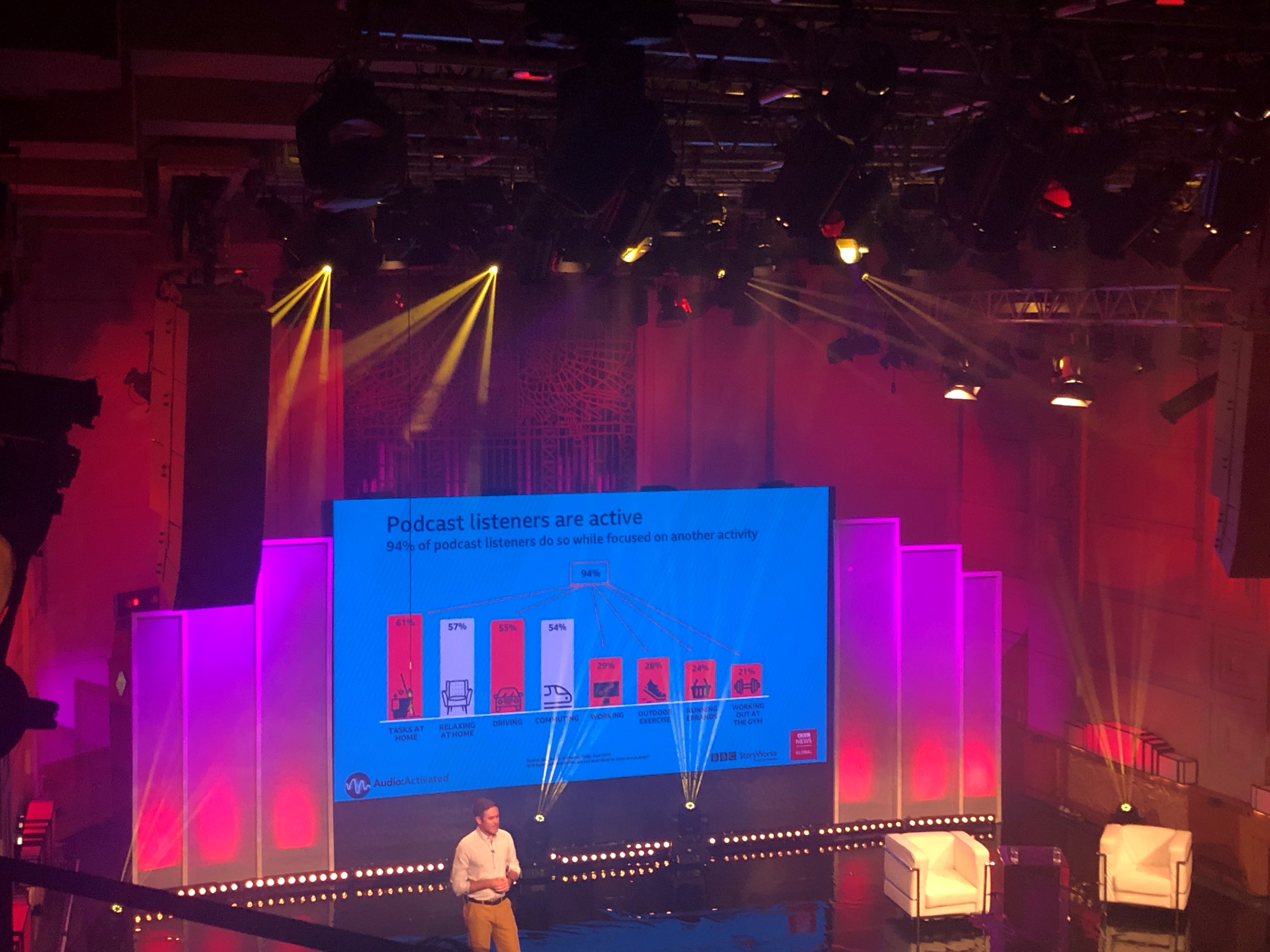
The new study, called Audio Activated, raises the point that the majority of the time when people are listening to podcasts they are doing another activity at the same time. Whether they’re cooking, running or cleaning, their body is likely to be otherwise engaged. However, this new research shows that their active bodies do not cause the content of the podcast to go straight over their heads.
In fact, the opposite is true.
The research, done in partnership with teams of neuroscientists, has shown that an active body lowers cognitive barriers to brand persuasion and there is a higher degree of memory encoding when being active whilst listening. In short, active audiences engage better with branded audio content than more focused listeners.
For brands seeking to create effective podcast content it is crucial to speak the language of the tribe of consumers in order to weave brand content into the conversation and create a seamless experience.

IAB Nonference 2019 – Why shouldn’t a conference be as fun as possible?

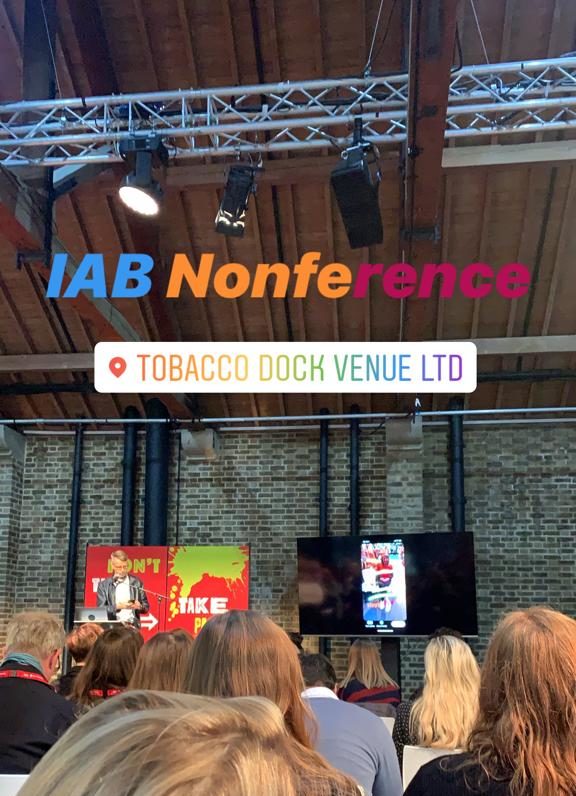
Preparing for Nonference, I had a small idea of what I was in store for, I knew it wouldn’t be a conventional conference, with the advertisements giving a hint, “don’t take notes, take part” but the reality was far more impressive. After making my way to Tobacco Docks, I soon realised that I was in for a treat. For anyone looking to both be educated and engaged, this is the conference for you.
Nonference has taken the traditional conference structure and turned it on its head – it’s a perfect example of how traditional, presentation-based conferences are able to re-invent themselves for the modern day, delivering relevant content through the medium of immersive and engaging live experiences.
From immersive meditation with 3D headphones, to building bots and creating your own Voice skill, the IAB offered a broad range of sessions, each surprising you at their nuanced take on the conference session.
The result? A lot of fun, cocktails and some happy conference goers – we have put together a couple of the sessions we attended to share our experience at IAB’s Nonference.

Generation Media – Move over Millennial’s

This session offered insight into working with Generation Alpha, from an agency, client and third-party point of view through a panel, even consisting of the Kidfluencers parents themselves. They spoke about the changing role of influence for this generation, moving from traditional forms such as TV, to digital platforms like YouTube. The discussion of how agencies and brands should change their strategy to follow the changing user behaviour of this generation was pertinent, with the Head of Marketing from Beano using their own company as an example. As the only publishers physically left on Fleet Street, they knew they had to change their strategy to survive. From going online, to holding focus groups in order to find out what’s hot on the playground, they have adapted their strategy for generation Alpha.
The session raised interesting points about the changing nature of the market opportunities by generation. Research by Super Awesome found that more than nine in ten kids in the US between the ages of 4-11 have access to a smart speaker, 20% of which engage with their smart speaker for more than five hours a week. Generation Media’s insights demonstrated how agencies and marketers will have to adjust their strategies to this demographics changing user behaviour who are ultimately, the future.
Lots of questions came up in the Q&A about the ethicality of children starting a career so young and where to draw the line in how much of the children’s lives are shared to the world. The topic of mental health was also raised, in the context of many older generations aware of the detrimental effects which social media can have on mental health and general outlook on life and success.

Blockchain – The Missing Link? with the 7stars

Dom from the 7 stars took us through a brief history of blockchain, from shifty beginnings in prisons to a force set to revolutionise the global financial system. Dom explained, and showed through a cross-audience data-transfer activity, that blockchain is essentially just a very reliable, efficient and trustworthy way of transferring data through an incorruptible digital ledger.
In the world of programmatic, many people are lionizing blockchain as some kind of holy grail. Dom argued against this, saying that blockchain really working is a long way away, as there are so many links in the chain, meaning that all the different players in the process would have to commit to this new process in order for it to work properly. When pressed, Dom admitted that for Blockchain to work for programmatic, it would have to start with the publishers.

Born Online: The Direct to Consumer Brands Reshaping Retail with IAB UK

The IAB hosted a fascinating session on DTC brands, starting with unveiling of their own research. The report, consisting of a list of top DTC brands, a consumer survey and interviews with founders showed that these brands tend to have clear purpose and digital channels at their core, and they always try to super-serve their audience – which tends to be young, affluent and urban.
In the second half of the session, Steph Douglas and Kate Huang, the founders of Callaly and Don’t Buy Her Flowers, were up on stage discussing their start-up stories. For Steph, it had been all about leveraging her personal experience to get a new perspective on what women actually want. Kate discussed innovating on both a product, and purchase behaviour level, and talked about the difficulties faced in challenging inertia in the period product vertical.
Both brands evoke strong positive emotional reactions from their user-base, generating powerful brand advocates. In terms of marketing, Kat and Steph both agreed that at the beginning PR was key, but now as they grow digital is becoming more and more important as they test and learn and grow. When asked about top tips for starting out the advice was to be more patient, and not to be fooled into thinking that running a business was just something else you could do on top of your normal life.

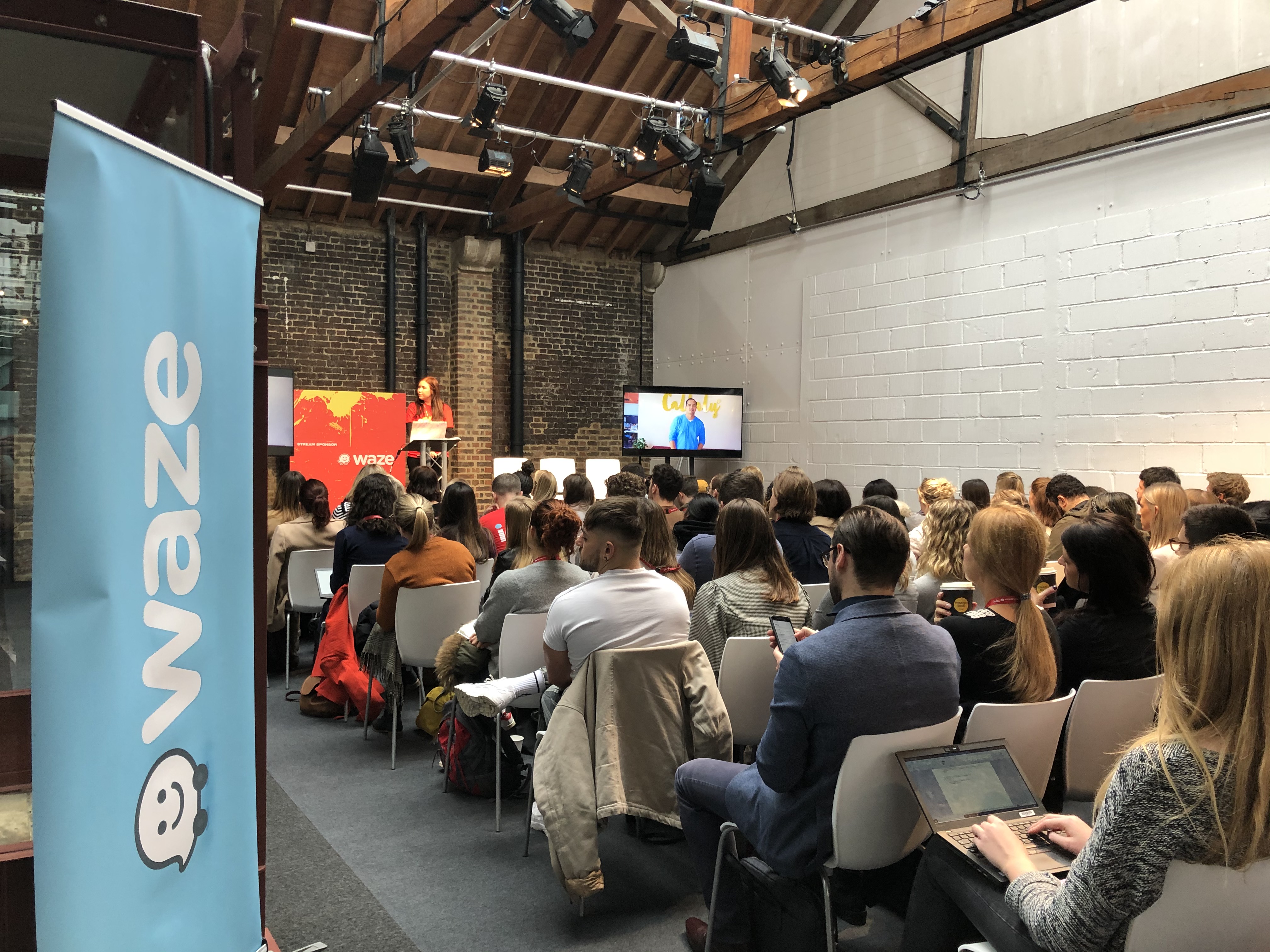
No Waze! with Waze

67% of Brits drive to work, and Waze is on a mission to improve their lives (and the lives of drivers around the world!) by eliminating traffic. In a world where we are increasingly time-poor, traffic can be a huge frustration, so Waze set out to use crowd-sourced data to get rid of it. With 3.2 million monthly users and 2.2 million reports per month, their mission is well underway.
The amount of brand-love surrounding Waze is impressive, for what is essentially a tech brand, with one user reportedly saying that Waze saved his marriage because him and his wife had now stopped arguing in the car. We also welcomed to the stage a Waze senior map editor – a volunteer with over 250,000 map edits.
Waze fund their maps with ads, so commercial opportunities were a part of the talk. With examples of BP and M&S ads being targeted to users in the right place at the right time through the app. There was also the example of getting guest voices into the map to promote films.

The Box Bingo with Simon Andrews from Mobile Fix

As TV reinvents itself and tries to find a model that works for advertisers, platforms and viewers , billions of dollars are at stake and experimentation is the order of the day. TV advertising has been too untargeted for too long, but now with developments like Sky Adsmart emerging (which has decreased channel-hopping by 33%) the landscape seems set to change.
Cord-cutting is gathering pace, led by the US, as people rebel against paying through the nose for hundreds of channels that they’ve never watched, this leads to opportunities for new players. Disney’s new service is launching soon, and Amazon has now got rights to show a string of Premier League football games in December.
Mergers and Acquisitions have proliferated across the sector as people sense the gap between TV and Digital closing and there have been rumours of Apple trying to purchase Netflix.
The great debate, at the moment, is around subscriber or ad funded TV. In the US, there seems to be a sentiment that ads are for poor people. Simon however believes that ads still have a big future in the world of TV, there is an opportunity for brands to innovate and make truly great content, such as BMW Films’ “The Hire” by Weiden+Kennedy.

Build a Bot with Rakuten Viber

In this workshop session we sat with a laptop and a team of six and set out to build a bot in just forty minutes. We had a good chuckle designed a conversation between a consumer and Sir Alan Sugar to promote the BBC’s Apprentice, while the other team representing TIPi Group won with a clever quiz to find out which Beyoncé song matches your personality, oh yes we did.
The Bots were judged by a senior marketer from the WWF, for whom Rakuten Viber had recently built a chatbot designed to engage consumers and drive donations in order to save the tiger.

Digital in the Dark with Global and Starcom

Despite being blindfolded in the final session of the day nobody was in any danger of dozing off as Starcom and Global took us though a phenomenal showcasing of 3D audio.
3D audio, described by them as ‘stereo on steroids’, sounds like its coming from all around you, so can be used to drop you into a truly immersive experience. Like VR for your ears, one of the case studies we listened to, from an anti-knife crime campaign, really made you feel like you were at the scene of the crime.
In order to demonstrate how audio is shifting from something you listen to something you experience, we were blindfolded and treated to a history of internet told through smell, taste, touch and, of course, sound. It was immersive, at times to the point of being disconcerting, but was always entertaining.
You know you’re at Nonference when you’re fed a gummy worm by a complete stranger…

That’s it from Jamie and I at TIPi Group who certainly enjoyed our day of learning and interactivity at Nonference. If you liked this, read the blog from Rabbit & Pork for a summary of their Voice Workshop – ‘A Carnival of Creativity’

Women in Tech SEO Festival – Round Up

Exactly one month ago, on International Women’s Day 2020, the WITFest took place. This full day women-only event at the Barbican was divided into 4 inspiring segments:

Analyse

Roxana Stingu

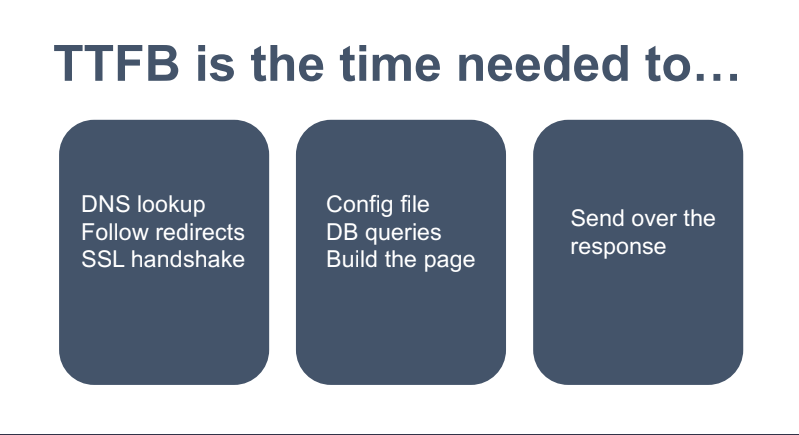
Is your TTFB slowing you down?

In a world where we want to provide users with as much information as possible all sites struggle with TTFB (time to first byte). Roxana provided tips to improve this metric including reduced network latency, GZIP compression utilised, redirects tidied, faster DNS lookups provided, move to latest SSL protocol, database design optimised and static caching implemented.

Roxana_Stingu

Kristina Azarenko

How to create high quality ecommerce categories?

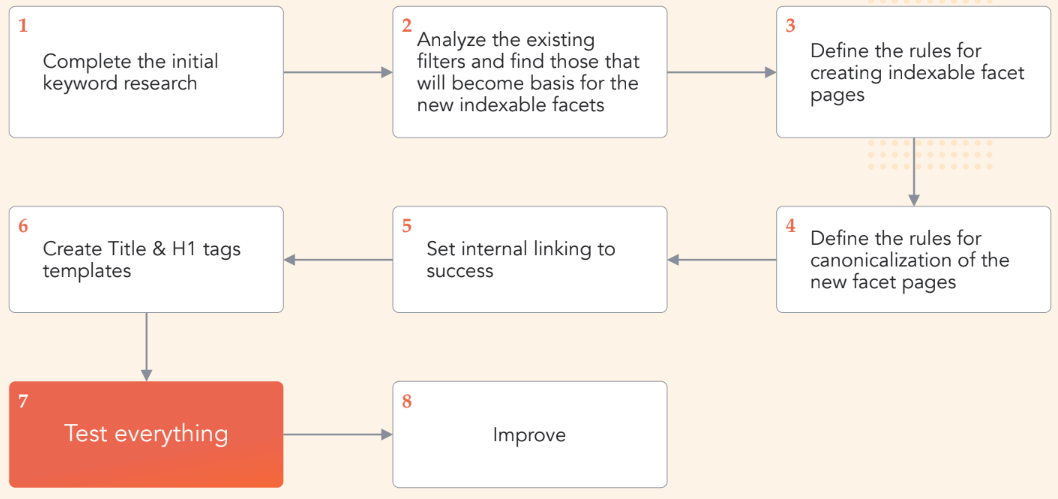
Create categories users are looking for. They’ll be more likely to convert on these pages providing more value to the site. Kristina’s 8 step framework can potentially save 2 years on implementation. One of the keys to this framework is communicating with everyone involved including site owners and developers.

Kristina_Azarenko

Miracle IInameti-Archibong

Proving your wealth: Demonstrating the value of SEO campaigns

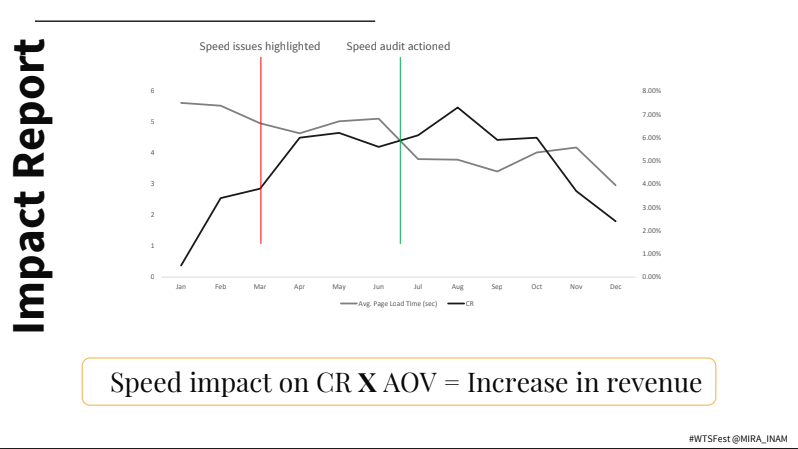
Miracle showed how to set up campaign tracking to ensure the full value of the project can be communicated to and understood by the client.

One of the most important insights is to understand the goals of the company in order to set the correct KPI’s. This ensures the structure of the site can be built out accordingly with the correct content and the right technical implementations to support.
Miracle_Ilnameti-Archibong

Advance

Aleyda Solis

SEO for Marketplaces: Overcoming technical challenges

Marketplaces, such as Amazon, have the largest sites which attracts many users lower down the conversion funnel. Users expect the same experience no matter which product they’re looking for. With this in mind, sites must make sure products can be discovered and the UX is consistent.

Aleyda_Solis

Izzi Smith

Building up powerful entities and connections in 2020

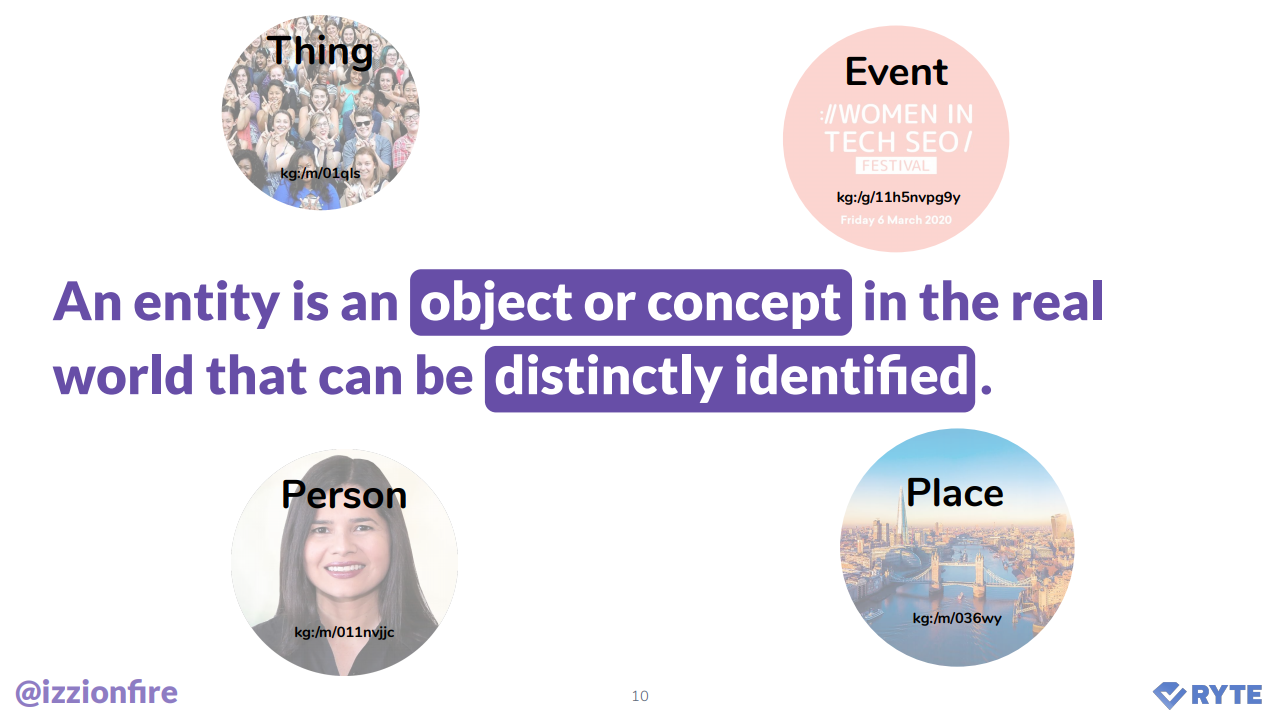
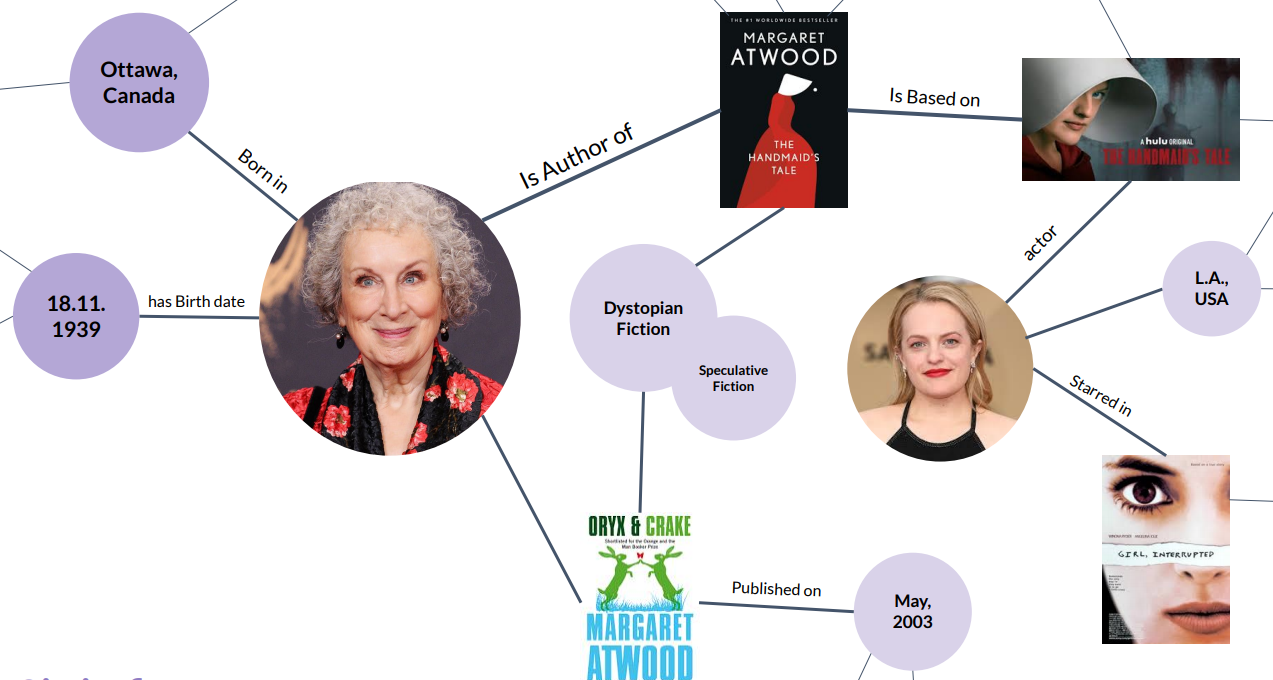
For search engines to understand the relationships between people, places, events and things better entities must be established. The more information the search engines can draw on for the entities, the more accurate the connections will be. This ensures the most relevant information is provided in SERPs to quickly give users the information they need.

Izzi_Smith
Entities can be expanded with structured data and broken into 3 groups to clearly define your SEO strategy:

  • Brand entities
    g. Company
  • Domain entities
    g. https://www.company.com
  • Topic entities
    g. Company products group A, company products group B and company products group C

Izzi_Smith

Innovate

Hannah Rampton

Delimit your data: Formulas for successHannah_Rampton

Hannah taught us the value of using simple functions, applications and queries to their full potential for SEO tasks. Have a look at Hannah’s slides and examples to learn master formulae:

Resource Location
Query QueryTalk
QuerySheets
PAA Tool PAAtool
Search Console Explorer Sheet SCE-HanR
Getting Started with Google Sheets SheetsHelper

Ruth Everett

Tackling Python: How it can help with technical SEO

As SEO evolves Python is becoming more essential for task automation and data extraction. Of course many off these tasks require some level of human validation but the more that can be automated, the more time can be saved.

Ruth provided many places to start learning including codeacademy, datacamp, sololearn and codecombat.

Emily Potter

On-page best practices that harm your traffic

Emily ran through some of her on-page SEO experiments and shared her findings of what worked and what didn’t. The most important lesson is to treat any ‘SEO fact’ with caution as different sites suit different techniques and the playing field is constantly evolving. What improved rankings for one site might not improve rankings on another, and what optimised SERPs before might damage performance now.

For more on events like this head over to the Women in Technical SEO site or join their Facebook Group. All scheduled meetups will be virtual for the foreseeable.

Seven days going live with Paige Hobart and the SERP Landscape

With so many fantastic events going on in the virtual world, our own The Now & The Next included, it’s an exciting time to get involved and also learn something new. Over the past seven days it has been SERPs which have been in high demand, with Paige Hobart, SEO Team Director at ROAST speaking at three events.

Going virtual with SMX London

SMX London is a fantastic event organised by Search Engine Land, luckily for us all, they decided to take the two-day event virtual for all those obsessed with SEO and SEM.

Paige was joined by Jason Barnard, Digital Marketing Consultant at Kalicube SAS for the session,  ‘The Ins and Outs of Featured Snippets and Knowledge Panels’,  in which both SERP experts took us through their insights on navigating the SERPs.

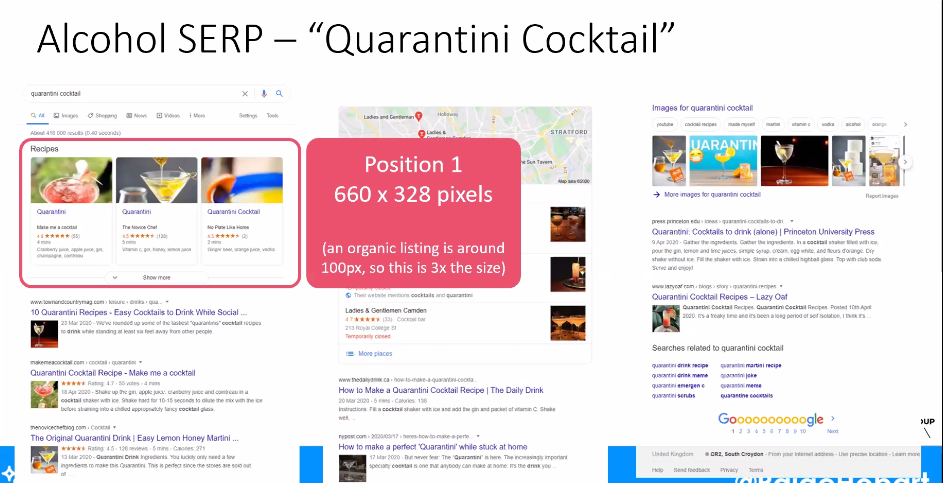
Paige took us through the SERP Landscape, explaining what SERP Features are, how many there are and how we can measure them and use the data to empower any SEO strategy. She demonstrated the effect of the pandemic on SERPs, including the wide ranging impacts on industries, as well as popular searches emerging, such as the “Quarantini Cocktail”.

Bringing the SEO community together with Turn Digi

Next was Turn Digi. Livestreaming from Barcelona, Turn DIGI is an online marketing event promoting entrepreneurs, rising talent and gender equality. This event was organised by Jo Juliana Turnbull, who has brought together an impressive host of SEO experts across borders.

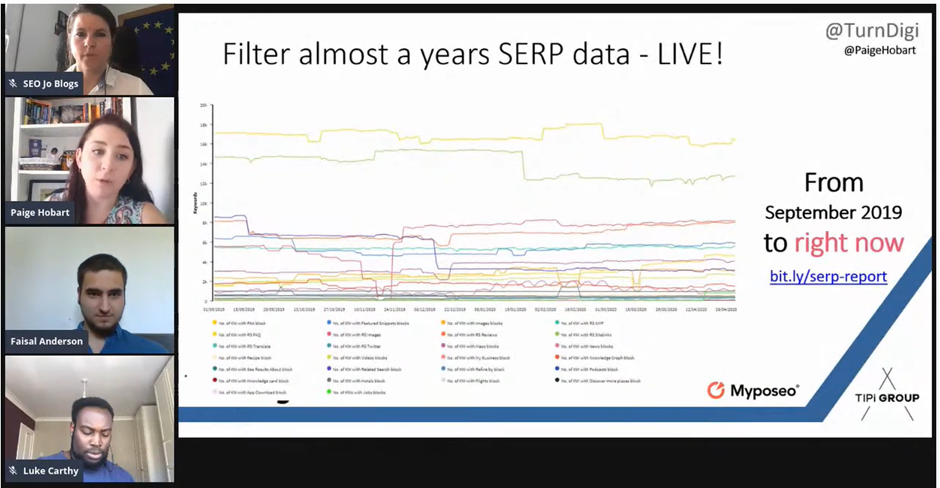
Again Paige, joined by Faisal Anderson and Luke Carthy, took the audience through the SERP features landscape. ROAST discovered 40 SERP Features, which are compiled in our SERP Features Glossary and with the help of Myposeo are tracked in the Live SERP Feature Report in which ROAST currently track 24 verticals across mobile and desktop.

All sessions are available via their YouTube, and Turn Digi will be returning by popular demand on the 2nd of July!

When GMB and Knowledge Panels Collide with Authoritas

To round off this fantastic seven days of live events, Paige joined Jason Barnard and Andrea Volpini on Tea-Time SEO with Authoritas. These sessions run daily at 4pm and bring together professionals from across the SEO industry to share Online Marketing Tips they can implement straight away!

Paige’s top tips:

  • It’s not just your GMB & Knowledge Panels
  • Be aware of YOUR knowledge graph data
  • There’s stuff you can impact and stuff you can’t
  • Don’t forget to think Mobile

Watch it here:


Interested in learning more about new SEO features and updates to help your business tackle any problems it might be facing due to COVID-19? Check out this guide to the latest changes.

Insights from Marketing Week’s session: Ritson’s Monster & The Twelve Traits of Great Marketers

Yesterday, Mark Ritson joined virtual screens once again to impart his wisdom. This session was exactly what it said on the tin, entertaining and highly unscientific, and consisted of a visualisation of the ‘perfect marketer’ according to Ritson, which was of course, a monster.

The following blog post takes you on a whistle-stop tour of the twelve most desirable traits Ritson has found in his years of experience working with the good, the bad and the ugly of the marketing world. Each trait was also paired with a character from a movie who epitomised these traits.

How many of the twelve do you think apply to you?

Trait #1 Empathy


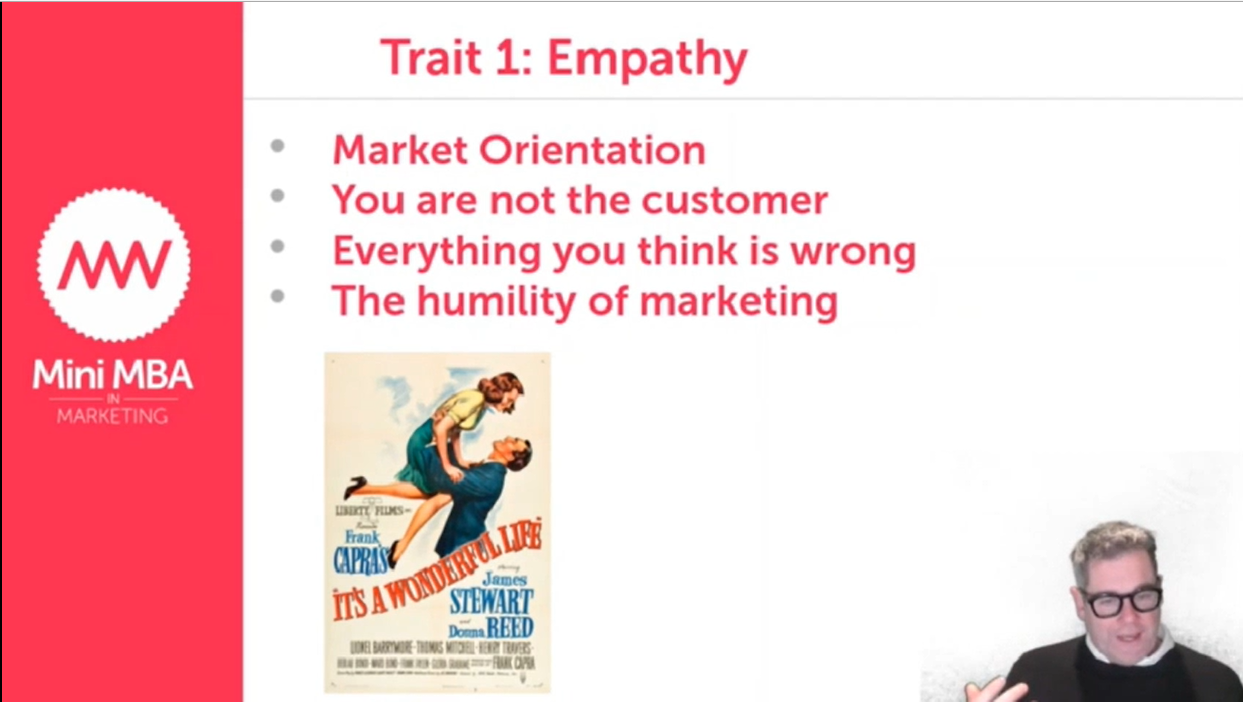
Much like George Bailey in It’s A Wonderful Life, great marketers should, at their core, have the capacity to be empathetic towards their customers. They should not assume they understand the consumer’s life, but try to put  their ‘boots’ on and attempt to understand the world from their point of view.

Trait #2 Curiosity


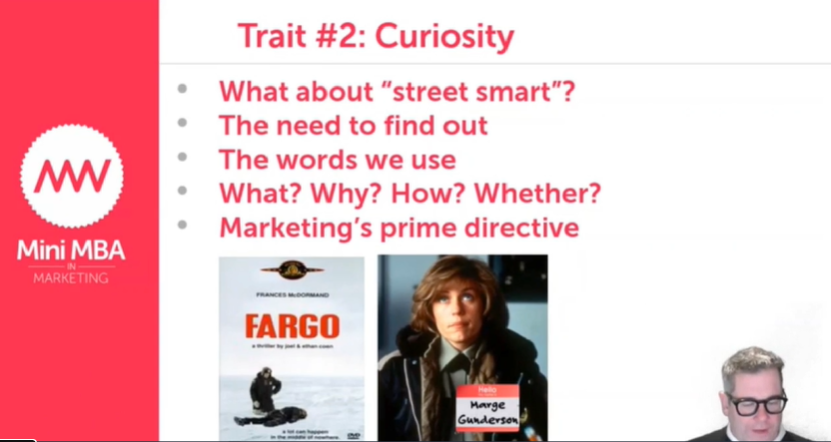
Ritson identified a constant sense of curiosity as a main trait in the great marketers he has known, who like Marge Gunderson in Fargo, display a perfect blend of innate and constant curiosity and seek to uncover and understand beyond the surface.

Trait #3 Big Picture Thinking


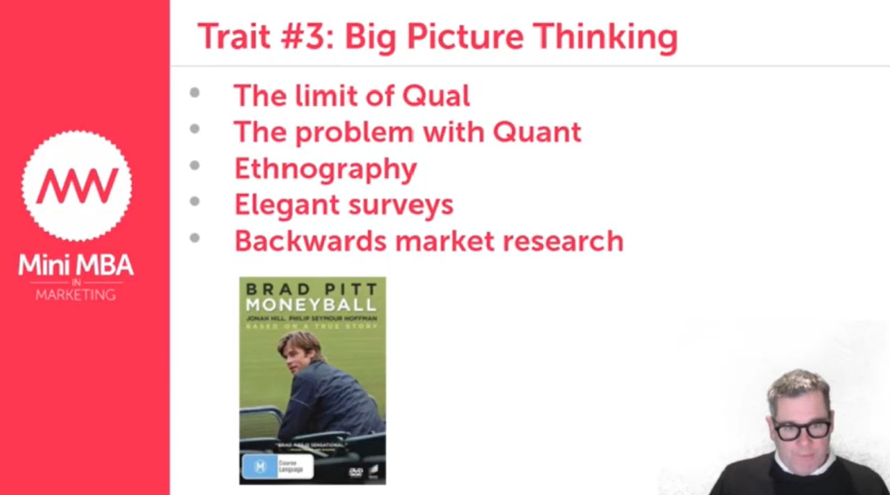
Ritson pointed out the importance of ‘Big Picture Thinking’ in marketers’ approach to research design and implementation. Just like Billie Bean in Moneyball, who challenges his staff of researchers to step back and look at the wider issue before they approach the problem. A ‘perfect’ marketer will understand the benefit and limitations of each method of research and work backwards from the problem with the ‘bigger picture’ in mind.

Trait #4 Comfort with Imprecision


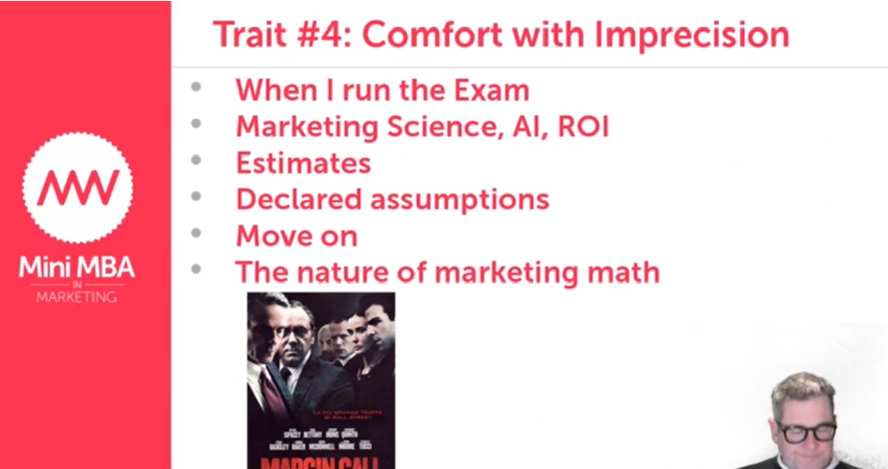
Ritson pointed out that despite marketers’ attempt to solidify numbers with concepts of ROI, the nature of ‘marketing math’ is assumptive and deals in estimates. The ‘perfect’ marketeers that he has come across, have all had a capability to be comfortable with the imprecision of numbers. He called on John Told from Margin Call for his ability to simplify a complex and high stress situation, without having all the information.

Trait #5 Making Time


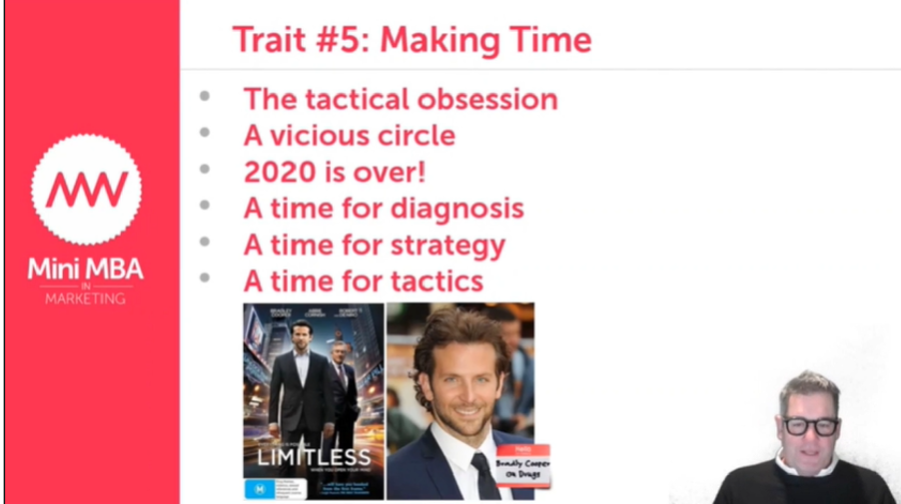
Ritson noticed that the marketers who exemplify this trait don’t get stuck in the vicious cycle of obsessing over tactics and neglecting strategies, instead they make time for the process of doing both. These marketers find time and organisation to achieve everything through maximising efficiency, much like Eddie Morra in Limitless who discovers a drug which unlocks his mind to limitless capabilities.

Trait #6 The Long Term View

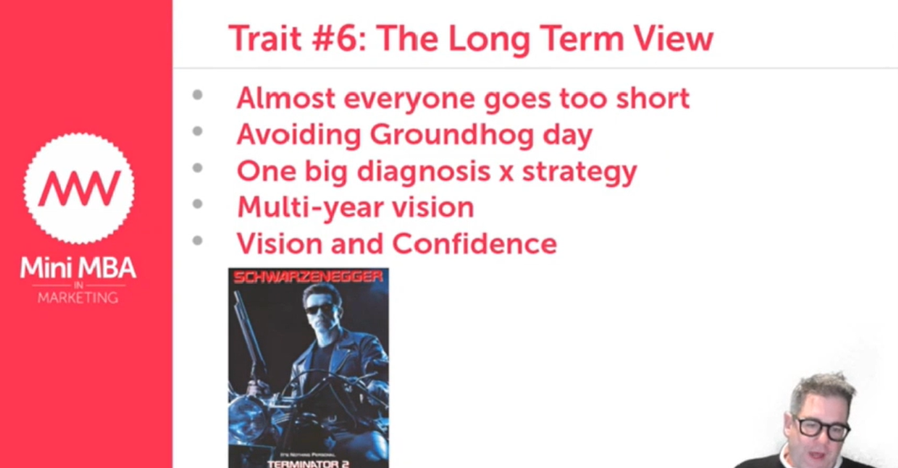
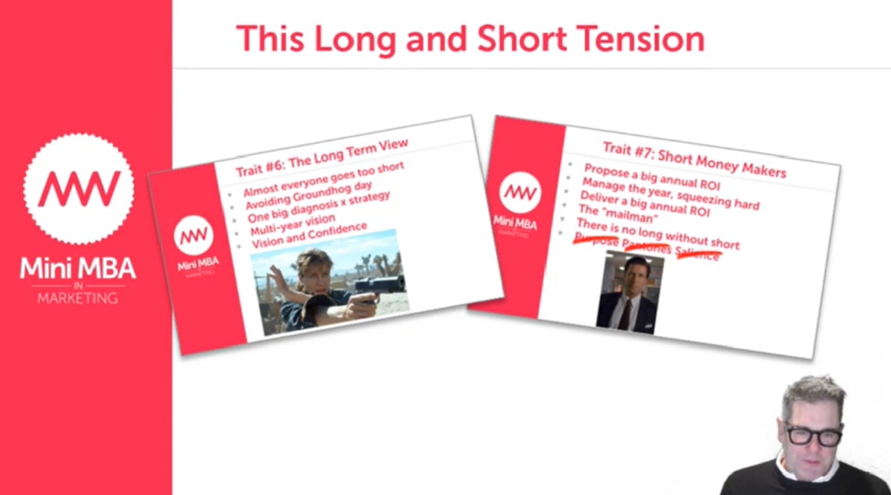
Much like Sarah Connor in The Terminator 2, who understands the long term vision that her son will one day save the world, Ritson purports that the ‘perfect’ marketer should have the capacity to understand the importance of the long term view, building your brand across the top of the funnel over time.
 

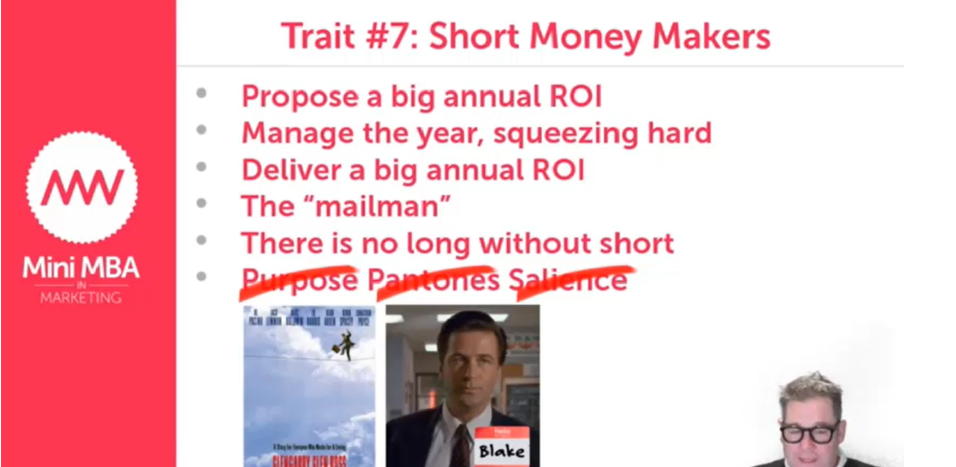
Trait #7 Short Money Makers


However, this isn’t to say that Ritson’s Frankenstein would only think long term, as there is no ‘long’ without the ‘short’. The perfect marketers Ritson has met along the way have had an ability to match long term outlook and focus with complete short termism and a capacity to deliver. He matched this trait to Blake in Glengarry Glen Ross who always closes the deal.

Taking Blake and Sarah Connor together, Ritson pointed out the tension between the long and the short, whilst seemingly working against one another, these two traits reflect two pieces of the puzzle of successful marketing according to Ritson.

Trait #8 Choicefulness


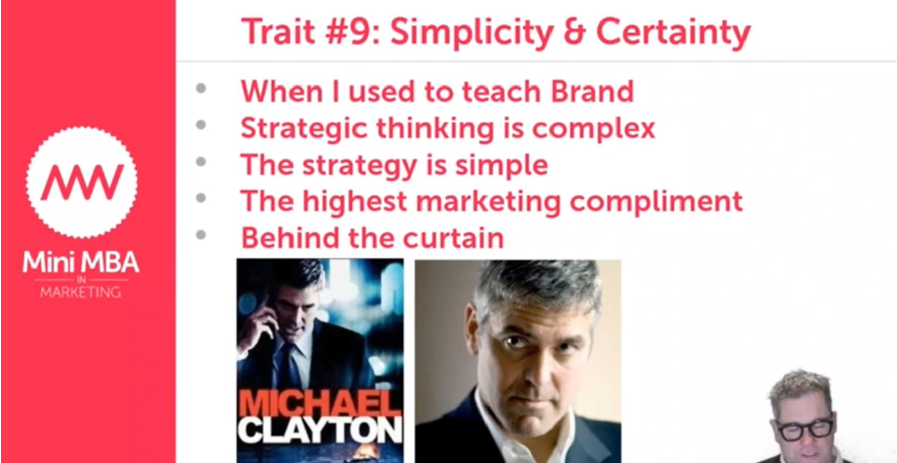
According to Ritson, the highest compliment a marketer can receive regarding their strategy is that it makes sense and is ‘obvious’. To him, this means that the marketer has repackaged complex thinking on their part ‘behind the curtain’ and simplified the output.  He pointed to the character Michael in Michael Clayton for his ability to handle simplicity and certainty in a situation where neither of which are present.

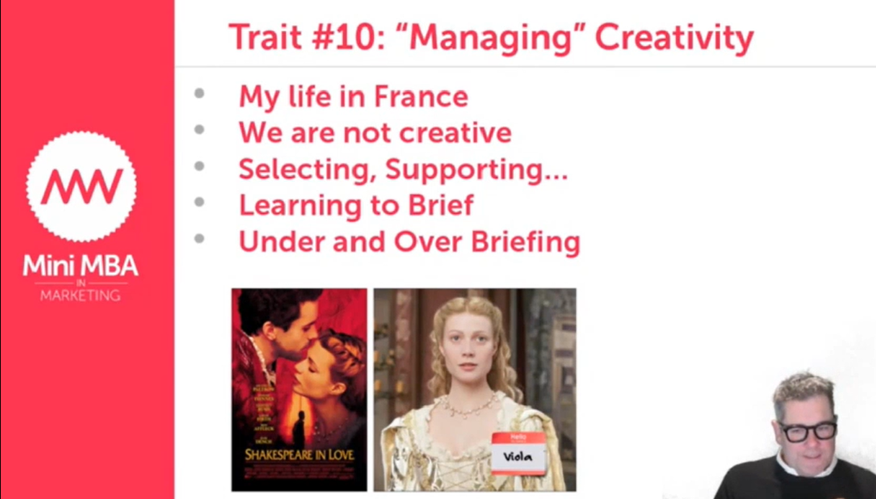
Trait #10 “Managing” Creativity


This trait for Ritson was not about ‘managing’ creatives, but the art of learning how to select, and support creatives and work with them in a symbiosis. He pointed out that great marketers took a sensitive approach to creatives and creativity, understanding that they themselves are not the creatives. Leaning on the character Viola in Shakespeare in Love, Ritson attested to her ability to both inspire and direct Shakespeare in their final moments.

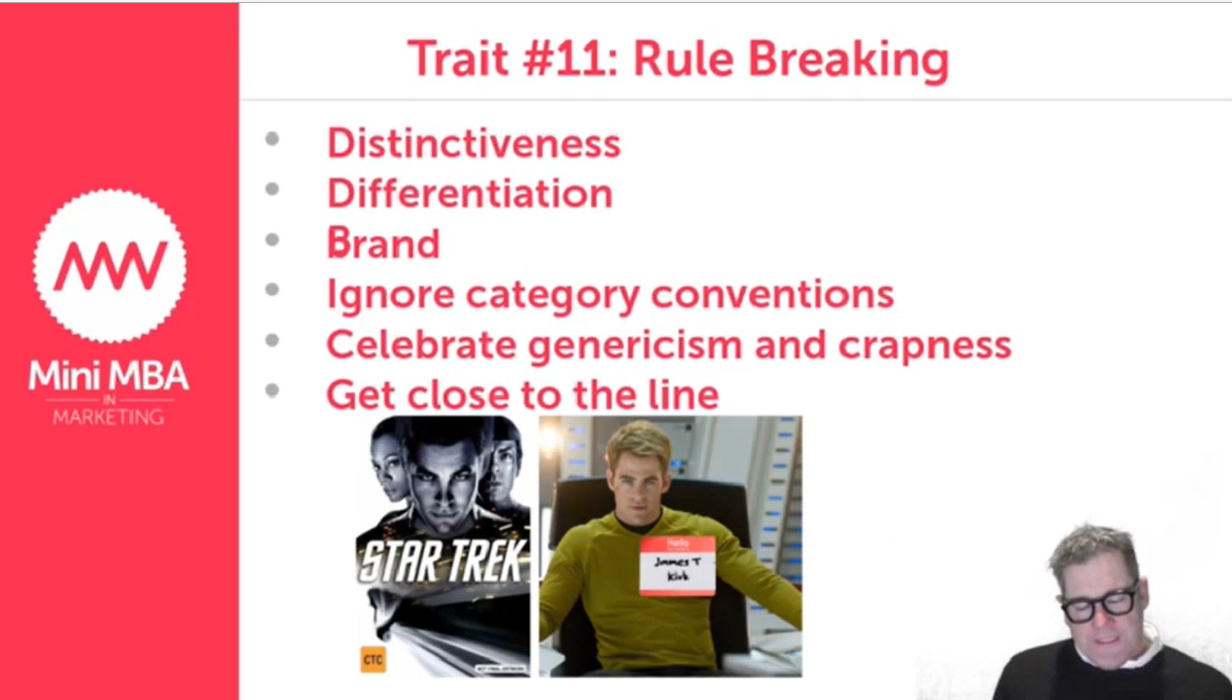
Trait #11 Rule Breaking


Although having contrasting meanings, Ritson pointed out the shared nature of the terms ‘distinctiveness’ and ‘differentiation’ in that they both transgress boundaries. Great marketers look for opportunities to make a statement and break rules, operating close against the ‘line’ to stand out against their competitors.

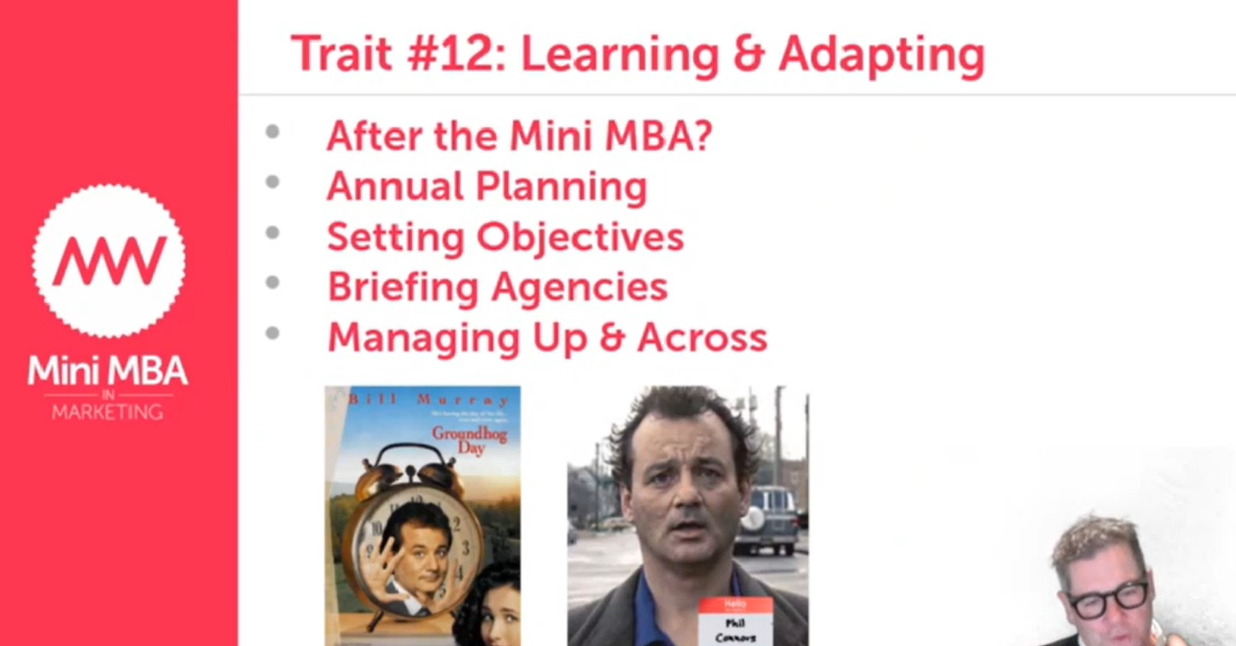
Trait #12: Learning & Adapting

Ritson identified his final trait in Phil Conners in Groundhog Day, who learns from each day, albeit the same, becoming a better person as a result. The ‘perfect’ marketer has a great capacity for learning and sets a rigorous process of planning and objectives which are then measured against.

Ritson’s Monster

Taken together, and with a strange resemblance to Adrian Brody, Ritson’s Monster is a combination of 12 traits and a wealth of experience which make up a successful marketer. He challenged us to think of ourselves in light of these traits, question where we measure up and asked us to come up with a trait of our own based on our own experience.

The session, marking the end of The Festival of Marketing, certainly left us all with some food for thought, as well as some much-needed film suggestions to see us through to the end of lockdown.

Thank you for reading this blog on Ritson’s Monster, while you’re here why not read our wrap up of Ritson’s first session – Ritson on Coronavirus – Key insights from the Marketing Week Webinar.

Exploring the goldmine of B2B Migrations with Daphne Xenakis at Advanced Tech SEO Summit

Earlier today, we tuned into the Advanced Technical SEO Summit run by Brighton SEO and Search Metrics, to hear Daphne Xenakis our Technical SEO Account Manager speak about B2B Migrations.

Her session, ‘B2B Migrations: A Hidden (oft-neglected) Goldmine for Mergers & Acquisitions’ was packed with insights about these unique migrations. We wrapped it up for you below:

The Hidden Goldmine

In this session, Daphne took us through her experience with B2B Migrations, the hidden goldmine for Mergers and Acquisitions which are often neglected.

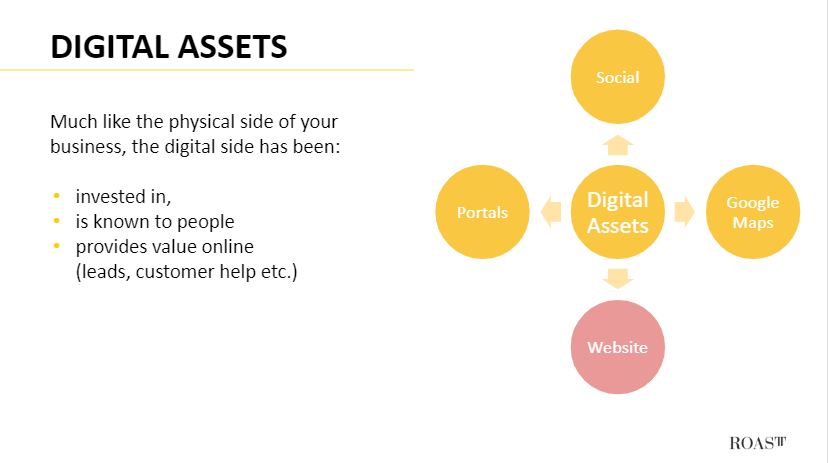
Just like your physical assets, companies digital assets will be nurtured, invested in and grow in visibility and reach over time. Websites have hours of hard work poured into them and translate to a level of digital equity which can help you grow your business.

When companies merge or acquire others, they often forget the significant value their online presence has earned and leave them to rot.

Trials and Tribulations

Daphne took us through the trials and tribulations of B2B Migrations and summarised her key pieces of advice for an SEO working on a B2B migration:

  1. Get all the logins
  2. Manage client expectations
  3. Have a dedicated internal IT connection, good communication is critical
  4. Don’t waste those years of growth

The result when it works?

Greater authority, links (and their equity), wider keyword ranking ability and more come to fruition when you start to consolidate your acquisitions into one place.
Thanks to Daphne for such an interesting insight into the goldmine that is B2B migrations! Catch the rest of the talks on the Advanced Tech SEO Summit page.