Our Head of Innovation, John Campbell, headed over to the beautiful city of Athens, for Athens SEO 2026, the international tech SEO & AI conference. Here are his highlights!
Last weekend I had the pleasure of attending the second Athens SEO conference, one of the most focused and genuinely insightful SEO events. The event was organised by Fran and Eva, two former ROAST colleagues who have built something really special in Athens. It’s an intimate, high-quality gathering, and if it hasn’t been on your radar yet, it should be. You can combine learning all about the latest developments in SEO, with a social visit to Greece at the same time.
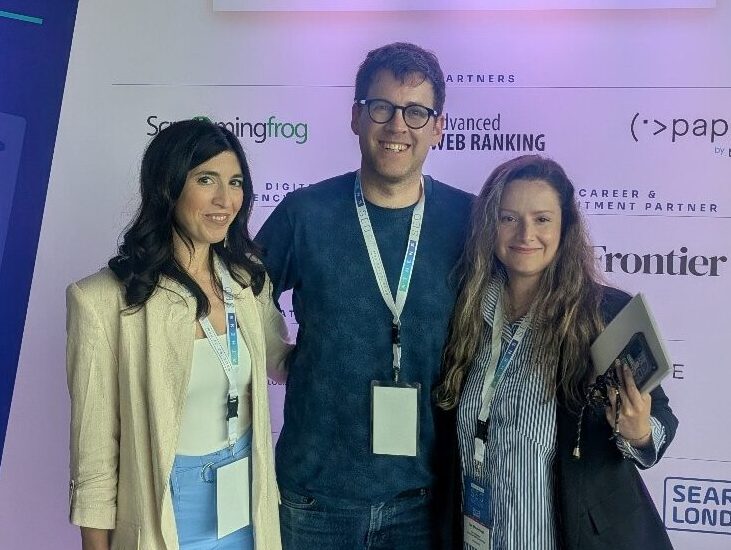
It was great to see such an event for the “locals”, there has not been anything like this for the SEO community in Athens / Greece. However, Athens SEO isn’t just for the Greeks, with an international audience attending from across Europe.
I was on the speaking panel on day two, but before I get into that, here are my standout moments from day one. I have to say all sessions were valuable, but these are the ones that stood out for me.
Day 1
Aleyda Solís – Ecommerce AI Search Trends & Wins
Aleyda opened the day with a sharp and well-structured overview of what’s actually shifting in AI-influenced ecommerce search. Rather than dealing in theory, she brought real examples and actionable techniques. If you work in e-commerce SEO, her lens on how AI search is changing visibility and what you can actually do about it right now is essential viewing. But very much noted that the speed of change is fast – so keeping up with the updates in the industry is key. A great scene-setter for the rest of the day.
Andrea Masoni & Alessia Mancini (GA Agency) – Content Maturity in the Age of AI
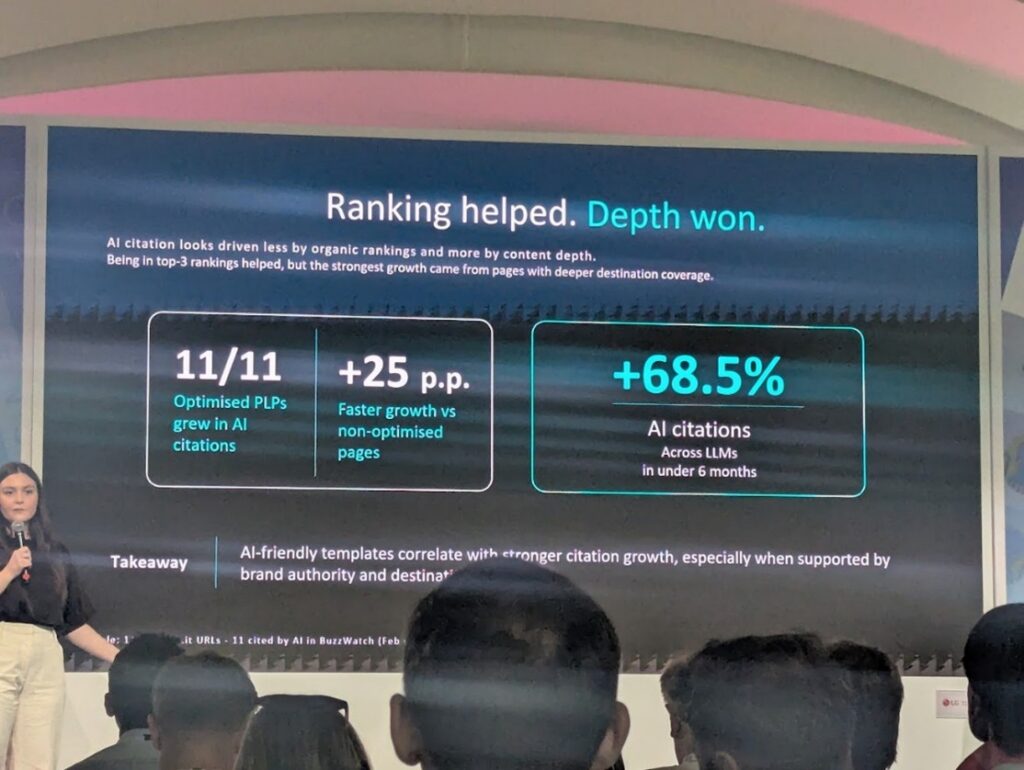
This was one of the most open and detailed presentations of the day. Andrea and Alessia shared real work from a travel sector client (Alpitor), walking through exactly how they have been rethinking content quality as clicks continue to decline across traditional search. They introduced a practical content maturity framework with GEO-optimised templates and a progress tracking approach that felt immediately usable. It’s rare to see an agency be this transparent about live client work, and it made the talk all the more valuable for it. They even included the examples of where things were taking time to be implemented, something that happens in all organisations.
Jamie Indigo – Taming the Bots: AI Crawler Management for the Modern SEO
Jamie’s talk was one of those sessions that reframes something you thought you understood. As AI crawlers from ChatGPT, Perplexity, Claude, Google, and others multiply, the importance of log file data has increased. I loved the way this talk gradually increased in complexity, starting with the basics before moving into practical examples of how to use the data.
Chris Lever – Automating Technical SEO with Screaming Frog CLI and n8n
Chris showed some genuinely impressive work combining Screaming Frog’s CLI with n8n (or “Nathan” as some people know it). From the talk, I could start to see how you can replicate a lot of what the big enterprise SaaS crawling platforms offer by building your own automated pipelines without the price tag. The integrations Chris walked through were the kind of thing that makes you want to open your laptop immediately. Great practical content from Chris, who clearly lives this stuff day to day.
Luke Gosha – The Power of Consulting: What AI in Search Has Really Taught Us About SEO
Luke flew all the way from Australia for this one, and it was worth it. His central argument was that AI’s growing importance in search is actually a huge opportunity for SEO professionals, not a threat. As AI search becomes a board-level concern, SEOs are uniquely positioned to be the people who can connect technical understanding with strategic business outcomes. He made a strong case for SEO as a consulting discipline, not just an execution function, and at a moment when the C-suite is paying more attention to search than ever, that framing felt timely and well-argued.
Frank van Dijk – Unlocking the Potential of Vector Embeddings
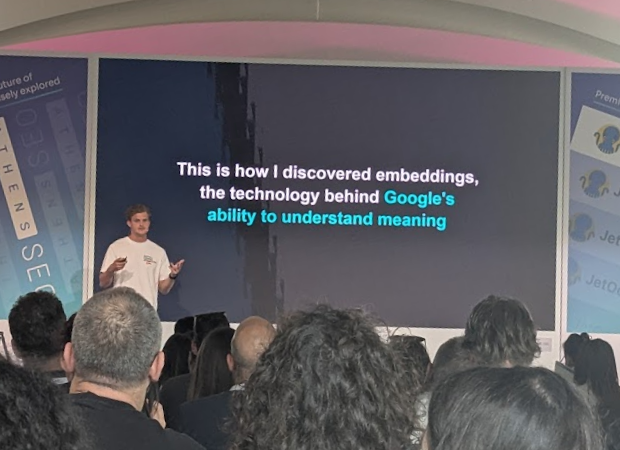
Probably my personal highlight of day one. Frank’s talk was that rare combination of genuinely exploratory and practically grounded. He walked through how vector embeddings can be used to understand content relationships at a level traditional tools simply can’t reach,and crucially, how that insight can inform content improvement decisions. Similar to Jamie’s talk, Frank explained the maths behind Vector embedding before going on to show how they can use the data.
It’s an area a lot of SEOs know exists but haven’t had a clear route into. Frank made it accessible, and I came away with a clear sense of where I want to take this kind of analysis for our own client work.
Dixon Jones – A Semantic Framework for Optimisation in LLMs
Dixon closed out the technical sessions with a framework-level talk on AI brand visibility, grounded in an entity-first approach. What I found most valuable was his emphasis on understanding what AI models already know (or think they know) about your brand, including the risk of hallucinations. That intelligence gap is something brands and agencies really need to be taking seriously, and Dixon gave a practical structure for how to approach it.
Day 2
Day two had a different energy to it, a little more philosophical in places, but no less practical. Here are my highlights.
Martin Splitt – Get Going with JavaScript & SEO the Right Way
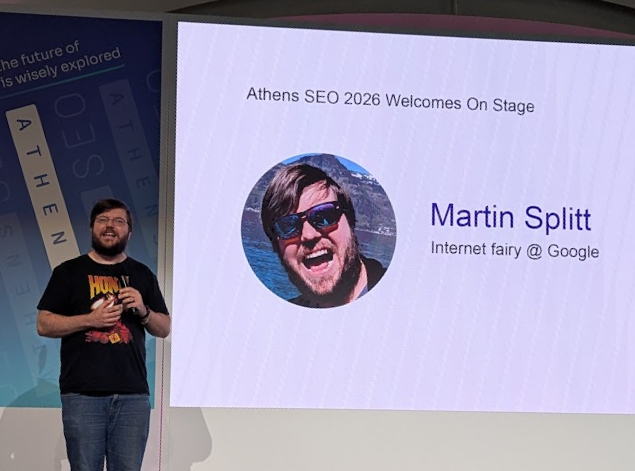
Martin opened the day in a way that can only be described as one part frustration with how vibe-coding works, one-part brilliant technical clarity, and one part comedy session. As Developer Relations for Search at Google, he is uniquely placed to cut through the mythology around JavaScript and SEO, and that’s exactly what he did. The core message: JavaScript isn’t the problem. It depends entirely on how it’s being used. Martin also walked through how Google’s rendering pipeline actually works, and one detail that stuck with me was just how much simpler the system is than most people assume. Rather than Google making decisions about what to render and what to skip, everything gets sent to the renderer. That’s less code, fewer bugs and less to go wrong.
Simone De Palma (TUI UK) – Advanced SEO Tracking Framework for Zero-Click and AI Search
Simone’s talk was quietly one of the most technically interesting of the weekend. He’s built a new tracking framework that is the first time I have seen the Bing API used meaningfully alongside Google Search Console data, pulling both together and then merging them with log file information into a unified data store. It’s a genuinely novel approach to the problem of first-party AI search visibility data, and it addresses one of the biggest blind spots in the space right now. If you’re serious about tracking AI search signals, this framework is worth digging into. Again, setting up reporting and data with the first-party data we have.
Mark Williams-Cook – Do Think Like a Human: SEO Decision Making in the Age of FOMO
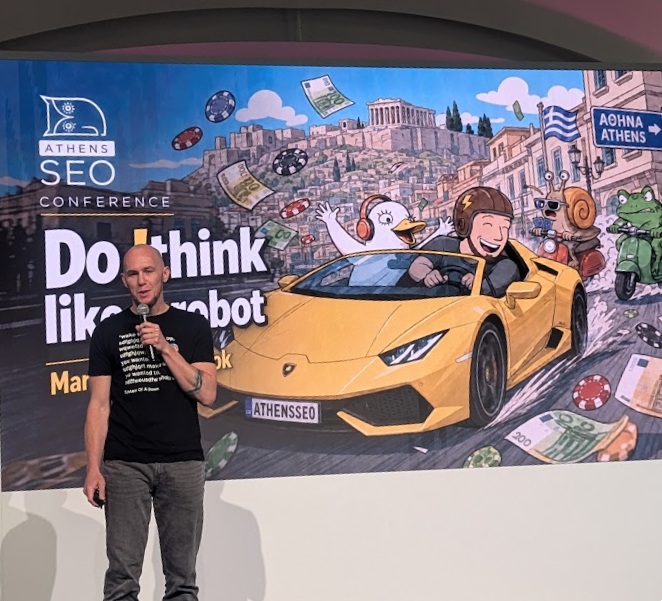
Mark gave one of the most grounded and reassuring talks of the conference. With GEO guides, AI playbooks, and growth hacks multiplying by the week, his core argument was: it all comes down to your risk appetite and where you sit between short-term vs long-term strategy. For brands and agencies, long-term strategy wins.. Yes, there are shorter-term, greyer approaches that can generate results, but if you’re not comfortable burning your domain in six months, they’re not for you. It was a refreshingly honest take, delivered with the kind of perspective that only comes from years of actually doing this.
He also went into some fascinating detail on cats.lms.txt and his findings around a new emerging standard which, by his own admission, had somewhat taken on a life of its own by others.
The Panel – State of Search: The Unfiltered Edition
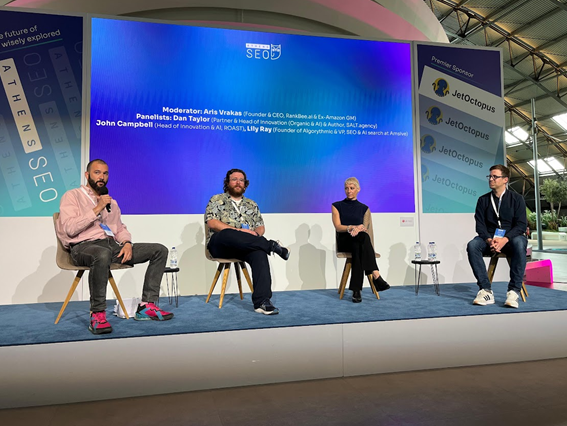
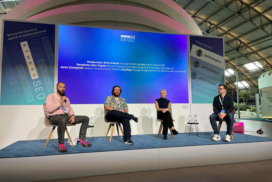
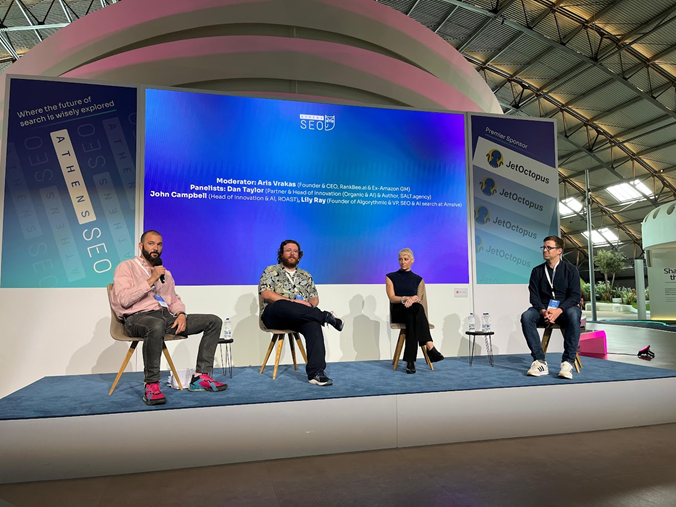
After lunch, it was my turn. I was on the main panel alongside Dan Taylor from SALT.agency and Lily Ray from Algorythmic, moderated byAris Vrakas. Ninety minutes, no slides, a packed room, and a lot of genuinely good questions from the audience.
We covered a lot of ground from the practical realities of how AI search is reshaping client work, where the wins are, what’s still deeply uncertain, and why SEOs are actually well-positioned right now. One line that felt worth saying out loud: AI search has clearly landed in our remit, not in social’s. That’s not an accident. SEO has always been about understanding how machines interpret and surface content, and that’s exactly the skill set that matters here.
Jonathan Moore – From Rankings to Recommendations: Closing the Measurement Chasm
Jonathan’s talk resonated with me more than almost anything else from day two. His framework for prompt tracking, which he’s been developing, included “Fingerspitzengefühl” which is a German phrase for fingertip feeling. E.g. test your prompts properly before tracking them on an ongoing basis. Jonathan addressed one of the most honest conversations we should be having right now: AI tracking isn’t perfect. The data isn’t always reliable. Results shift. And yet it’s what we have, and more importantly, it’s directionally useful.
The point Jonathan made that I keep coming back to is this: we don’t need perfect data. We need a benchmark, and we need to know whether we’re moving in the right direction. That’s a mindset shift that applies well beyond AI tracking it’s a healthier way to approach measurement in general when the ground is moving beneath you.
A Shoutout to Everyone on Stage
Beyond my personal highlights, the standard across the board was genuinely impressive. A huge shoutout to every speaker who took the time to put together a talk and share their thinking so openly Bengü Sarica Dincer, Judith Lewis “Its just SEO”!, Yagmur Simsek, Konstantinos Sfyris, Serge Bezborodov, Fili Wiese, and Lazaros Koutsas. That kind of generosity is what makes conferences like this genuinely worth attending.
Three Overriding Trends from the Weekend
Stepping back across both days, three key themes kept surfacing:
- First-party data is the new competitive advantage. Whether it was Jamie Indigo on log files or Simone De Palma on GSC and Bing API the consistent thread was that the data you already own is underused and increasingly important. The signals are there. Most people aren’t looking at them properly.
- SEO is the grounding framework for AI search. This was said in various ways across the weekend, but it crystallised for me during the panel. Platforms like ChatGPT, Claude, and Perplexity are “standing or sitting” on the shoulders of Google’s results. Mark Williams-Cook had a brilliant image of a large Google bot with a much smaller ChatGPT bot perched on its shoulder. That’s phase one. It won’t always be this way, but right now, SEO is powering what AI surfaces. That’s our moment.
- Direction matters more than precision. In a landscape where no measurement framework is perfect and best practices are being rewritten in real time, the ability to assess whether you’re moving in the right direction is more valuable than chasing certainty.