
Panel Discussion led by Performance Marketing Agency, ROAST
AI has moved from a buzzword to a foundational element of daily agency operations. Yet, behind the scenes, brands, agencies, and procurement leaders are grappling with fundamental questions: How do you prove the real ROI of artificial intelligence? Who should benefit from the resulting efficiencies? And how must the client-agency dynamic evolve in an increasingly tech-driven ecosystem?
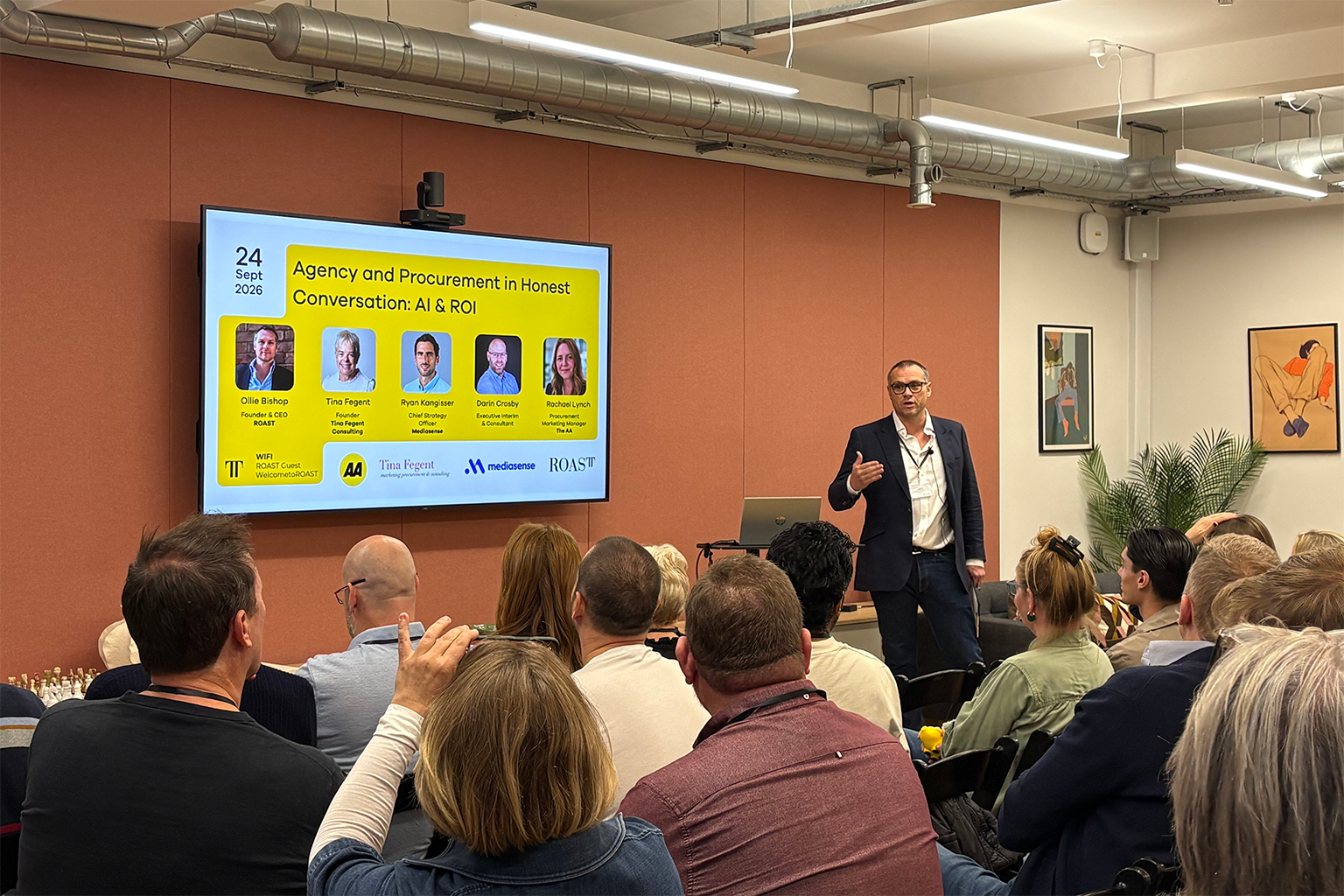
In a candid panel discussion moderated by Ollie Bishop, our CEO and Founder of Performance Marketing Agency, ROAST, industry experts spanning marketing, consultancy, and procurement sat down to debate the true cost of innovation, the limits of current pricing models, and why transparency remains the bedrock of success.
The Panel
- Tina Fegent – Founder, Tina Fegent Consulting
- Ryan Kangisser – Chief Strategy Officer, MediaSense
- Darin Crosby – Executive Interim & Consultant
- Rachael Lynch – Procurement Marketing Manager, The AA
- Moderator: Ollie Bishop, CEO and Founder, ROAST
Efficiency vs. Effectiveness: Sharing the AI Dividend
As AI streamlines workflows, procurement and marketing leaders are looking closely at agency billings. Should clients expect a share of the cost efficiencies AI creates?
Ryan Kangisser warns against treating technology as an end in itself. “I see a lot of agencies and their capabilities, and the risk is that we treat data and tech as the strategy, when data and tech should inform the strategy,” he states. “Efficiencies without outcomes, outputs and performance are just another data point. As an industry we’ve talked a lot about outcome-based models, and we’re not there yet, but none of this matters if it doesn’t drive business performance.” Kangisser notes that while media is vital, it may contribute only 5-10% of total sales in some businesses. “There should be some sharing of efficiencies, but if it doesn’t wash its face on outcomes, we’re looking at the wrong things.”
From a brand procurement perspective, Rachael Lynch emphasises that the conversation starts with open communication. “Our perspective is transparency, which is part of any good agency client relationship anyway. We’re finding it hard to understand the impact,” Lynch explains. “Being transparent doesn’t mean every tool and every prompt. It means, what material changes are you seeing, and how can we repurpose that into something else? We have a long list of priorities we’d like to get to. So we’re keen for agencies to lean in, highlight those opportunities and be really transparent, so we can work out a model together that works for everyone and we all see the benefits.”
Tina Fegent agrees that transparency is key, but highlights a knowledge gap that procurement can help bridge. “Agencies are way ahead of clients in their use of AI. AI drives efficiencies, but some of my procurement colleagues think that just means cost savings,” Fegent notes. “There are 14 to 16 remuneration models, and it isn’t all about outcomes. Agencies can be so fixated on outcomes and outputs without understanding why. AI is a brilliant opportunity. Clients need education, and procurement can be the connector, showing where AI is driving the best value and delivering results, whatever those results are.”
Unintended Costs and Shifting Fee Models
While AI promises speed and savings, it can also introduce hidden operational expenses that catch financial leaders off guard.
Darin Crosby points out that fee structures must adapt “On fee structure, I steer well away from time and materials. It’s either a fixed fee or outcome-based. Internally, finance wants budget certainty, so anything with variable costs is a risk, and that risk grows as agencies move to consumption-based models.”
Crosby cites a growing issue with cloud and compute costs: “With martech it used to be a seat licence. Now there are many more variables, including the cost of whichever AI tool the agency uses. And there are unintended consequences. Several clients have seen their Microsoft Azure bills rocket, in one case by 74%. When you look at the martech the business has brought in, some of it is plugged into their cloud, so as it burns through tokens and compute, the bill goes up. So, at the start you need to ask – what’s the business case, what’s the ROI, and what could this affect beyond the part you’re contracting for?”
Fegent stresses that defining transparency early prevents friction later when hours shift from execution to high-level strategy. “Think about it before the relationship starts. With a good procurement client you’ll have regular commercial reviews, and in pitches it should be: here are our AI tools and the value they’ll deliver. There are different degrees of transparency… Agree the definition together. Every client and agency is different, and we don’t use the word partnership lightly, but look at the longest-standing client–agency relationships – they’re built on partnership with transparency.”
Redefining ROI and Measurement
Measuring marketing return is notoriously complex, and the introduction of AI has only added nuance to how metrics are interpreted.
Lynch points out that overarching business targets often sit outside marketing’s direct control. “From my perspective, the client generally owns the ROI figure. It’s what they use to report into the business, but it’s important that everyone understands how it’s built, because data sources and priorities differ by client. Is it EBITDA? Profit? Customer acquisition? All of that needs to be understood. To give an example, in financial services customer lifetime value is generally a data point marketing doesn’t own, but it’s a big factor in ROI. If we only get those results annually or twice a year, everyone needs to understand that, and the models and outcomes we set up need to acknowledge that longer-term impact, so we don’t lose sight of important factors that sit further away.”
Kangisser believes the industry spends too much time chasing perfect measurement rather than driving better decision-making. “It’s much more nuanced, by sector and by business… A large share of performance comes down to creative, and that’s before price, product and all the other factors that inform ROI. So I think it’s about outcomes rather than ROI. Those outcomes could be anything: deliverables, behaviours, intermediate metrics that enable an eventual return.”
He adds that current agency incentives rarely encourage efficiency: “Frankly, no one has truly cracked measurement either. People are still flip-flopping between MTA and MMM, and it’s too slow. What an agency can affect is making the right decisions: saying yes or no, flagging over- or under-investment. But the system doesn’t incentivise anyone to tell marketers: I think you should spend less, run fewer campaigns, produce fewer assets.”
Fegent urges clients not to skimp on evaluation: “For me, managing ROI comes down to marketers. I worry about how well the marketing community understands ROI and investment. Too often at pitch stage I see clients take out the budget for effectiveness… So the question at pitch stage is: what are the metrics? Everyone has a different interpretation of ROI, so it’s vital that all stakeholders are aligned on the metrics and the result we’re looking for. Then invest in measurement. Don’t just cut that £50,000 out.”
“Prove It”: Moving Beyond the Pitch Demo
As pitches become increasingly tech-focused, clients are moving past polished videos and demanding live, hands-on proof of an agency’s AI capabilities.
“Generalising across the industry, I’d say ambition outpaces adoption,” says Kangisser. “Some agencies can show quite tangibly that they built something, they use it and it delivers. Contrast that with big corporates with 110,000 employees all supposedly using AI operating systems and agentic workflows. What’s presented to clients is that everyone uses this multiple times a day, and the reality we’re finding is very different.”
To separate reality from polished sales decks, buyers are pushing for practical evaluation. “We encourage clients to ask agencies to prove it. Any demo in a pitch can be vibe-coded, and many probably have been. What agencies need to show is that these solutions have transformed how they work and how they perform… Agencies that present what they’ve built in a way that lets clients get their hands dirty move the reaction from ‘wow, that looks amazing’ to ‘I get it, I can see it being used, and it’s delivering”, Kangisser explains.
Furthermore, tech capabilities should ultimately serve strategy. “Strategy has been massively diluted,” Kangisser notes. “With access to the whole internet and all this data, you should be finding insights no one has come up with before, and strategy that drives true differentiation and some risk-taking. That’s when the penny drops. All of that capability is table stakes, but now it lets you do things no one else can.”
Actionable Takeaways
To close the session, the panellists shared practical advice for agencies and procurement teams looking to improve their working relationships immediately:
-
Tina Fegent: “Be transparent and agree what transparent means. Have that conversation, involve procurement, and put options on the table.”
-
Rachael Lynch: “Lean in now. Start bringing opportunities to the table, own the narrative and have those conversations now. And be flexible. We appreciate there are bills to be paid and a balance to strike, but it’s going to be harder to commit to long-term fixed retainers given how much is changing.”
-
Darin Crosby: “Think about ways of working, and the people you propose to put on the client. A lot of agencies are obsessed with prior industry experience, but today you want people with a continuous-improvement mindset and the right aptitude to work with that client.”
-
Ryan Kangisser: “The perception is that procurement comes in to negotiate. But I’ve seen great procurement people who understand how agencies make money and what they need to sustain themselves… Remove the stigma that you’ll be told to cut your fees by 50%, and go back to first principles: you need this team of people, they cost money, this costs money, so let’s be successful together and make sure the incentives work for many years.”