
Following on from the explosion of LLM usage from 2023, 2025 has seen a widespread rollout of AI Overviews (AIO) across Google’s search results, changing the way users behave and interact with search results.
To set the scene, the first published study by OpenAI on how people use ChatGPT was released in September 2025, and notes the following: “work usage is more common for educated users in highly-paid professional occupations”.
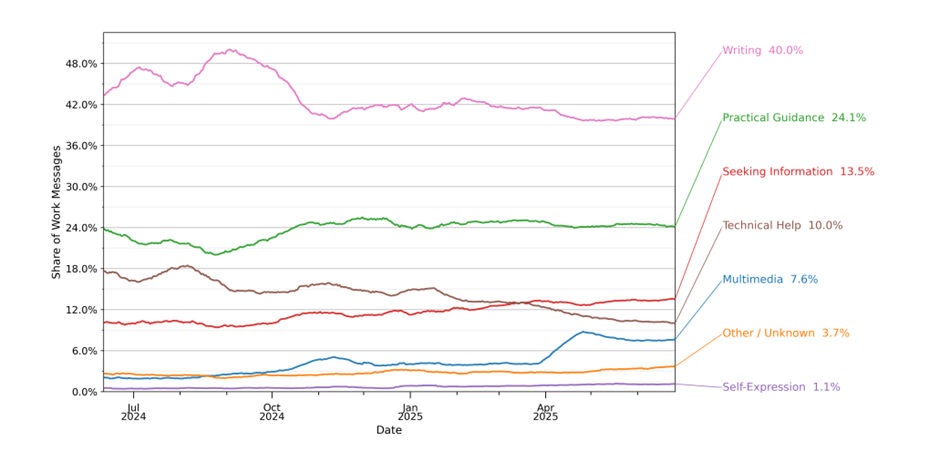
The graph above displays the share of work-related consumer ChatGPT messages broken down by high level conversation topic, showing a high proportion of users looking for ‘writing assistance’, while ‘seeking information’ has been steadily growing with the assistance of features like Deep Research.
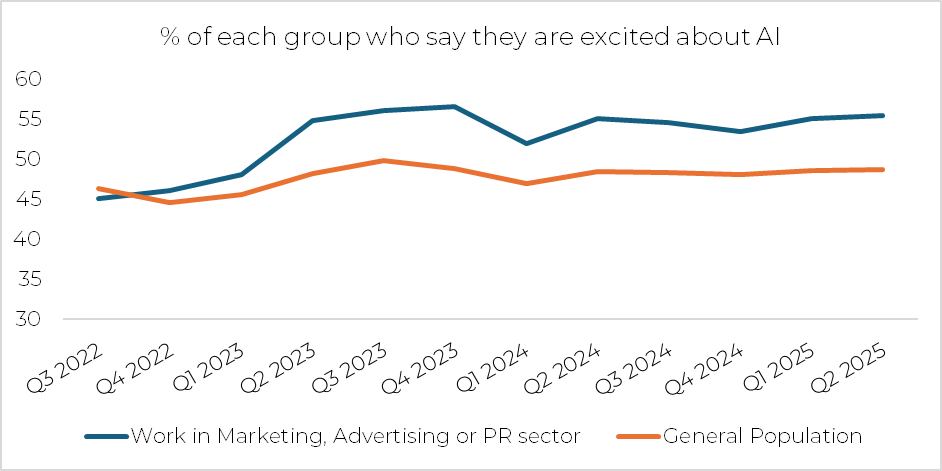
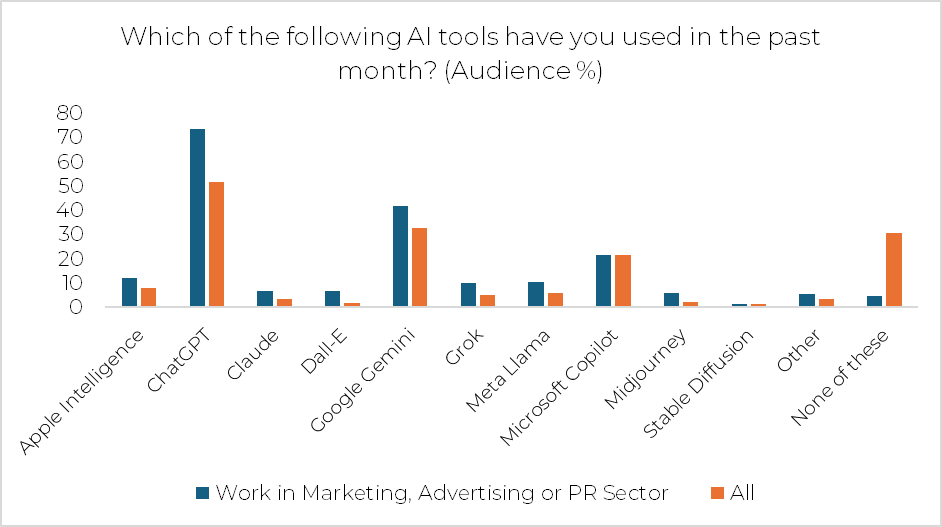
Our own research through GWI also shows perceptions of AI are most favourable within Marketers, in comparison to the general population, as it can help improve workflows and boil down complex and time-consuming research processes.
While much of the discussion has naturally been around the impact of Organic Search, there are also wider implications for Paid Search activity that are becoming clear as AIO prevalence continues to increase on Google.
AI Overviews have seen a consistent increase since launch in May 2024. A dataset of 8,000 keywords from Advanced Web Rankings showed that AIOs appeared on over half of US SERPS across all industries in August 2025.
Visibility in AI Overviews is highly competitive, and is largely dominated by Google’s own sources, high authority informational sites and user generated content platforms, such as Reddit. However, they are also seemingly more prevalent across B2B queries than they are B2C. There is evidence around this from across the web and is also validated when looking at the distribution between B2B and B2C clients at ROAST, with AI Overviews appearing on average for 54% of tracked B2B keywords vs only 22% on tracked B2C keywords.
As presence of AI overviews has been increasing it has led to several notable trends:
- An increase in “zero-click” searches as users find immediate answers in AI Overviews, directly impact Click-Through-Rate on Paid and Organic Search.
- Higher potential impression rates due to improved ranking opportunities, fuelled by a shift towards more complex and niche search queries
- Rising Cost-Per-Clicks (CPC) as ad slots move further down the page and intensified ad competition driven by AI-powered targeting and ad generation
ROAST have been monitoring these trends closely, and rising CPCs are something already being observed across the industry, and AI Overviews are set to cause further disruption.
The Data Behind AI’s Impact on Paid Search
There is an observable impact when reviewing the rise of AI Overviews and the impact on performance across the SERP for both PPC and Organic Search.
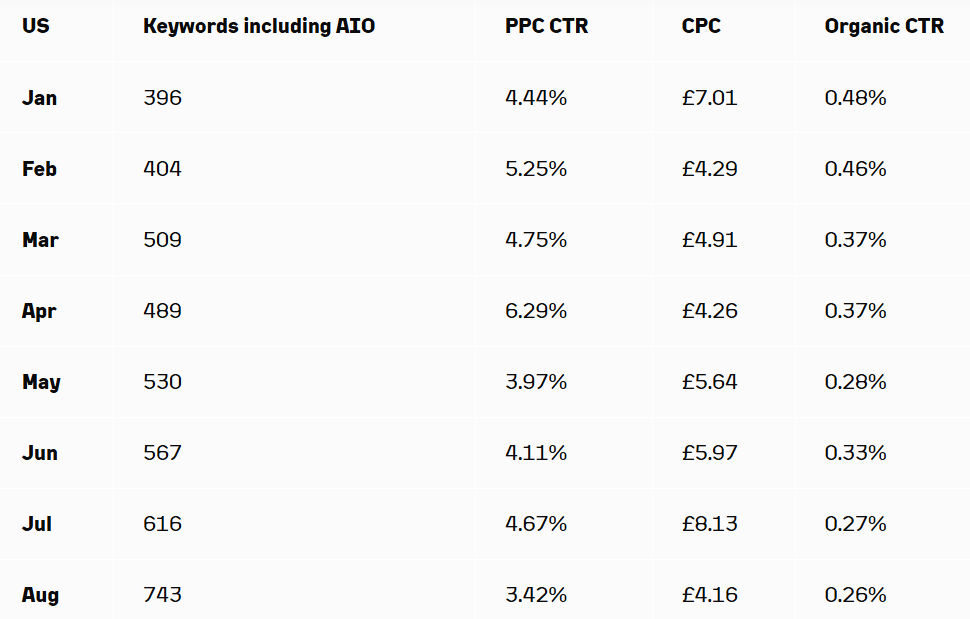
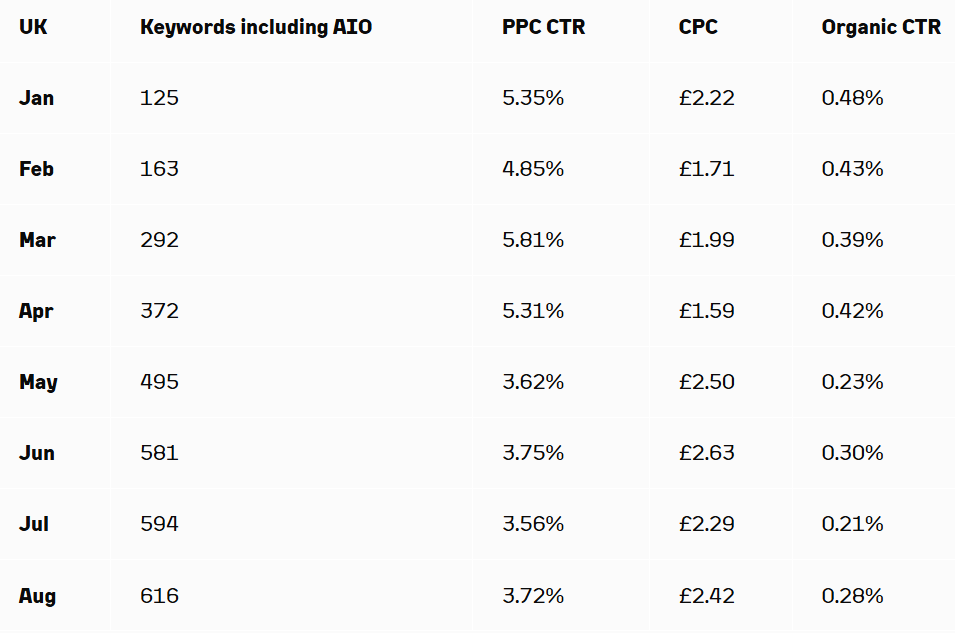
The above looks at a specific group of queries matched against both paid search and organic targeting to get a comparable view across both channels. We can see trends follow closely across both the UK and US, and further analysis showed similar impact on other regions such as LATAM and APAC markets too.
The decline in CTR can be attributed to two primary factors:
- Queries being answered directly within AI Overviews, reducing the need for users to click through
- Ad placements being pushed below the fold, decreasing visibility
These changes have potential knock-on effects on quality scores and CPC as the data shows that as CTR decreases, CPCs tend to rise, exacerbated by increased competition for ad placements.
What’s next?
The landscape continues to evolve for PPC, and we may begin to see some variations in these trends due to ads rolling out in AI Overview placements in the US. Currently, these are appearing on desktop and mobile in the US, with further expansion to other English speaking countries expected in the remainder of the year.
But what about the new AI Mode feature on Google? This browsing mode provides more conversational and in-depth answers to complex question, similar to typical LLM behaviour. Ads have started to appear here with experiments in the US since May, appearing below the first response. However, towards the end of the year ads are also expected to be integrated into the first response as well.
The catch is that these ad units are only going to run through AI powered campaign types, namely Performance Max and the newly launched AI Max. Unfortunately, there isn’t any reporting available on how often and what these are appearing against in order to optimise to these placements in any specific way.
So, what should B2B marketers need to be doing to keep up with the changing landscape and search behaviour?
Key Takeaways
- Adopt: As user behaviour shifts, we need to be ready to adapt and test new ad units to ensure you are not left behind. AI Overviews are only likely to increase, and manual strategies are becoming less viable to keep up.
- Consider the importance of data quality fed into these campaigns and ensure it is strong enough to allow effective optimisation towards valuable customers. 1st Party data to guide bidding algorithms will become more important to avoid low quality lead generation caused by AI.
- Optimise Content: Website content needs to be detailed enough to fuel AI powered campaigns and improve ability to match landing page content and ad copy to user queries. Image focused pages and those with minimal text content will not be efficient in this landscape.
- Measure: The user journey has become more complicated. Ad placements within AIO are not possible to track, and users may be researching on the SERP before converting through other sources. Holistic views of performance across channels and incrementality testing need to be considered.
- Monitor: We need to keep monitoring the impact of AI Overviews and the changing SERP landscape. Performance changes should not be passively reviewed, and strategies shifted if needed, such as targeting more long tail queries, budget distribution against competitors, and enhanced testing.
- Beyond Google Search, ensure you are optimising to LLM placements as well. From our testing, while this traffic is proportionally low in comparison to most, intent is high with strong conversion rates.
- ChatGPT is also actively hiring to build out their own ad product which will further the change landscape, so this is one to watch out for.
Interested in more insights about B2B? Discover our breakdown of the goldmine of B2B Migrations with Daphne Xenakis.